Introduction
Influencer marketing has matured significantly over the past several years, and with that maturity has come a growing recognition that a single snapshot of an influencer's profile their current follower count, their most recent engagement rate tells you relatively little about what kind of partner they actually are.
What matters far more is trajectory. Is this influencer's audience growing or shrinking? Is their engagement improving as they scale, or eroding? Has their content strategy been consistent, or have they pivoted significantly in ways that might affect how their audience responds to your brand?
Answering these questions requires tracking an influencer's account over time not just checking it once before signing a contract, but monitoring it before, during, and after a partnership to understand the full picture of who you are working with and how the relationship is performing.
This guide covers how to track influencer growth systematically, what patterns to look for, and how to use this ongoing data to make better partnership decisions.
Why a Single Snapshot Is Not Enough
Before getting into tracking methods, it is worth understanding exactly what a single point-in-time check misses.
Growth Direction Is Invisible in a Snapshot
An account with 80,000 followers could be steadily climbing toward 100,000, could be holding steady at roughly 80,000 for the past year, or could have dropped from 120,000 over the past six months. All three scenarios show the same number today, but represent fundamentally different situations for a potential partner and only tracking over time reveals which one you are looking at.
Engagement Trends Reveal Audience Health
An influencer's current engagement rate is useful, but the trend matters more. An influencer whose engagement rate has been climbing as their following grows is building an increasingly engaged community. An influencer whose engagement rate has been declining as their following grows may be experiencing audience fatigue, algorithm changes affecting their content specifically, or a shift in content quality any of which could affect how your sponsored content performs.
Content Strategy Shifts Affect Audience Expectations
An influencer who has recently pivoted their content focus changing niches, shifting from organic content to heavily sponsored content, or changing their posting frequency dramatically may be in a period of audience adjustment that affects how receptive their audience currently is to new sponsored partnerships.
Spikes Can Mask Underlying Trends
A single recent viral post can dramatically inflate an influencer's current follower count and recent engagement metrics in ways that do not reflect their typical, sustainable performance. Tracking over time helps distinguish between a genuine upward trajectory and a temporary spike that may settle back toward previous levels.
Setting Up an Influencer Tracking System
Here is a practical approach to building a tracking system for influencers you are evaluating or working with.
Step 1: Create a Tracking List
Whether you are evaluating multiple influencers for a potential campaign or monitoring influencers you currently work with, start with a list of usernames. For evaluation purposes, this might be 10 to 20 candidates you are considering. For ongoing partnership monitoring, this is your current roster of partners.
Step 2: Establish a Baseline
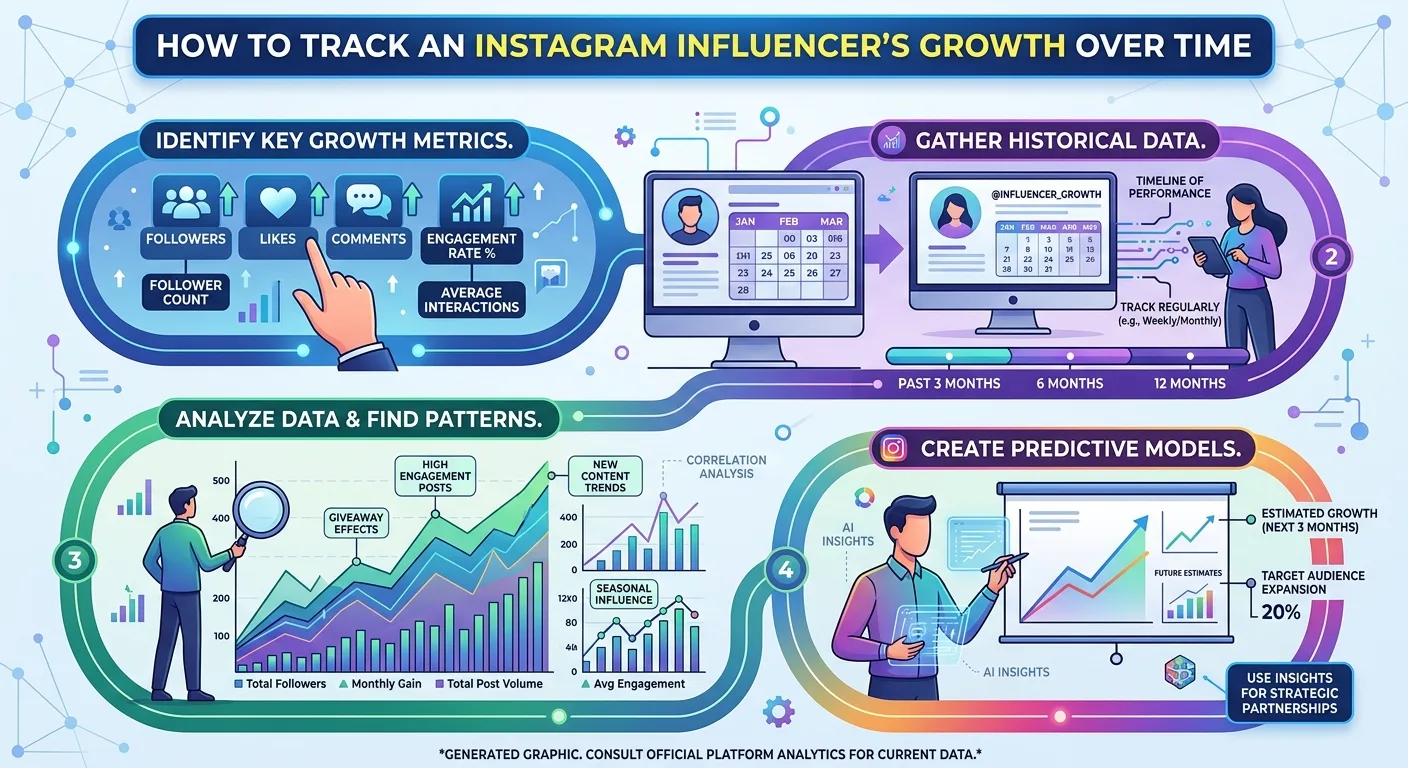
For each influencer on your list, record baseline data using InstaPV analytics: current follower count, current engagement rate, follower growth trend over the recent past (typically the last one to three months of available data), and notes on content themes and posting frequency.
Step 3: Set a Review Cadence
Decide how often you will revisit this data. For active partnerships, monthly reviews provide a good balance between staying informed and avoiding excessive time investment. For pre-partnership evaluation of candidates over a longer decision timeline, biweekly checks during the evaluation period can help you see how candidates are trending before making a final decision.
Step 4: Track Changes Over Time
At each review, record the same metrics again follower count, engagement rate, and any notable content or strategy changes you observe. Over several review cycles, this builds a picture of trajectory rather than just a series of disconnected snapshots.
Step 5: Use Saved Profiles for Efficiency
InstaPV's Pro tier allows saving profiles into collections, which streamlines the process of repeatedly checking the same set of influencer accounts without needing to search each one individually during every review cycle.
What Growth Patterns to Look For
Once you have tracking data across multiple review periods, here is how to interpret what you are seeing.
Steady, Sustainable Growth
A pattern of consistent percentage growth over multiple review periods for example, growing by roughly 3 to 5 percent each month consistently combined with stable or improving engagement rate, indicates a healthy, sustainable trajectory. This is generally the most attractive pattern for partnerships, as it suggests the relationship will likely continue to benefit from a growing audience over the partnership period.
Accelerating Growth
If growth rate itself is increasing over successive periods for example, 3 percent growth in the first month, 5 percent in the second, 8 percent in the third this indicates an influencer who is gaining momentum, potentially due to a successful content strategy shift, viral content, or growing word-of-mouth. Partnering during an acceleration phase can mean your campaign benefits from above-average reach growth during the partnership period, though it also carries some uncertainty about whether the acceleration will sustain.
Plateau
An influencer whose follower count has remained essentially flat across multiple review periods has reached a plateau. This is not necessarily disqualifying plateaued accounts can still have highly engaged, valuable audiences but it does mean you should not expect the partnership to benefit from audience growth during the engagement, and the influencer's current audience composition is likely to remain stable rather than evolving.
Decline
A consistent downward trend in follower count across multiple review periods is a significant signal worth investigating further. Possible causes include declining content quality or relevance, periodic removal of inactive or bot followers by Instagram (which can cause visible follower count drops even for healthy accounts), a controversial event affecting the account's reputation, or reduced posting frequency leading to algorithmic deprioritization. Understanding the cause matters a decline due to periodic bot removal is very different from a decline due to audience disengagement.
Volatile or Erratic Patterns
Some accounts show significant swings sharp increases followed by sharp decreases, or highly inconsistent month-to-month changes. This pattern can sometimes indicate periodic use of growth tactics that produce temporary follower spikes followed by drop-off (such as participation in follower-exchange groups or temporary promotional campaigns), which may not reflect a stable, genuine audience.
Tracking Engagement Rate Alongside Growth
Follower growth alone does not tell the whole story tracking engagement rate trends alongside growth provides essential context.
The Combinations That Matter
Growing followers, stable or improving engagement rate. This is the strongest combination the audience is expanding while remaining (or becoming more) engaged. This suggests genuine, organic growth driven by content that resonates.
Growing followers, declining engagement rate. This is worth investigating. It could simply reflect the natural pattern where larger audiences tend to have somewhat lower engagement rates (as discussed in earlier posts in this series on engagement rate benchmarks by account size), which is expected and not necessarily concerning if the decline is proportionate to the size increase. However, if the decline is steeper than would be expected from size alone, it could indicate that new followers are less engaged than the existing audience potentially from less organic growth sources.
Stable followers, improving engagement rate. This can indicate an influencer who has refined their content strategy to better serve their existing audience, even if that audience size has not grown potentially a sign of strengthening community even without expansion.
Declining followers, declining engagement rate. This combination suggests broader audience disengagement and warrants the most caution for partnership purposes.
Tracking During an Active Partnership
Once a partnership is underway, tracking serves a different purpose evaluating the performance and impact of the specific campaign.
Before-and-After Comparison
Record the influencer's follower growth and engagement rate trends in the weeks immediately before the partnership content goes live, and compare these to the weeks during and immediately after. This helps isolate whether the partnership period coincided with any notable change in the influencer's overall account trajectory though attributing causation requires care, since many factors affect these metrics simultaneously.
Monitoring for Audience Reaction
If the influencer's engagement rate drops noticeably during a period when sponsored content is concentrated, this could indicate audience fatigue with sponsored content frequency useful information both for adjusting the current partnership's content cadence and for informing future partnership structures.
Long-Term Relationship Tracking
For ongoing or repeat partnerships, tracking the influencer's trajectory across the entire relationship not just individual campaigns helps assess whether the partnership continues to make sense as both the brand's and the influencer's situations evolve over time.
Comparing Multiple Influencers Over Time
When evaluating multiple influencer candidates, tracking all of them over the same period allows for direct comparison of trajectories, not just current snapshots.
Normalize for Account Size
When comparing growth rates across influencers of different sizes, use percentage growth rather than absolute follower numbers, since percentage growth is comparable across different account sizes while absolute numbers are not (an account gaining 1,000 followers represents very different growth rates depending on whether the starting base was 5,000 or 500,000).
Look for Relative Trajectory, Not Just Absolute Performance
An influencer with a smaller current following but a stronger growth trajectory than a larger competitor candidate may represent a better long-term partnership opportunity, particularly for ongoing or multi-campaign relationships where the partnership will span a period during which that growth trajectory plays out.
Consider Content Consistency Alongside Numbers
Throughout your tracking period, note any significant content strategy changes for each candidate. An influencer with strong numbers but frequent significant pivots in content direction may represent more unpredictability for planning future campaigns than an influencer with steadier numbers and more consistent content approach, even if the latter's growth rate is somewhat lower.
Red Flags to Watch For During Tracking
Beyond the growth pattern analysis above, certain specific signals that emerge during tracking warrant particular attention.
Sudden, Unexplained Follower Spikes
A sharp increase in followers over a very short period particularly if not correlated with any viral content or notable event you can identify combined with no corresponding increase (or even a decrease) in engagement rate is a common signature of purchased followers.
Engagement Rate That Does Not Scale With Reported Reach Claims
If an influencer reports specific reach or impression figures for their content (which they may share during partnership negotiations, since this data is private and not independently verifiable through third-party tools), but the publicly visible engagement on their content does not seem proportionate to those claimed figures, this discrepancy is worth raising directly with the influencer for clarification.
Disappearing and Reappearing Content
If you notice during tracking that previously visible posts have been deleted, or that posting history shows gaps that were not present in earlier reviews, this could indicate content removal for various possible reasons that is worth understanding, particularly if it relates to sponsored content specifically.
Frequently Asked Questions
Q: How long should I track an influencer before making a partnership decision?
For significant partnership decisions, tracking over at least four to eight weeks provides enough data to identify a trend rather than relying on a single data point. For lower-stakes or smaller partnerships, a shorter evaluation period combined with a thorough single review of historical content and current metrics may be sufficient.
Q: Can I track an influencer's growth without them knowing?
Yes. Using InstaPV to research and track a public Instagram account's follower growth and engagement data generates no signal visible to the account owner they will not know their account is being tracked.
Q: What if an influencer's account is private?
Tracking tools, including InstaPV, only work with public accounts. If an influencer's account is private, follower growth and engagement data are not accessible through any third-party tool. In practice, most influencers seeking brand partnerships maintain public accounts, since visibility is generally important to their business model.
Q: How do I know if a follower count drop is due to bot removal versus genuine audience loss?
Periodic bot and inactive account removal by Instagram tends to produce relatively modest, occasional drops that do not correlate with any specific content or event. A drop that is significantly larger than typical bot-removal patterns, or that correlates closely with a specific controversial post or event, is more likely to reflect genuine audience reaction.
Q: Should engagement rate or follower growth weigh more heavily in partnership decisions?
Both matter, but for most partnership goals, engagement rate trends are generally more directly predictive of how sponsored content will perform, since engagement reflects how actively the existing audience responds to content. Follower growth matters more for partnerships specifically focused on long-term audience expansion or for assessing the overall trajectory of a relationship over multiple campaigns.
Conclusion
Evaluating an influencer based on a single current snapshot is like judging a business based on one month's revenue figure without any context about whether that figure represents growth, decline, or business as usual. The number alone tells you very little the trend tells you much more.
Building a simple, consistent tracking system using InstaPV recording follower growth, engagement rate, and content patterns over multiple review periods transforms influencer evaluation and partnership management from a series of one-off snapshots into a genuinely informed understanding of who you are working with, how their audience is evolving, and how your partnerships are performing over time.