Introduction
Few topics in social media marketing generate more confusion, more misinformation, and more anxiety than Instagram's algorithm. Every few months, a new wave of posts claims the algorithm has changed dramatically, that follower counts no longer matter, that the platform is dying, or that some new trick will unlock massive reach overnight. Most of this content is either incomplete, outdated, or simply wrong.
The reality is more nuanced and more useful than either the panicked "the algorithm is broken" narrative or the overly simplistic "just post good content" reassurance.
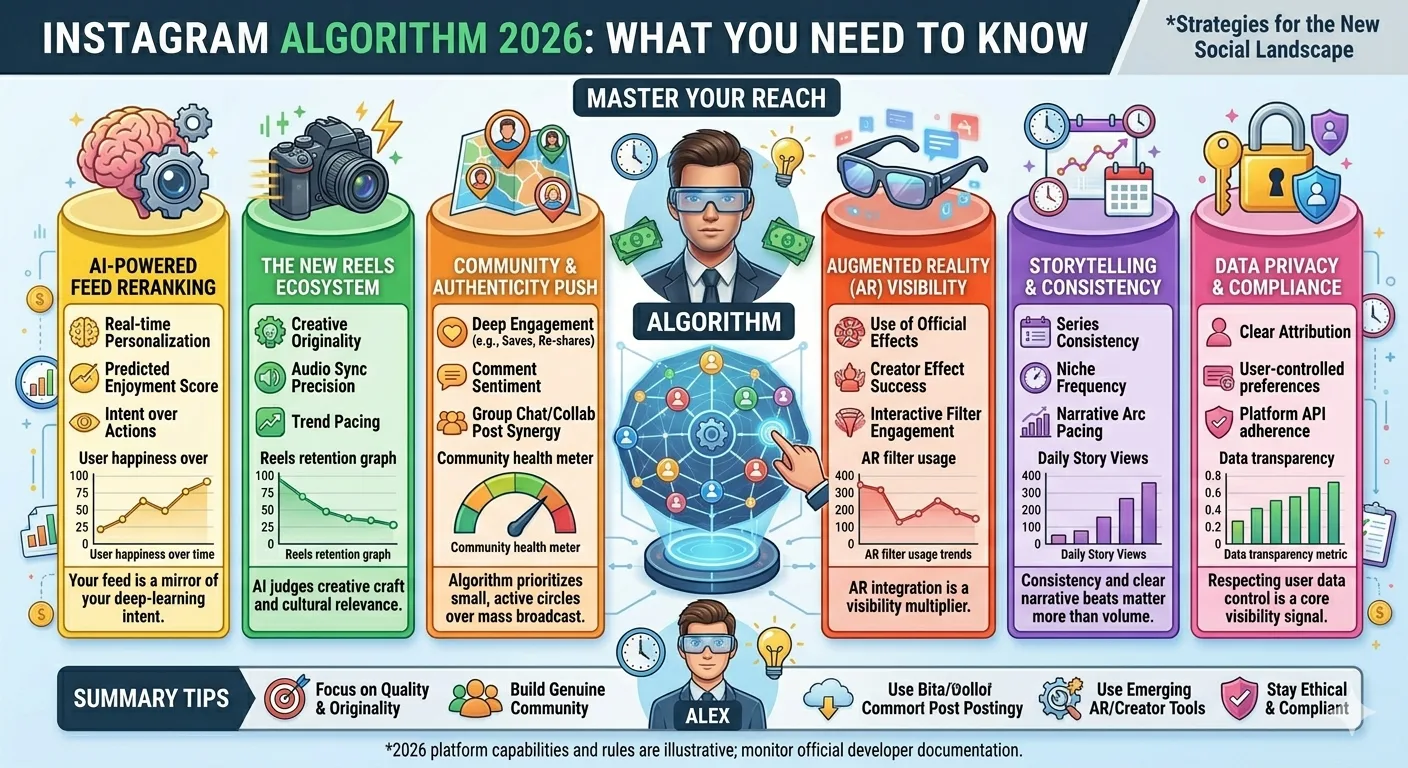
Instagram does not have a single monolithic algorithm. It has multiple ranking systems, each designed for a different surface of the platform the main feed, the Explore page, the Reels tab, and the Stories bar all use different signals and weighting to determine what content to show each user. Understanding how each of these systems works, what signals they respond to, and how they interact with your content is the foundation of any effective Instagram strategy in 2026.
This guide covers exactly that not speculation, not hacks, but a clear explanation of how Instagram's ranking systems actually function and what that means for how you create and distribute content.
What the Algorithm Actually Is
Before getting into how it works, it is worth being precise about what Instagram's "algorithm" actually refers to.
Instagram uses the term to describe a collection of machine learning models that predict, for each individual user at each moment they open the app, which content they are most likely to find valuable and engage with. The goal from Instagram's perspective is to maximize the time users spend on the platform and the satisfaction they feel when using it which means surfacing content that genuinely resonates with each individual user rather than simply showing the most recent posts from followed accounts.
These prediction models are trained on enormous datasets of user behavior what users have liked, commented on, saved, shared, watched, and scrolled past and they update continuously based on ongoing user behavior. This means the algorithm is not a static ruleset but a dynamic, personalized system that responds differently for each user based on their unique behavior history.
The practical implication is significant: there is no universal formula for algorithmic success, because the algorithm is optimized for individual user satisfaction rather than universal reach. Content that performs exceptionally well for one account's audience may perform mediocrely for another, not because of differences in content quality but because of differences in audience behavior and preferences.instapv
How the Main Feed Algorithm Works
The main feed the scrollable stream of posts from accounts a user follows uses a ranking system that prioritizes content based on several primary signals.
Signal 1: Interest Prediction
Instagram predicts how likely each user is to engage with a given post based on their past behavior with similar content. If a user has consistently liked, saved, and commented on fitness content, Instagram predicts high interest in new fitness posts from accounts they follow and ranks those posts higher in their feed.
This prediction is highly personalized two followers of the same account may see that account's posts ranked very differently in their respective feeds based on their individual engagement histories with that account and with similar content more broadly.
Signal 2: Relationship Strength
The strength of the relationship between a viewer and the account that posted significantly affects ranking. Instagram infers relationship strength from the frequency and depth of past interactions how often the user has liked, commented on, or shared posts from the account, whether they have exchanged direct messages, whether they have searched for the account directly, and whether they have engaged with the account's stories.
Accounts that a user interacts with regularly and deeply appear higher in their feed consistently. Accounts the user rarely engages with, even if followed, may effectively disappear from the user's feed over time if no engagement signal refreshes the relationship strength score.
Signal 3: Recency
While Instagram's feed is no longer strictly chronological, recency still matters as a ranking signal. More recent posts are given some advantage over older posts from the same account, all else being equal. This is why posting timing still matters despite the algorithmic feed a post published when your audience is most active has a recency advantage during the period when your audience is most likely to be scrolling.
Signal 4: Post Frequency
Instagram tracks how frequently an account posts and adjusts how its content is distributed to avoid flooding individual followers' feeds from a single highly active account. This means that dramatically increasing posting frequency does not proportionally increase reach the algorithm distributes the increased posting volume across a wider time window rather than showing every post to every follower.
How the Explore Page Algorithm Works
The Explore page the discovery surface that surfaces content from accounts a user does not follow operates on fundamentally different principles from the main feed algorithm.
The Two-Stage Explore Ranking Process
Instagram's Explore algorithm works in two stages. In the first stage, the system identifies a candidate set of posts based on the accounts and content that people with similar engagement histories have recently interacted with. This creates a personalized pool of potentially relevant content from across the entire platform.
In the second stage, this candidate pool is ranked using engagement prediction signals how likely a given user is to like, save, share, or comment on each post based on their behavior history. The highest-ranked posts from this second stage are what appears in each user's Explore feed.
What This Means for Content Strategy
Getting onto the Explore page is essentially a two-step problem. First, your content needs to generate enough engagement from your existing audience to be identified as high-quality content worth including in the candidate pool for users with similar interests. Second, it needs to be compelling enough to generate engagement predictions above the threshold for ranking in the final Explore feed.
The first step explains why strong engagement from your existing followers is a prerequisite for Explore page reach without that foundation of real engagement, the algorithm has no signal to work with in identifying your content as relevant for new audiences.
The second step explains why content on the Explore page needs to communicate its value immediately from the first frame or image Explore users are encountering your content cold, without the context of following your account, and need a compelling immediate reason to engage.
How the Reels Algorithm Works
Reels have their own ranking system distinct from the main feed, reflecting their role as Instagram's primary discovery format and the surface most directly competing with TikTok.
Watch Time Is the Primary Signal
For Reels specifically, watch time how long viewers watch before scrolling away, and whether they watch to completion is the dominant ranking signal. A Reel that consistently holds viewers' attention through to the end tells the algorithm that the content is genuinely compelling, triggering wider distribution.
This makes the first three seconds of any Reel the most algorithmically critical moment in the content as discussed in Day 4's growth hacks post. Content that loses viewers in the opening seconds generates poor watch time signals regardless of how strong the rest of the Reel is, because most viewers will have already left.
Completion Rate and Replays
Beyond simple watch time, completion rate the percentage of viewers who watch all the way to the end and replay rate the percentage who watch the Reel more than once are strong positive signals for Reels distribution. Content that people finish and then immediately rewatch is sending one of the strongest possible quality signals to the algorithm.
Engagement Signals for Reels
Likes, comments, saves, and shares all contribute to Reels ranking, but they play a secondary role to watch time signals. A Reel with strong watch time but modest explicit engagement will typically outperform a Reel with weak watch time but high like counts, because watch time is a more direct measure of genuine content quality than a passive like tap.
Originality and Recommender Eligibility
Instagram has stated that Reels are evaluated for originality as part of determining recommender eligibility whether the content is eligible to be recommended to non-followers through the Reels tab and Explore. Reels that are clearly reposts of content that has already appeared elsewhere, that contain watermarks from other platforms, or that are identified as recycled content may be deprioritized for non-follower distribution.
How the Stories Algorithm Works
Stories appear in the Stories bar at the top of the app, and the order in which they appear is determined by a ranking algorithm rather than simple chronology.
Relationship and Interaction History
The primary ranking signal for Stories is the strength of the relationship between the viewer and the account essentially the same relationship signal used in feed ranking, but weighted more heavily toward recent interactions specifically with stories rather than feed posts.
Accounts whose stories the user regularly watches, replies to, and interacts with through polls and questions are ranked higher in that user's Stories bar. Accounts whose stories the user consistently skips or exits early are progressively deprioritized, potentially disappearing from the front of the queue entirely.
Story Completion and Exit Signals
Within any individual story sequence, the algorithm tracks whether viewers complete the story or exit partway through. Consistent completion generates positive signals that keep an account ranked prominently in followers' Stories bars. Consistent early exits particularly if viewers exit directly out of the app rather than moving to the next account generate negative signals.
Interactive Element Responses
Stories that generate responses to polls, questions, quizzes, and other interactive elements signal strong engagement to the algorithm, contributing positively to ranking in followers' Stories bars.
Common Algorithm Myths Debunked
Given the volume of misinformation circulating about Instagram's algorithm, it is worth explicitly addressing several persistent myths that continue to affect how people approach content strategy.
Myth: Shadowbanning Is a Systematic Policy
"Shadowbanning" the idea that Instagram secretly suppresses accounts without notification is one of the most persistent myths in Instagram marketing. Instagram has addressed this directly, stating that it does not secretly suppress accounts without reason.
What does happen is that content that violates Instagram's guidelines, content that generates negative signals (high exit rates, low engagement), or content from accounts with a history of policy violations may see reduced distribution. But this is the result of the algorithm's quality and policy filtering, not a secret punishment system applied arbitrarily.
Myth: Using Certain Hashtags Gets You Shadowbanned
There is no credible evidence that using specific hashtags results in algorithmic suppression. Hashtags associated with content that violates Instagram's guidelines may be restricted (Instagram does this openly, not secretly), but using an unrestricted hashtag does not trigger any punishment mechanism.
Myth: You Need to Post at Exactly the Right Time Every Day
As covered in Day 5's posting time guide, timing matters but not at the level of precision implied by advice like "post at 11:17 AM on Tuesdays." Posting during your audience's peak activity windows matters. Hitting an exact minute within that window does not.
Myth: More Hashtags Always Means More Reach
The relationship between hashtag use and reach is not linear. As discussed in the growth hacks post, niche-specific hashtags in moderate volume currently outperform maximum-hashtag strategies. The quality and relevance of hashtags matters significantly more than the quantity.
Myth: The Algorithm Penalizes Accounts for Not Posting Every Day
Instagram's algorithm does not penalize accounts for maintaining a less-than-daily posting frequency. Consistency within your established rhythm matters, but there is no evidence of any algorithmic penalty for accounts that post three times per week versus seven times per week.
What the Algorithm Rewards in 2026
Setting aside myths, here is what the current evidence suggests Instagram's algorithms genuinely reward across all surfaces.
Genuine Engagement Quality
Saves, shares, comments, and strong watch time are weighted more heavily than likes in the algorithm's quality assessment. Content that people actively engage with in substantive ways rather than passively scrolling past and occasionally tapping a like consistently receives stronger distribution.
Audience Relationship Maintenance
Content that strengthens the relationship between an account and its followers through regular, consistent publishing, genuine interaction in comments and DMs, and story content that creates conversation maintains the relationship strength scores that determine how prominently an account appears in followers' feeds.
Content Originality
Across all surfaces, original content ideas, perspectives, and formats that are not simply copied from elsewhere is treated more favorably than recycled or repurposed content from other platforms.
Consistent Publishing Cadence
Consistency within an account's established posting rhythm is rewarded through more predictable algorithmic distribution. Accounts that publish regularly provide the algorithm with more data points for predicting audience interest and distributing content accordingly.
Early Engagement Velocity
Strong engagement in the first hour after posting across all formats signals to the algorithm that the content is performing well and triggers broader distribution. This makes the quality of your audience relationship, and your posting time strategy, directly consequential for each post's reach ceiling.
Working With the Algorithm Rather Than Against It
The most useful mindset shift for anyone building an Instagram strategy around algorithmic understanding is moving from adversarial framing trying to "beat" or "hack" the algorithm to collaborative framing: understanding what the algorithm is optimizing for and aligning your content strategy with those goals.
The algorithm is optimizing for user satisfaction keeping users on the platform by showing them content they genuinely value. An account that consistently creates content its specific audience genuinely values is aligned with the algorithm's goals by definition. An account that tries to game engagement signals through inauthentic means is working against the algorithm's direction and will find that Instagram's increasingly sophisticated detection systems progressively neutralize those tactics.
The accounts that grow most sustainably on Instagram in 2026 are those built around genuinely serving a specific audience so well that the algorithm's natural function surfacing valuable content to interested users works in their favor automatically.
How to Monitor Algorithm Changes Over Time
Instagram's algorithms are not static they evolve continuously, and significant updates happen several times per year. Staying informed about algorithm changes allows you to adjust strategy proactively rather than reactively.
Watch Your Own Analytics Closely
Sudden, unexplained changes in reach or engagement across multiple posts simultaneously are often the first signal of an algorithm update affecting your account type or content category. Maintaining a regular analytics review habit as discussed in earlier posts in this series means you are positioned to notice these changes quickly.
Follow Platform Communications
Instagram periodically publishes communications about how its ranking systems work through its official blog, its creators' help center, and the accounts of key Instagram executives. These are the most authoritative source of information about how the algorithm functions and how it is changing.
Use Competitive Benchmarking
If your reach and engagement change suddenly, checking whether similar accounts in your niche are experiencing comparable changes through InstaPV's analytics helps distinguish between algorithm changes affecting your niche broadly versus issues specific to your account.
Frequently Asked Questions
Q: Does the algorithm treat business accounts differently from personal accounts?
Instagram has stated that account type does not directly affect algorithmic distribution. Business and creator accounts have access to additional features (Insights, shopping tools, promoted posts) but are not algorithmically penalized or advantaged relative to personal accounts purely based on account type.
Q: Does paying for ads help your organic reach?
Instagram has consistently denied any relationship between advertising spend and organic algorithmic reach meaning running paid promotions does not directly boost the organic reach of non-promoted posts. The algorithm evaluates organic and paid content through separate systems.
Q: How does the algorithm handle accounts that post very different types of content?
The algorithm builds audience interest profiles based on what content each follower engages with from your account. If you post widely varied content, different followers may see different posts based on their individual interest predictions. Niche consistency tends to result in more uniform distribution because the algorithm has a clearer picture of who in your following is most likely to be interested in any given post.
Q: Does commenting on other accounts' posts boost your own reach?
Engaging genuinely with other accounts' content can strengthen relationship signals if people follow you back as a result of discovering you in comment sections, and if those new followers engage with your content, that engagement benefits your distribution. But there is no direct mechanism by which commenting on other accounts boosts the reach of your own posts.
Q: How can I tell if an algorithm update has affected my account specifically?
Compare your reach and engagement metrics during the affected period to the same metrics from the equivalent period three to four weeks prior. If your metrics have changed significantly and the change correlates with reports of broader algorithm updates (which are often discussed across the Instagram marketing community simultaneously), it is likely that an algorithm change is involved rather than a content quality issue specific to your account.
-
How to Use InstaPV for Influencer Research: Full Walkthrough
-
Instagram Trends to Watch: Week 1 Roundup for 2026
-
Instagram Trends to Watch: Week 1 Roundup for 2026
Conclusion
Instagram's algorithm in 2026 is a sophisticated collection of machine learning systems optimized for individual user satisfaction across multiple distinct platform surfaces. Understanding how each surface works the main feed's relationship and interest prediction signals, the Explore page's two-stage candidate selection and ranking, the Reels algorithm's emphasis on watch time and completion, and the Stories ranking's dependence on relationship and interaction history provides the foundation for content strategy decisions that work with these systems rather than against them.
The accounts that thrive algorithmically in 2026 are not those that find the cleverest hacks or tricks they are those that most effectively serve their specific audiences with content those audiences genuinely value. That alignment between creator intent and audience benefit is precisely what Instagram's algorithms are designed to identify and reward.
Analyze how top-performing accounts in your niche work with the algorithm on InstaPV →