Introduction
Influencer marketing is one of the most powerful tools available to brands and marketers on Instagram and one of the most frequently misused. The difference between an influencer partnership that delivers meaningful results and one that wastes budget almost always comes down to the quality of the research done before the contract is signed.
Most brands that have disappointing influencer marketing experiences share a common story: they chose a partner based on follower count and a quick look at recent posts, without digging into the data that actually predicts campaign performance. They did not check engagement rate trends. They did not verify follower growth patterns. They did not analyze content consistency or audience alignment. They made a significant financial commitment based on surface-level information.
The research that prevents these outcomes does not require expensive enterprise software or weeks of analysis. With the right tool and a clear process, thorough influencer research can be completed in 20 to 30 minutes per candidate and InstaPV makes the entire process accessible without requiring any Instagram login, any special access, or any payment for the core research functionality.
This guide is a complete, step-by-step walkthrough of how to use InstaPV for influencer research from initial discovery through to a final evaluation decision.
Why InstaPV Is Suited to Influencer Research
Before getting into the walkthrough, it is worth understanding specifically why InstaPV is well-suited to influencer research rather than just directing you to use it without context.
No Login Required
Conducting influencer research through your own Instagram account creates signals your brand account's username appears in story viewer lists, your profile visits may be noticed, and your follow activity is visible. For brands that want to evaluate influencers without tipping them off to the evaluation, anonymity during research is important. InstaPV provides this by default.
Analytics Beyond What Instagram Shows Publicly
Instagram's public interface shows follower counts, post counts, and visible engagement (likes and comments) but does not surface growth trends, engagement rate calculations, or historical data comparison. InstaPV's analytics engine calculates and displays these metrics for any public account, turning a static profile snapshot into a dynamic performance picture.
Consistent Access Regardless of Device or Login Status
Influencer research often happens across multiple team members, devices, and sessions a marketing manager, an agency partner, and a brand director all reviewing the same candidates at different times. InstaPV provides consistent access to the same profile data for anyone with the URL or the username, without requiring any shared login credentials.
Phase 1: Building Your Research Candidate List
Effective influencer research starts before you open InstaPV with a clearly defined candidate list based on your campaign goals.
Define Your Target Audience First
Before identifying influencer candidates, be specific about whose attention you are trying to reach. The more precisely you can define your target audience demographic characteristics, interests, behaviors, geographic location the more effectively you can evaluate whether a given influencer's audience actually matches.
A skincare brand targeting women aged 25 to 40 in urban markets interested in clean beauty ingredients has a very different influencer brief than a skincare brand targeting teenagers interested in affordable drugstore routines, even though both are "skincare brands." Starting with audience clarity prevents you from discovering late in the research process that an otherwise impressive influencer reaches completely the wrong audience for your campaign.
Identify Initial Candidates Through Multiple Channels
Build your initial candidate list through several complementary methods.
Instagram's native search surfaces accounts when you search relevant topics, hashtags, and keywords useful for finding accounts you did not already know about.
Hashtag exploration in your niche's relevant hashtags, particularly looking at Top Posts, surfaces accounts that are currently performing well algorithmically in your space.
Existing brand fans and customers who have organically mentioned or tagged your brand are often overlooked as influencer candidates they have already demonstrated genuine affinity for the brand, which is one of the most important indicators of authentic partnership potential.
Recommendations from industry contacts, agency partners, or influencer marketing platforms provide additional candidates that systematic search might not surface.
Aim for an initial candidate list of 15 to 30 accounts broad enough to allow meaningful filtering during research, specific enough to remain manageable within a realistic research time budget.
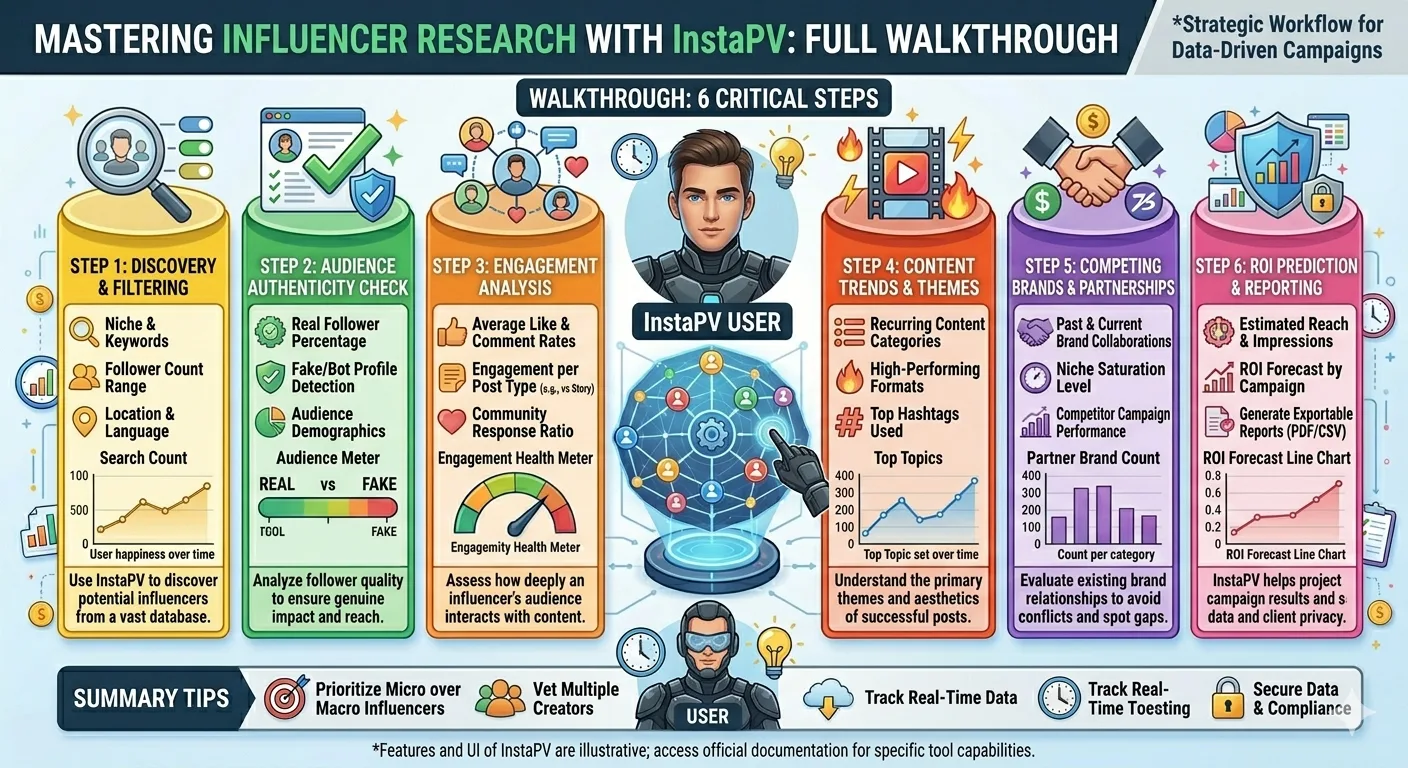
Phase 2: Initial Screening on InstaPV
With your candidate list established, the first phase of InstaPV research is a rapid initial screening designed to eliminate clearly unsuitable candidates before investing time in deeper analysis.
Step 1: Open InstaPV
Navigate to instapv.xyz in any browser. No login is required.
Step 2: Search the First Candidate
Type the influencer's username into the InstaPV search bar and press Search. The profile loads within a few seconds.
Step 3: Review the Basic Profile Information
The first elements to check in initial screening are the basics: display name, bio, follower count, following count, and post count. These take less than 30 seconds to review but can quickly eliminate candidates who are obviously misaligned.
Bio review: Does the account's stated focus and personality align with your brand's values and target audience? An influencer whose bio emphasizes a content area clearly different from your campaign focus is unlikely to be the right fit regardless of their metrics.
Follower-to-following ratio: An account following 15,000 accounts while having 18,000 followers has built its audience largely through follow-back mechanics rather than content merit. An account following 500 accounts with 18,000 followers has built its audience through content quality. This ratio is a quick initial signal worth noting.
Post count relative to follower count: An account with 200 posts and 50,000 followers has built an audience more efficiently than an account with 2,000 posts and 50,000 followers though this is a rough signal that requires context from other metrics.
Step 4: Quick Content Scan
Before going deeper into analytics, spend one to two minutes looking at the account's recent feed content visible through InstaPV. Does the visual style, content quality, and topic focus look like a natural fit for your brand? Is the content consistent, or does it show significant variation in quality or topic?
This is not a comprehensive content audit that comes in Phase 3 but a quick gut-check that prevents investing analytical time in candidates who are obviously unsuitable on a content basis.
Step 5: Make an Initial Keep or Eliminate Decision
Based on bio, ratio, and content scan, make a preliminary keep or eliminate decision for each candidate. You are not making a final partnership decision at this stage just filtering your list from 15 to 30 candidates down to the 8 to 12 who merit deeper analysis.
Phase 3: Deep Analytics Analysis
For the candidates who pass initial screening, this is the core research phase where InstaPV's analytics capabilities provide the data that actually predicts partnership performance.
Step 1: Open the Analytics View
For each remaining candidate, navigate to the analytics section of their InstaPV profile. This is where follower growth trends, engagement rate data, and posting activity analysis are displayed.
Step 2: Analyze the Follower Growth Chart
The follower growth chart is often the single most revealing piece of data in influencer research. Here is what to look for.
Overall trajectory: Is the line going up, flat, or down? A consistent upward trajectory is the baseline positive signal. Flat growth is neutral the account has a stable audience but is not expanding. Declining growth raises questions worth investigating.
Growth acceleration or deceleration: Is the growth rate speeding up, maintaining a consistent pace, or slowing down? An influencer whose growth rate is accelerating is in a stronger position for a partnership than one whose growth is decelerating, even if current follower counts are similar.
Spike patterns: Look for sudden sharp increases in follower count. Note approximately when these occurred. Can you identify what caused them a viral post, a notable collaboration, press coverage? Spikes that cannot be explained by any visible content event may indicate purchased followers and warrant further scrutiny.
Consistency of growth: Smooth, consistent growth over time is the most reliable indicator of genuine organic audience building. Highly erratic patterns large increases followed by significant drops suggest unstable audience dynamics.
Step 3: Review Engagement Rate Trends
After the growth chart, the engagement rate trend is the second most critical analytics element to examine.
Current engagement rate: Using the benchmarks covered in earlier posts in this series, assess whether the current engagement rate is appropriate for the account's size. An account with 80,000 followers showing a 6 percent engagement rate is exceptional. An account with 8,000 followers showing 0.8 percent engagement has a serious problem.
Engagement rate direction: Is engagement improving, stable, or declining over time? A declining engagement rate particularly if it is declining as follower count grows may indicate that recent growth has brought in less engaged followers than the original audience.
Engagement rate consistency: Does engagement rate remain relatively stable across different content types and time periods, or does it show extreme swings? Consistent engagement suggests a reliably responsive audience. Extreme variability may indicate engagement pods or other artificial amplification.
Step 4: Analyze Posting Frequency and Consistency
InstaPV's posting frequency data shows how regularly the influencer publishes content and whether their cadence is consistent or erratic.
Consistency: A consistent posting schedule indicates a professional creator who treats their account as a serious operation rather than a casual hobby. Inconsistent posting long gaps followed by bursts of content is a yellow flag for partnership reliability.
Frequency: Very low posting frequency (once a month or less) means sponsored content will likely account for a disproportionate share of the account's posts during your campaign period, which audiences often notice and respond to negatively. Very high frequency may mean sponsored content gets lost in a flood of other posts.
Phase 4: Content and Story Analysis
Analytics tell you about performance patterns. Content and story analysis tells you about what the influencer actually creates and how they present sponsored partnerships.
Step 1: View Recent Stories Through InstaPV
Using InstaPV's story viewer, watch the influencer's current active stories. This gives you insight into their day-to-day content personality often more authentic and less curated than feed posts and helps you assess whether their natural communication style aligns with your brand.
Pay attention to how they communicate verbally and in written text, what their production quality looks like in less formal story format, how they interact with their audience through interactive story elements, and whether their stories feel like natural extensions of their feed content or completely disconnected.
Step 2: Review Highlights Systematically
Use InstaPV to browse through the influencer's Highlight collections. Highlights reveal several important things about an influencer as a potential partner.
Past sponsored content: Many influencers save sponsored content to a dedicated Highlight. Reviewing this content shows you exactly how they present and communicate partnerships their disclosure style, their integration of brand messaging with personal voice, and the overall quality of their sponsored storytelling.
Content categories and depth: The Highlight structure reveals what the influencer considers important enough to preserve permanently a window into their core content pillars and what they prioritize communicating to their audience.
Audience interaction evidence: Highlights that include audience responses to polls, questions, or other interactive elements provide indirect evidence of audience engagement quality beyond what engagement rate numbers show.
Step 3: Analyze Feed Content in Depth
Go through the last 20 to 30 feed posts in detail more thoroughly than the quick scan in Phase 2. Categorize posts by content type, note which posts show significantly higher or lower engagement than the account's average, and look for patterns in what drives exceptional versus below-average performance.
This deeper content analysis serves two purposes. First, it helps you identify the content formats and topics that drive the best performance for this specific influencer informing how you should structure a partnership if you move forward. Second, it reveals the overall quality and consistency of their content operation, which is a strong indicator of the quality of sponsored content you can expect them to produce.
Phase 5: Red Flag Assessment
Before making any final evaluation decision, run each remaining candidate through a systematic red flag check.
Red Flag 1: Follower Spike Without Explanation
Sharp follower count increases that do not correspond to any identifiable viral content, collaboration, or press event are a primary indicator of purchased followers. Cross-reference growth spikes with content from that period if you cannot find any post that would plausibly explain the spike, treat it as a serious concern.
Red Flag 2: Engagement Rate Inconsistent With Account Size
Using the benchmarks from earlier in this series, an engagement rate significantly below what is typical for the account's size suggests a follower quality problem either purchased followers, significant audience churn, or content that has become disconnected from what the audience originally followed for.
Red Flag 3: Comment Quality Issues
Read through comments on multiple recent posts. Generic, short, or formulaic comments particularly those that do not reference the specific content of the post can indicate engagement pod activity or purchased engagement. Look for real, substantive comments that reference the actual content.
Red Flag 4: Sponsorship Oversaturation
Count what percentage of the influencer's recent posts are sponsored content. An influencer whose feed is dominated by sponsorships more than 30 to 40 percent of recent posts may have an audience that has become fatigued with sponsored content, which directly affects campaign performance.
Red Flag 5: Inconsistent Brand Alignment
Review all sponsored content in the influencer's Highlights and recent feed. If they have a history of promoting brands that are inconsistent with each other spanning widely different values, aesthetics, and audience types this may indicate an approach to partnerships that prioritizes financial opportunity over authentic alignment, which can reduce the trust their audience places in any individual recommendation.
Phase 6: Building Your Evaluation Summary
After completing the analysis phases for each remaining candidate, organize your findings into a comparison document that allows side-by-side evaluation.
What to Include in Your Summary
For each candidate, record the following from your InstaPV research and content analysis.
Follower count and growth trajectory assessment growing steadily, accelerating, plateauing, or declining.
Engagement rate current figure, benchmark comparison for their account size, and trend direction.
Content quality and brand alignment assessment a qualitative rating of how well their content style, values, and audience match your campaign needs.
Posting consistency rating reliable and professional, or inconsistent.
Sponsored content history how they handle partnerships, how frequently they take them, and the overall quality of their sponsored content.
Red flags identified any concerns from the red flag assessment, with notes on their severity.
Overall recommendation proceed to outreach, deprioritize, or eliminate.
-
Instagram Trends to Watch: Week 1 Roundup for 2026
-
Complete Guide to Instagram Bio Optimization for More Followers
-
Instagram Story vs Post: Which Drives More Engagement?
Frequently Asked Questions
Q: How long should the full research process take per influencer?
With practice and a clear process, the full Phase 2 through Phase 6 research process takes approximately 20 to 30 minutes per candidate using InstaPV. Initial screening in Phase 2 can be done more quickly five to ten minutes per candidate since many will be eliminated before the deeper analysis phases.
Q: What if an influencer's InstaPV analytics show limited historical data?
If an account has not been previously searched and tracked through InstaPV, historical growth data may be limited. In this case, the current engagement rate and content analysis become more important relative to the growth trajectory data, and a longer monitoring period before making a partnership decision may be warranted.
Q: Should I reach out to influencers whose accounts show some yellow flags but are otherwise strong?
Yellow flags warrant discussion during the partnership negotiation rather than automatic elimination. If an influencer has one or two areas of concern but is otherwise a strong candidate, raising those concerns directly asking for their explanation of a growth spike, or discussing their approach to sponsored content frequency often resolves the concern or provides context that changes the assessment.
Q: Is there a minimum follower count I should require for partnerships?
Minimum follower counts are less meaningful than engagement rate and audience alignment. A micro-influencer with 8,000 followers and 7 percent engagement in your exact target niche will almost always outperform a macro-influencer with 300,000 followers and 0.6 percent engagement for most campaign goals. Define minimums around engagement rate and audience alignment rather than raw follower count.
Q: Can I use InstaPV to monitor an influencer's performance during an active partnership?
Yes. Continuing to check an influencer's follower growth and engagement trends through InstaPV during an active partnership provides an ongoing picture of their account trajectory and whether the partnership period coincides with any notable changes in their performance.
Conclusion
Thorough influencer research is the single most reliable way to improve influencer marketing outcomes and the research process described in this walkthrough is accessible to any brand or marketer regardless of budget or technical expertise.
Using InstaPV for the analytics, story, and content components of this research provides the data depth needed to distinguish genuinely strong partnership candidates from superficially impressive ones. The entire process from initial candidate list to final evaluation summary can be completed in a single focused research session, without ever logging into Instagram or alerting any influencer that they are being evaluated.
The investment in research pays for itself many times over in avoided poor partnerships and better-informed decisions about where to invest influencer marketing budget.