Introduction
The best time to post on Instagram is one of the most searched questions in social media marketing and one of the most consistently misanswered. Articles confidently declaring that 11 AM on Wednesdays or 7 PM on Fridays is universally optimal appear regularly, typically citing aggregate data from studies that average across millions of accounts in completely different industries, time zones, and audience demographics.
This guide takes a different approach. Rather than presenting a universal optimal posting time that does not exist, it examines what the data actually shows about posting time effects, why aggregate recommendations are structurally limited in their applicability, how to use your own account data to identify genuinely optimal windows, and what research reveals about the mechanisms through which timing affects content performance.
The goal is not a simple answer to put in a calendar. It is an accurate understanding of how posting time works so you can make evidence-based decisions for your specific situation rather than following generic advice that was never designed for your account. Instapv
What Research Actually Shows About Posting Time Effects
Several bodies of research have examined the relationship between Instagram posting time and content performance. The findings are more nuanced than most posting time advice suggests.
The Early Engagement Velocity Effect
As covered in Day 20's algorithm science post, research has documented a strong relationship between early engagement velocity and ultimate reach for Instagram content. Posts that accumulate strong engagement signals in the first hour after publishing receive meaningfully broader algorithmic distribution than posts with comparable eventual engagement but slower initial accumulation.
This finding provides the scientific foundation for why posting time matters at all. Posting during your audience's peak activity periods increases the likelihood of strong early engagement, which the algorithm interprets as a quality signal and rewards with broader distribution. The posting time effect is therefore primarily mediated through early engagement velocity rather than through any direct algorithmic preference for specific time slots.Read blog
This mechanism has a specific implication that most posting time advice overlooks: the relevant question is not what time maximizes views broadly but what time maximizes early engagement from the specific audience most likely to engage with your specific content. These are related but not identical questions.
The Audience Activity Pattern Research
Research on social media usage patterns consistently shows that activity levels vary by time of day and day of week, but that these patterns are significantly modulated by demographic characteristics including age, profession, geographic location, and device usage habits.
Studies of general Instagram usage patterns show activity concentration in three broad windows across most markets: morning periods roughly corresponding to commute and breakfast time, midday periods corresponding to lunch breaks, and evening periods corresponding to post-work leisure time. Weekend patterns differ from weekday patterns, with morning activity starting later and remaining elevated through more of the day.
However, the variance around these general patterns is substantial. A professional audience working standard business hours in a specific time zone shows very different peak activity patterns than a student audience in a different time zone. The general patterns are a reasonable starting point in the absence of specific data but should not be treated as precise guidance for any specific account.
The Competitive Density Effect
One research finding that receives less attention in popular posting time advice is the competitive density effect: popular posting times are popular for many accounts, which means content competition for feed placement and audience attention is higher during these periods.
Publishing at the peak of audience activity maximizes the probability that your content appears in your audience's feed at a time when they are active, but it also maximizes the probability that your content is competing with more other content for their limited attention during that window. Some research suggests that for accounts whose content already has strong engagement signals, publishing slightly before peak activity, so that content has accumulated initial engagement before the audience's most active period, may produce stronger outcomes than publishing at the exact peak.
This competitive density consideration does not reverse the general principle that posting during audience activity periods is better than posting when audiences are least active, but it introduces nuance that purely audience activity-focused advice ignores.
Why Universal Posting Time Recommendations Are Structurally Limited
Understanding why generic posting time recommendations have limited applicability for any specific account makes it easier to avoid misplacing confidence in them.
The Aggregation Problem
When a study averages engagement data across millions of Instagram accounts to identify optimal posting times, it is averaging across accounts in fundamentally different situations: different industries, different audience demographics, different geographic distributions, different content types, and different competitive environments.
The optimal posting time that emerges from this aggregation may be optimal for the average of these extremely diverse situations without being optimal for any specific situation within the dataset. An account whose audience is predominantly in one time zone and one demographic cohort will have peak activity patterns that may differ substantially from the aggregate finding.
The Time Zone Problem
Most posting time recommendations that specify times do not adequately account for the fact that audience time zones differ across accounts. A recommendation to post at 11 AM Eastern time is implicitly useful only for accounts whose primary audience is in the Eastern time zone. An account with a predominantly European, Asian, or Pacific Coast audience would be posting at a time significantly removed from their audience's corresponding activity window.
Even accounts with primarily domestic audiences within a large country like the United States span multiple time zones, which means no single time is simultaneously optimal for followers in New York and Los Angeles.
The Content Type Problem
Different content types within the same account may have different optimal posting times based on when the audience is most likely to engage with each type. Educational reference content that people save for later use may perform well at any time the audience encounters it. Entertainment content that people engage with in the moment may be more time-sensitive to when the audience is in a leisure, scrolling mode.
Generic posting time recommendations do not distinguish between these content type differences, which means they are simultaneously too specific, claiming a precise best time, and too general, not accounting for content type variation.
How to Find Your Actual Best Posting Times
With the limitations of generic recommendations understood, here is the process for identifying the genuinely optimal posting windows for your specific account.
Step 1: Access Your Audience Activity Data
Instagram's native Insights tool for business and creator accounts provides direct data on when your specific followers are most active by hour and by day of week. This is the most directly relevant data available for posting time decisions and should be the foundation of your time optimization rather than any generic recommendation.
Navigate to your account's Insights, select your audience section, and find the follower activity data. This typically shows a heatmap or bar chart of when your followers are most active across different days and times.
Step 2: Identify Your Peak Activity Windows
From the activity data, identify your two or three peak activity windows: the specific day and time combinations where your follower activity is highest. These are the windows where publishing content maximizes the probability of strong early engagement.
Note whether the peak activity varies significantly across different days of the week. For many accounts, weekday peak times differ meaningfully from weekend peak times, which has practical implications for posting schedule planning.
Step 3: Run a Controlled Posting Time Test
With identified peak windows, run a structured test over four to six weeks. Publish similar types of content at different times within and slightly before your identified peak windows, keeping all other variables as consistent as possible, and track early engagement metrics for each post.
The early engagement metrics to track are: likes and comments within the first hour of publishing, which are the primary signals driving algorithmic distribution decisions. Record these for each post alongside the posting time and note any patterns that emerge across the sample.
Step 4: Analyze Results and Identify Patterns
After four to six weeks of structured testing, review the data. Are there specific time windows that consistently produce stronger first-hour engagement than others? Do these patterns hold across different content types or only for specific formats?
The patterns that emerge from your own account's data are the most reliable posting time guidance available for your specific situation, because they reflect the actual behavior of your actual audience rather than averages across unrelated accounts.
Step 5: Build a Schedule and Monitor for Shifts
Once you have identified the optimal windows from your own data, build a posting schedule that consistently targets these windows. Monitor whether the patterns hold over time and revisit the analysis quarterly, since audience composition and behavior patterns can shift as accounts grow and attract different follower demographics.
Posting Time Data by Audience Type: Starting Hypotheses
While your own data should ultimately guide posting time decisions, general patterns from research provide useful starting hypotheses for accounts that do not yet have sufficient Insights data to identify their own patterns.
Professional and B2B Audiences
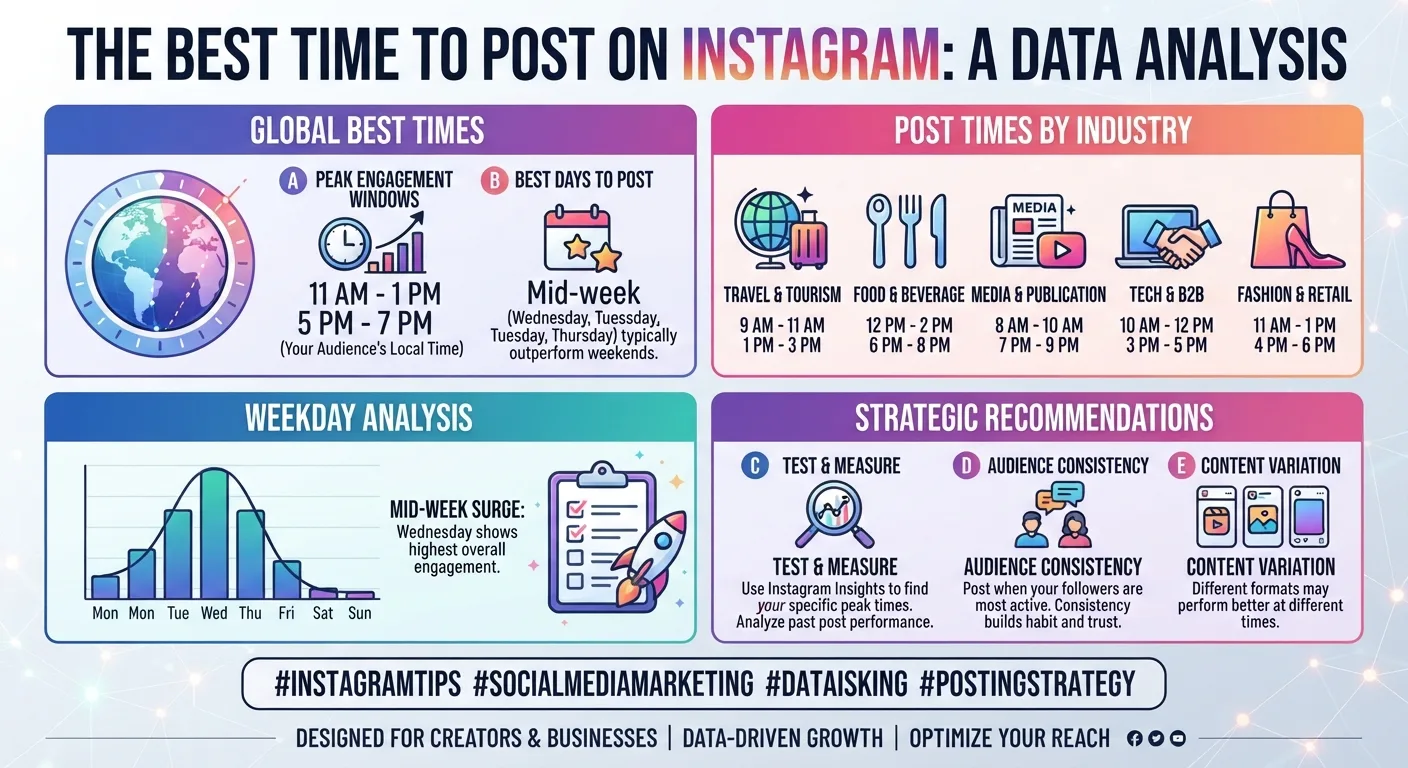
Audiences with professional and business demographics consistently show activity concentration during commute windows, specifically early morning between 7 and 9 AM and early evening between 5 and 7 PM, and during lunch break windows between 12 and 1 PM. Weekday activity typically significantly outperforms weekend activity for these audiences.
Consumer and Lifestyle Audiences
General consumer audiences show more distributed activity patterns throughout the day, with consistent evening peaks between 6 and 9 PM across most markets and days. Weekend patterns show later morning starts and more sustained activity through the afternoon and evening.
Younger Audiences
Younger audiences, particularly students and those in the 18 to 24 demographic, show later peak times than older demographics, with activity concentrated in after-school and evening windows and significant late-night activity. Weekend patterns are less differentiated from weekday patterns than for professional demographics.
International Audiences
For accounts with significant international audience concentration, the relevant time zone is the audience's local time rather than the account owner's local time. An account based in one time zone but with a primary audience in another should anchor its posting schedule to the audience's local peak activity windows.
The Relationship Between Posting Time and Content Format
As noted in Day 5's posting time guide, different content formats have somewhat different posting time considerations.
Feed Posts and Reels
For feed posts and Reels, posting time matters primarily because early engagement velocity determines algorithmic distribution, as discussed above. The first hour after publishing is the most critical period, and timing publication to precede or coincide with peak audience activity maximizes the probability of strong early signals.
Stories
For Stories, posting time matters differently because of the 24-hour visibility window. A Story published just before the audience's most active period maximizes the overlap between when the Story is visible and when the audience is most likely to see it. A Story published after the audience's peak activity has passed loses a significant portion of its visibility window before the audience's next active period.
Common Posting Time Mistakes
Chasing the Generic Optimal Time
Following generic best time to post recommendations without verifying whether they correspond to your account's actual audience activity patterns is the most common mistake. The specific times in these recommendations are averages that may bear no relationship to when your specific audience is actually active.
Sacrificing Content Quality for Timing
Posting mediocre content at an optimal time consistently underperforms strong content published at suboptimal times. Content quality is a more powerful driver of performance than timing optimization. Timing is a multiplier on content quality rather than a substitute for it.
Ignoring Time Zone Reality
Publishing at a time that is optimal for the account owner's local time zone without considering where the audience is actually located misapplies the logic of audience activity optimization. The relevant clock is the audience's, not the creator's.
Over-Indexing on Timing at the Expense of Consistency
Waiting for the perfect posting time to the point where publishing frequency suffers is a mistake that costs more than suboptimal timing would. Consistent publishing at approximately optimal times outperforms infrequent publishing at perfectly optimal times for most accounts.
Frequently Asked Questions
Q: Does the optimal posting time change over time?
Yes. As an account grows and attracts followers from different demographics or geographic markets, the aggregate audience activity pattern can shift. Revisiting your audience activity data quarterly and updating your posting schedule accordingly maintains alignment between publishing timing and audience behavior.
Q: Should I post at the same time every day?
Consistency in posting time can help establish audience expectations and may contribute to algorithmic pattern recognition, but rigid adherence to a single daily time should not override data showing that different times perform better on different days. Optimizing by day of week rather than using a single universal time often produces better results for accounts whose audience shows meaningful day-of-week activity variation.
Q: Does Instagram Insights audience activity data show my followers' local time or my time zone?
Instagram Insights displays activity data in the time zone associated with your account, which is typically set based on your device's time zone. If your account is set to a time zone that does not reflect where your primary audience is, the displayed activity data may show incorrect timing. Verifying your account's time zone setting in settings ensures the activity data you use for posting time decisions is accurately representing your audience's local time.
Q: How long does it take to see meaningful results from posting time optimization?
Sufficient data for reliable pattern identification typically requires four to six weeks of consistent testing as described in the process above. The natural variation between individual posts makes shorter testing periods insufficiently reliable for drawing firm conclusions.
-
Instagram Growth Case Study: How an Account Goes From 1K to 100K
-
How to Use Instagram as a Research Tool for Students and Journalists
-
Instagram Week 3 Recap: Trends, Insights, and What to Focus On Next
Conclusion
The best time to post on Instagram for your account is not 11 AM on Wednesdays. It is whatever time your specific audience is most active and most likely to engage with your specific content type, discovered through your own data rather than borrowed from aggregate recommendations that were never calibrated to your situation.
The mechanism is clear from the research: early engagement velocity drives algorithmic distribution, and posting when your audience is active maximizes early engagement velocity. The application is account-specific: the audience activity data in your own Instagram Insights is the most reliable guide available, supplemented by structured testing that produces empirical evidence for your specific account rather than speculation based on what works on average for everyone else.
Research posting patterns of top accounts in your niche on InstaPV →