Introduction
Fake Instagram accounts are more common than most people realize. They range from obvious spam bots with no profile picture and zero posts to sophisticated fake accounts with curated content, realistic follower counts, and engagement patterns designed to appear legitimate at a casual glance.
For brands evaluating influencer partners, the ability to distinguish genuine accounts from inflated ones is directly tied to whether marketing budget gets spent effectively or wasted. For individuals trying to assess whether an account they are considering following or interacting with is real, it is a basic digital literacy skill worth having.
This guide covers every signal worth checking, how to interpret each one, and how to combine them into a reliable overall assessment of whether any Instagram account is genuine.
Why Fake Accounts Exist
Understanding why fake accounts exist helps clarify what you are actually looking for when you check.
Some fake accounts are created purely to sell followers. Services that promise to boost follower counts deliver their numbers through networks of bot accounts or inactive accounts that follow whoever pays for the service. These accounts exist only to be followers.
Some fake accounts are created to inflate engagement. Engagement pods and purchased comment services use networks of accounts to like, comment on, and share specific posts on demand. The accounts themselves may have some real looking content but exist primarily to generate engagement on request.
Some fake accounts impersonate real people or brands for scam purposes, attempting to deceive followers into sending money or personal information.
Some fake accounts are created by individuals who want a private secondary account, a throwaway account, or a specific persona separate from their main identity. These are not harmful in the same way as bot networks but are worth understanding as a category.Instapv
Signal 1: Profile Completeness
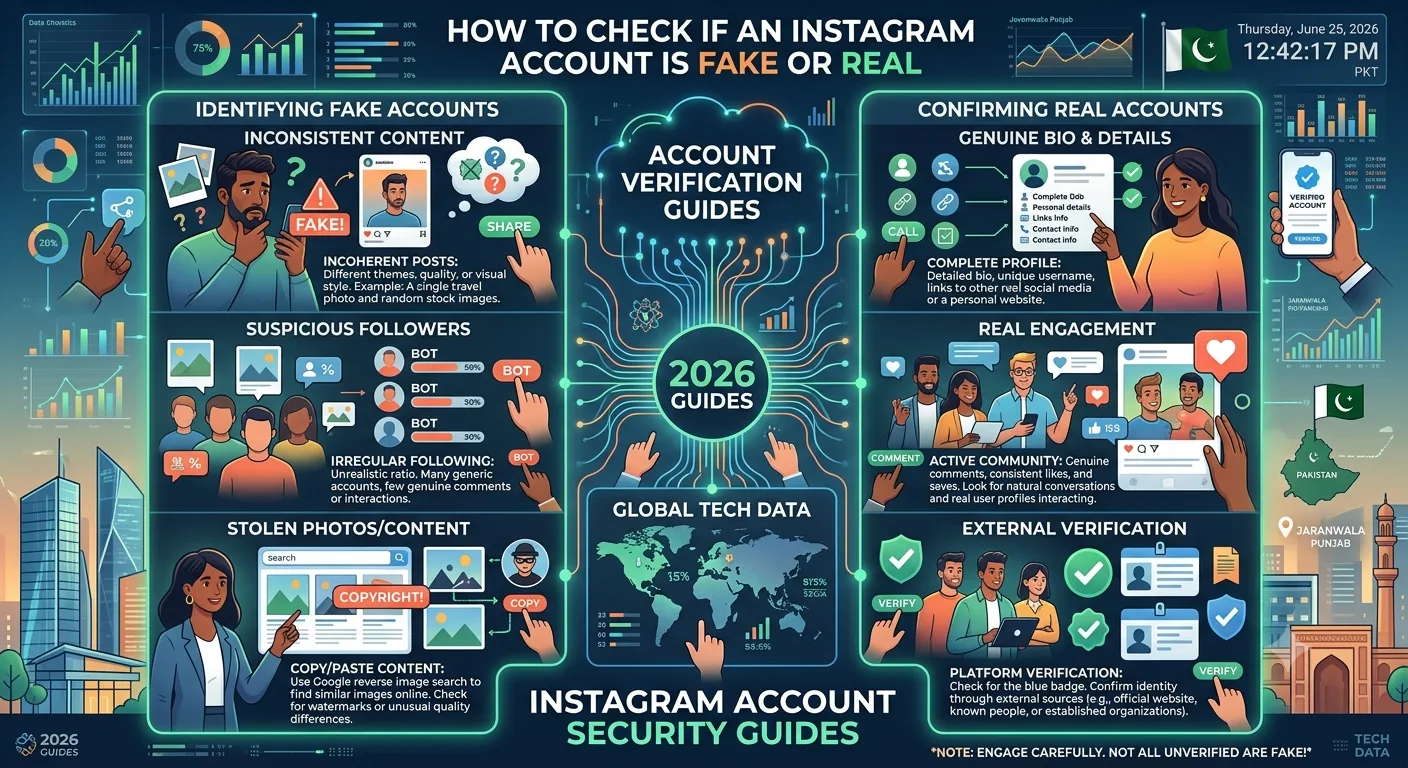
A genuine account almost always has a complete profile. This means a profile picture, a bio with at least some content, and a posting history that makes sense for the account's stated identity.
Incomplete profiles, specifically those with no profile picture, a generic username made up of random letters and numbers, no bio, or very few posts relative to account age, are a baseline signal worth noting. Not every incomplete profile is fake, but most fake accounts are incomplete in one or more of these ways.
Signal 2: Follower to Following Ratio
As touched on throughout this series, the ratio between an account's followers and the accounts it follows carries meaningful information about how that account built its audience.
An account following 8,000 accounts while having 9,000 followers has clearly built most of its following through follow back mechanics rather than through content that people chose to follow organically. This is not necessarily fake, but it does indicate an audience built through artificial social pressure rather than genuine interest.
An account with 50,000 followers following only 300 accounts has built its following through content merit. This ratio is consistent with organic audience building.
Very high following counts combined with very low follower counts, such as following 15,000 accounts while having only 200 followers, is a strong signal of a bot or follow for follow account that has not yet gained traction or that Instagram has already started limiting.
Signal 3: Engagement Rate Relative to Follower Count
This is one of the strongest signals available for detecting purchased followers specifically.
As covered extensively throughout this series, engagement rate should generally fall within predictable ranges based on account size. Accounts with 10,000 to 50,000 followers typically show engagement rates of 2 to 5 percent for genuinely organic accounts.
An account with 80,000 followers generating an average of 50 likes and 3 comments per post has an engagement rate well below 0.1 percent. This is almost impossible to achieve organically without a massive bot follower problem. Real followers, even passive ones, generate more engagement than this simply through normal Instagram browsing behavior.
Using InstaPV's analytics, you can check engagement rate trends for any public account quickly. A very low engagement rate relative to follower count is one of the most reliable indicators that a significant portion of the following is fake.
Signal 4: Comment Quality
Engagement rate tells you how much interaction an account generates. Comment quality tells you whether that interaction is genuine.
Spend a few minutes reading through comments on recent posts. Genuine comments reference the specific content of the post, ask relevant questions, share personal reactions, or contribute to a real conversation. They are written in natural language specific to the context.
Fake or purchased comments tend to share specific characteristics. They are generic, such as "great post" or "amazing content" without any reference to what the post actually contains. They are very short, often a single word or an emoji repeated across multiple posts. They appear in clusters, with several similarly generic comments posted within seconds of each other. They come from accounts that are themselves incomplete or suspicious looking.
The presence of some generic comments is normal for any account. Comment sections dominated by generic, non specific responses relative to the total comment count is a meaningful signal.
Signal 5: Follower Growth Pattern
As covered in Day 5's influencer tracking guide, the shape of a follower growth curve carries specific information about how an audience was built.
Organic follower growth produces a relatively smooth upward curve, with occasional spikes corresponding to viral content, collaborations, or press coverage that can be identified by reviewing the account's content around those dates.
Purchased follower growth produces a distinctively different pattern. Very sharp, near vertical increases in follower count over one or two days without any corresponding viral content or identifiable event are the classic signature of a purchased followers campaign. These spikes are particularly visible when reviewing growth charts through InstaPV's analytics dashboard.
Some accounts show a pattern of spikes followed by drops, where follower counts increase sharply and then decline as Instagram periodically removes fake or inactive accounts. This sawtooth pattern is another strong indicator of ongoing follower purchasing behavior.
Signal 6: Post Consistency and Content Authenticity
Genuine accounts generally show content consistency that reflects a real person or real brand operating over time. The content makes sense as a coherent body of work from a specific perspective or identity.
Fake accounts often show content inconsistency in telling ways. Very old posts followed by a sudden burst of recent activity after a long gap suggests an account that was dormant and has recently been activated for a specific purpose. Content that is completely generic, featuring stock images, unattributed quotes, or obvious low effort posts, suggests an account created to look active rather than to genuinely communicate anything.
Accounts that repost large volumes of other people's content without any original content mixed in are not necessarily fake but are often not the genuine creators they may be presenting themselves as.
Signal 7: Username and Display Name Patterns
Bot accounts and fake accounts are often created in batches by automated systems, and this origin sometimes shows in username patterns. Usernames containing long strings of random numbers, usernames that combine a common name with an unusual number sequence, or usernames that follow an obvious template pattern such as firstname.lastname followed by a four digit number are more common among fake accounts than genuine ones.
This is a weak signal on its own since many genuine users also have number containing usernames, but in combination with other signals it adds to the overall picture.
Signal 8: Story and Highlights Activity
Real accounts with genuine followers almost always have some level of story activity, particularly if they are large enough to be worth evaluating for partnership purposes. A large account with no Stories history and empty or absent Highlights is unusual for a genuinely active creator or business.
Using InstaPV to check whether a public account has any active stories or Highlights gives you a quick additional data point. An account with tens of thousands of followers and no story content worth preserving in Highlights is not typical of a genuinely active Instagram presence.
Putting the Signals Together: A Scoring Approach
No single signal proves an account is fake or real. The most reliable approach combines multiple signals into an overall assessment.
A simple scoring approach assigns a concern level to each signal and combines them. An account that scores no concerns across all signals is almost certainly genuine. An account that shows two or three moderate concerns warrants closer scrutiny. An account that shows multiple strong signals, particularly very low engagement rate combined with a suspicious growth spike and poor comment quality, has almost certainly used artificial growth tactics at some point.
The most important signals in order of reliability are engagement rate relative to follower count, follower growth pattern, and comment quality. Profile completeness and follower to following ratio are supporting signals that add confidence to conclusions drawn from the primary indicators.
Using InstaPV for Fake Account Detection
InstaPV's analytics dashboard provides the two most important data points for fake account detection, follower growth trends and engagement rate over time, for any public Instagram account without requiring any login.
The follower growth chart makes purchase spikes visually obvious, since the near vertical increases that characterize purchased followers stand out clearly against the smoother curves of organic growth. The engagement rate trend shows whether the account's interaction levels are consistent with its follower count or suggest a significant fake follower problem.
Combining this analytics data with a manual review of comment quality and profile completeness gives you a comprehensive assessment of any public account in under ten minutes.
-
How to Build a Personal Brand on Instagram from Scratch
-
The Best Instagram Reels Strategy for 2026 (Data-Backed)
-
Instagram Audience Demographics: How to Understand Your Followers
Frequently Asked Questions
Q: Can an account have some fake followers without being a fake account itself?
Yes. Many otherwise genuine accounts have some portion of fake followers, either from purchased growth earlier in their history or from bot accounts that follow large numbers of accounts automatically. The question for evaluation purposes is what proportion of the following appears to be fake rather than whether any fake followers exist at all.
Q: Does Instagram remove fake followers automatically?
Instagram periodically removes accounts it identifies as fake or inactive and has run several large scale purges of bot accounts over the years. These purges sometimes produce visible drops in follower counts for accounts with significant fake follower proportions.
Q: Can an influencer have a genuine, engaged audience alongside a history of purchased followers?
Yes, though the engagement rate will typically show the impact of the fake followers since they dilute the ratio even when the real followers are genuinely engaged. An influencer who purchased followers in the past but has since grown a real audience will often show an engagement rate lower than expected for the quality of their genuine following.
Q: Are there any tools that give a precise percentage of fake followers for an account?
Some platforms offer follower quality analysis that estimates the proportion of genuine versus fake followers using multiple signals. These estimates are approximations rather than precise measurements since the distinction between a fake follower, a dormant real follower, and an inactive bot is not always clear cut.
Q: Is it possible for an account to look fake but actually be genuine?
Yes. New accounts that have not yet built much content or engagement history can appear incomplete in ways that superficially resemble fake account signals. Context matters. A brand new account with low engagement and few posts may simply be new rather than fake. Apply the full set of signals rather than drawing conclusions from any single indicator.
Conclusion
Identifying fake Instagram accounts is a combination of pattern recognition across multiple signals rather than any single definitive test. Engagement rate relative to follower count and follower growth pattern are the strongest signals and should anchor any assessment. Comment quality, profile completeness, following ratio, and content consistency add supporting evidence that builds toward a reliable overall conclusion.
The process takes less than ten minutes per account using InstaPV for the analytics data combined with a brief manual review of comments and profile content. For anyone making partnership decisions, hiring decisions, or simply trying to assess whether an account is worth engaging with, this ten minute process pays for itself many times over in avoided poor decisions.
Check follower growth and engagement trends for any public account on InstaPV →