Introduction
Creating content without knowing who you are creating it for is one of the most common reasons Instagram strategies underperform. You might be producing genuinely good content, but if it is designed for a 25 year old professional in a major city and your actual audience is predominantly 45 year olds in smaller regional markets, the disconnect between content and audience will show up in your engagement data whether you recognize the cause or not.
Audience demographics are the data that closes this gap. They tell you who is actually following and engaging with your account rather than who you assumed would. That information changes everything from the tone and topics of your content to the products you promote and the partnerships you pursue.
This guide covers what demographic data Instagram provides, how to interpret each element, what to do when your actual audience differs from your intended one, and how demographic research extends to accounts you do not own.
What Demographic Data Instagram Provides
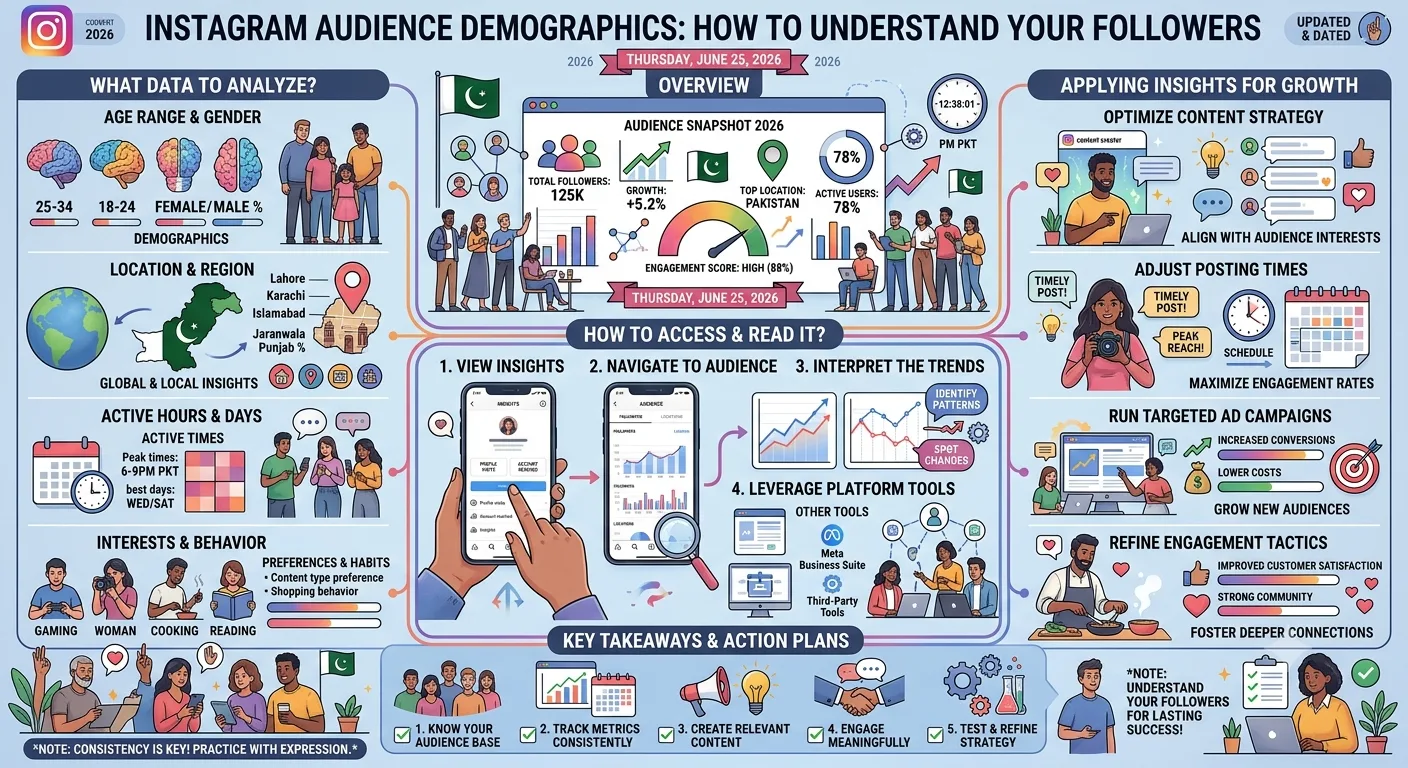
Instagram Insights provides demographic data for business and creator accounts covering three primary dimensions.
Age and Gender
Instagram shows a breakdown of your followers by age range and gender. Age ranges are typically presented in brackets such as 18 to 24, 25 to 34, 35 to 44, 45 to 54, 55 to 64, and 65 plus. Gender is presented as a percentage split.
This data is derived from information users provide when creating their accounts and from behavioral signals that Instagram uses to infer demographic characteristics when explicit information is not provided.
Geographic Location
Instagram shows your top follower locations by country and by city. The country breakdown is useful for understanding whether your audience is primarily local, national, or international. The city breakdown is particularly useful for local businesses and location specific brands that want to understand whether their Instagram audience is actually located in their service area.Instapv
Active Hours and Days
As covered in Day 5's posting time guide, Instagram also shows when your followers are most active by hour and day of week. While not a demographic in the traditional sense, this activity data is closely related to demographic information since different age groups, professions, and geographic locations produce distinctive activity patterns.
How to Read Your Age and Gender Breakdown
The first step in reading your demographic data is comparing it against your intended audience profile.
If you have a documented target customer, write down the age range and gender split you designed your content for. Then compare this against what Instagram Insights actually shows.
A close match between intended and actual demographics means your content is reaching the audience you designed it for. A significant mismatch means one of two things: either your content is reaching the wrong audience, or your intended audience definition needs to be revised based on who is actually responding to what you create.
Neither outcome is inherently bad. Some of the most successful Instagram accounts discovered their real audience through data and adjusted their strategy to serve that real audience better rather than forcing content toward an initially assumed audience that turned out not to be the primary responder.
How to Read Your Geographic Data
Geographic data interpretation depends heavily on what your business or account is trying to accomplish.
For local businesses, the city breakdown is the most critical piece of demographic data available. If a significant proportion of your followers are not in your service area, this raises an important strategic question. Either your content is reaching the wrong geographic market, or your content has appeal beyond your local area that could be redirected toward local audiences through more targeted approach.
For national or global brands, the country breakdown shows where audience concentration lies and whether it reflects your strategic priorities. A brand targeting the United States market but finding that 40 percent of its Instagram audience is in another country has a distribution question worth addressing.
For content creators with no geographic constraint on their audience, the location data primarily informs time zone considerations for posting schedule optimization and can reveal unexpected geographic concentrations that suggest content resonance in specific markets.
The Engaged Audience vs the Total Follower Audience
One of the most important and frequently overlooked distinctions in demographic analysis is the difference between your total follower demographics and your engaged audience demographics.
Instagram Insights provides demographic data for both your total followers and for the accounts that have interacted with your content during a specific period. These two datasets are often different, sometimes significantly so.
Your total follower demographics reflect everyone who has ever chosen to follow you, including people who followed years ago, people who followed for a specific post and have since lost interest, and people whose interests have shifted since they followed.
Your engaged audience demographics reflect who is actually paying attention and responding to your content right now. This is the more actionable dataset for current content planning purposes since it shows who your content is actually reaching and resonating with in the present rather than who accumulated in your follower count over time.
If your total followers skew significantly older but your engaged audience skews significantly younger, your content is resonating much more strongly with the younger segment. This is important directional information for content decisions.
What a Demographic Mismatch Means
Finding a gap between your intended audience and your actual demographic data is common. Here is how to think about the most typical mismatches.
Age Skew
If your account skews significantly older or younger than intended, review your content through the lens of age relevance. Content that uses references, humor styles, or formats strongly associated with a specific generation will naturally attract that generation more than others. Adjusting the cultural references, communication style, and format mix can shift the age composition of your engaged audience over time.
Gender Imbalance
A significant gender imbalance that does not match your intended positioning often reflects visual and tonal choices as much as topic choices. Certain visual aesthetics, communication styles, and content formats reliably skew toward specific gender audiences on Instagram. Understanding which elements of your current content are driving the imbalance allows for more targeted adjustments.
Geographic Concentration
Unexpected geographic concentrations often reflect where you have the strongest resonance or where organic discovery has happened to occur. For local businesses this is a real strategic concern. For content creators and national brands it is primarily informative rather than problematic.
Using Demographic Data to Inform Content Decisions
Once you understand your actual audience demographics, here is how to translate that understanding into specific content decisions.
Topic Selection
Different demographic segments have different primary concerns, interests, and information needs. Understanding that your audience skews toward a specific age group or geographic area should directly inform which topics you prioritize. A financial education account with a primarily 35 to 45 audience should be creating different content than one with a primarily 22 to 28 audience even if the general topic is the same, since the financial priorities and concerns of these age groups differ substantially.
Tone and Communication Style
Demographic data informs not just what you talk about but how you talk about it. Age group, geographic culture, and platform behavior patterns all influence what communication styles feel natural and resonant versus formal or out of touch.
Partnership and Collaboration Choices
Your demographic data directly informs which influencer partnerships and brand collaborations make sense. Partnering with an account whose audience demographics closely match yours creates genuine alignment. Partnering with an account whose audience is significantly different from yours may serve a strategic expansion goal but requires acknowledging that the partnership is about reaching a new audience segment rather than serving your existing one.
Demographic Research for Accounts You Do Not Own
The demographic data discussed above is only directly available to account owners through Instagram Insights. You cannot see the exact demographic breakdown of a competitor's followers or an influencer's audience through any legitimate third party tool.
However, you can make reasonable demographic inferences from publicly available information when combined with careful observation.
Content analysis provides demographic signals. The topics, references, communication style, and visual aesthetic of an account's content reflect the audience it was designed for and is attracting.
Comment analysis provides additional demographic signals. Reading through comment sections reveals how followers communicate, what they care about, and what their relationship with the account's content appears to be, all of which carry demographic implications.
Geographic signals appear in content through location tags, regional references, currency mentions, and cultural context. These allow reasonable inferences about geographic concentration even without access to exact data.
InstaPV's analytics provide engagement rate and growth trend data that, when combined with content and comment analysis, allows a reasonably complete picture of an account's audience character even without access to the specific demographic numbers in their Insights dashboard.
Tracking Demographic Shifts Over Time
Your audience demographics are not static. They change as your content evolves, as your account grows, and as the Instagram user base itself shifts demographically over time.
Reviewing your demographic data quarterly allows you to track these shifts and adjust strategy when significant changes occur. An account that was reaching a 25 to 34 primary audience six months ago may find its audience composition has shifted if its content strategy changed or if a specific viral post brought in a different demographic in large numbers.
This periodic review prevents the gradual drift that happens when content strategy is locked in for a specific audience profile that no longer accurately reflects who the account is actually reaching.
Frequently Asked Questions
Q: Can I see the exact demographic breakdown of my competitors' audiences?
No. Audience demographic data is private to each account owner and is not accessible through any third party tool. You can make informed inferences from public signals but cannot access precise figures for accounts you do not own.
Q: How accurate is Instagram's demographic data?
Instagram's demographic data is derived from a combination of user provided information and behavioral inference. It is accurate enough for strategic decision making but should be treated as a strong approximation rather than a precise census of your audience.
Q: What should I do if my demographic data shows my audience is very different from my intended target?
Assess whether the mismatch represents an opportunity or a problem. If your actual audience is clearly valuable and engaged, consider whether to adjust your content strategy to serve them better. If the mismatch means you are not reaching the audience most relevant to your business goals, investigate which content and distribution changes are most likely to shift the composition toward your intended audience.
Q: Does Instagram show demographic data for Story viewers specifically?
Yes. Instagram Insights provides some demographic information for Story viewers alongside the overall account demographic data, allowing you to compare who is watching your Stories against your overall follower composition.
Q: How does knowing my audience demographics help with Instagram growth?
Understanding your actual audience allows you to create more precisely targeted content that resonates more strongly with the people already following you, which improves engagement rate, which as covered throughout this series improves algorithmic distribution, which drives growth. Demographic clarity also improves the quality of partnership and collaboration decisions, which are another primary growth driver.
-
How to Check If an Instagram Account Is Fake or Real
-
The Best Instagram Reels Strategy for 2026 (Data-Backed)
-
How to Build a Personal Brand on Instagram from Scratch
Conclusion
Audience demographic data is one of the most directly actionable pieces of information available to any Instagram account owner. It tells you who is actually paying attention rather than who you assumed would, and it informs content decisions at every level from topic selection to tone to partnership choices.
The most effective Instagram strategies are built around serving a real, understood audience rather than an assumed one. Demographic data is what makes the real audience visible.
Research audience signals for public accounts in your niche on InstaPV →