Introduction
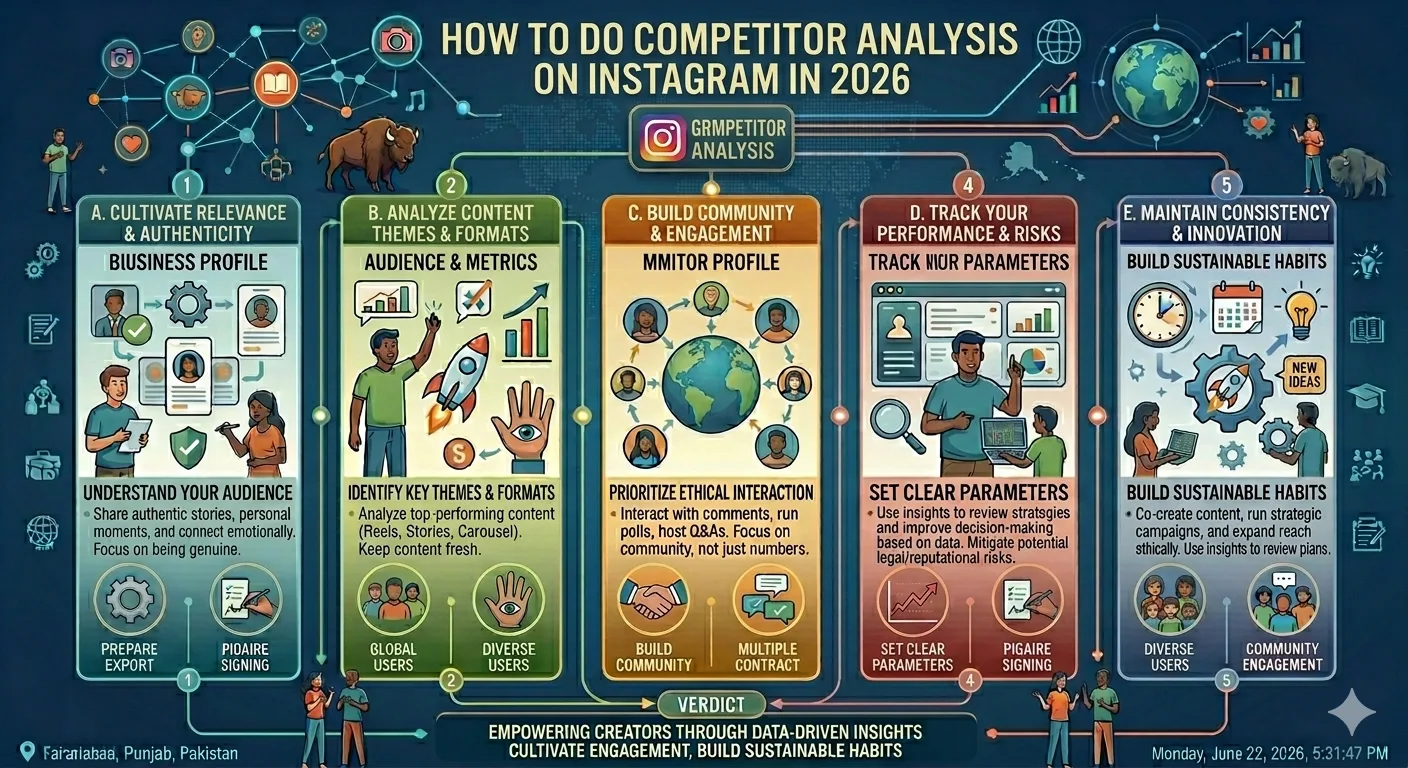
Competitor analysis on Instagram is often done casually. Someone scrolls through a competitor's feed, forms a general impression, and moves on without ever turning that impression into anything actionable. The brands that get real value from competitor analysis treat it differently. They follow a structured process, track specific data points consistently, and translate findings into concrete strategy decisions.
This guide lays out a complete, repeatable framework for Instagram competitor analysis in 2026. It builds on ideas covered earlier in this series, including the anonymous research methods from Day 4 and the tracking systems from Day 8, but brings everything together into a single structured process you can apply directly.
Step 1: Define Your Competitor Set
Before analyzing anything, identify who actually counts as a competitor for your specific purposes. This is not always as obvious as it seems.
Direct competitors offer the same product or service to the same audience. Indirect competitors solve the same underlying problem through a different approach. Aspirational competitors are larger or more established brands in your space whose strategy you want to study even if you do not compete with them directly at your current size.
For most competitor analysis purposes, focusing on three to five direct competitors plus one or two aspirational accounts gives you enough comparative data without becoming overwhelming.instapv
Step 2: Establish Your Tracking System
Using the saved profile approach covered in Day 8, set up a tracking system for your competitor set. Decide on a review cadence, weekly for fast moving industries or monthly for more stable ones, and commit to it consistently.
Step 3: Analyze Content Strategy
For each competitor, review their recent content and categorize it by type. Common categories include product showcases, educational content, behind the scenes content, promotional content, and user generated content.
Calculate the approximate proportion of each category in their recent posting history. This reveals their overall content philosophy and what they prioritize communicating to their audience.
Step 4: Analyze Posting Patterns
Note how often each competitor posts to their feed and how often they post Stories. Look for consistency or irregularity in their schedule. A competitor posting daily is operating under very different resource constraints than one posting twice a week, and this affects how you should interpret their performance relative to your own.
Step 5: Analyze Performance Data
Using InstaPV's analytics, review each competitor's follower growth trend and engagement rate over time. Look for whether growth is accelerating, steady, plateaued, or declining. Compare engagement rate trends against the benchmarks discussed in Day 8's engagement rate guide for their account size.
Step 6: Analyze Visual and Brand Identity
Examine the visual consistency across each competitor's feed. Note their color palette, photography style, and use of templates or recurring formats. Significant shifts in production quality or visual identity over time can signal changes in budget, team, or strategic direction worth understanding.
Step 7: Review Highlights and Permanent Content
As discussed in Day 2's Highlights guide, a competitor's Highlight structure reveals what they consider important enough to make permanently accessible. Review the categories and content within each competitor's Highlights for insight into their priorities and key messaging.
Step 8: Document Promotional and Campaign Patterns
Note how each competitor handles promotions, launches, and sales. Look at their typical lead time before an announcement, whether they use teaser content, and how they structure their calls to action. This is particularly valuable intelligence ahead of your own promotional periods.
Step 9: Build a Comparison Summary
Bring everything together into a single comparison document. For each competitor, record their follower growth trend, engagement rate trend, primary content themes, posting frequency, and any notable strategic patterns observed.
Reviewing all competitors side by side, rather than account by account in isolation, makes it much easier to spot which strategies are shared across your industry and which are unique to a specific competitor.
Step 10: Translate Findings Into Action
Analysis without action is just data collection. For each significant finding, ask a direct question: what does this mean for our own strategy?
If multiple competitors are succeeding with a content format you have not tried, consider testing it in your own voice. If your engagement rate consistently lags behind competitors of similar size, dig into whether the gap is about content quality, posting consistency, or audience alignment. If a competitor's growth recently accelerated, investigate what triggered it and whether a similar approach is relevant to your brand.
Common Mistakes in Competitor Analysis
Treating a single review as sufficient rather than building an ongoing tracking habit is one of the most common mistakes. A snapshot tells you very little compared to a trend observed over multiple review periods.
Copying competitor content directly rather than using analysis to inform original strategy is another common error. As noted in Day 4's competitor research post, research should inform your own approach, not result in direct replication.
Ignoring account size differences when comparing performance is also common. A competitor with twice your follower count will naturally show a different engagement rate, and comparisons need to account for this rather than treating raw numbers as directly comparable.
-
Instagram Hashtag Strategy: What Works in 2026
-
Anonymous Instagram Viewing: Is It Legal and Ethical?
-
How to Export Instagram Data as CSV: A Simple Guide
Frequently Asked Questions
Q: How many competitors should I actively track?
Three to five direct competitors is manageable for most businesses. Tracking too many dilutes the depth of analysis you can give each one.
Q: How often should I conduct a full competitor analysis cycle?
A full review using this framework works well on a monthly basis, supplemented by lighter ongoing tracking of growth and engagement metrics between full reviews.
Q: Can competitors tell I am researching their account?
No. Using InstaPV for this research generates no signal visible to the account owner, consistent with the anonymous research approach covered throughout this series.
Q: What if a competitor's account is private?
Private accounts cannot be analyzed through InstaPV or any legitimate third party tool. Competitor analysis is limited to publicly available accounts.
Conclusion
Effective competitor analysis on Instagram is a structured, repeatable process rather than an occasional casual scroll through a rival's feed. Defining your competitor set, tracking consistently, analyzing content and performance systematically, and translating findings into concrete action turns competitor research into one of the most valuable ongoing activities in any Instagram strategy.