Introduction
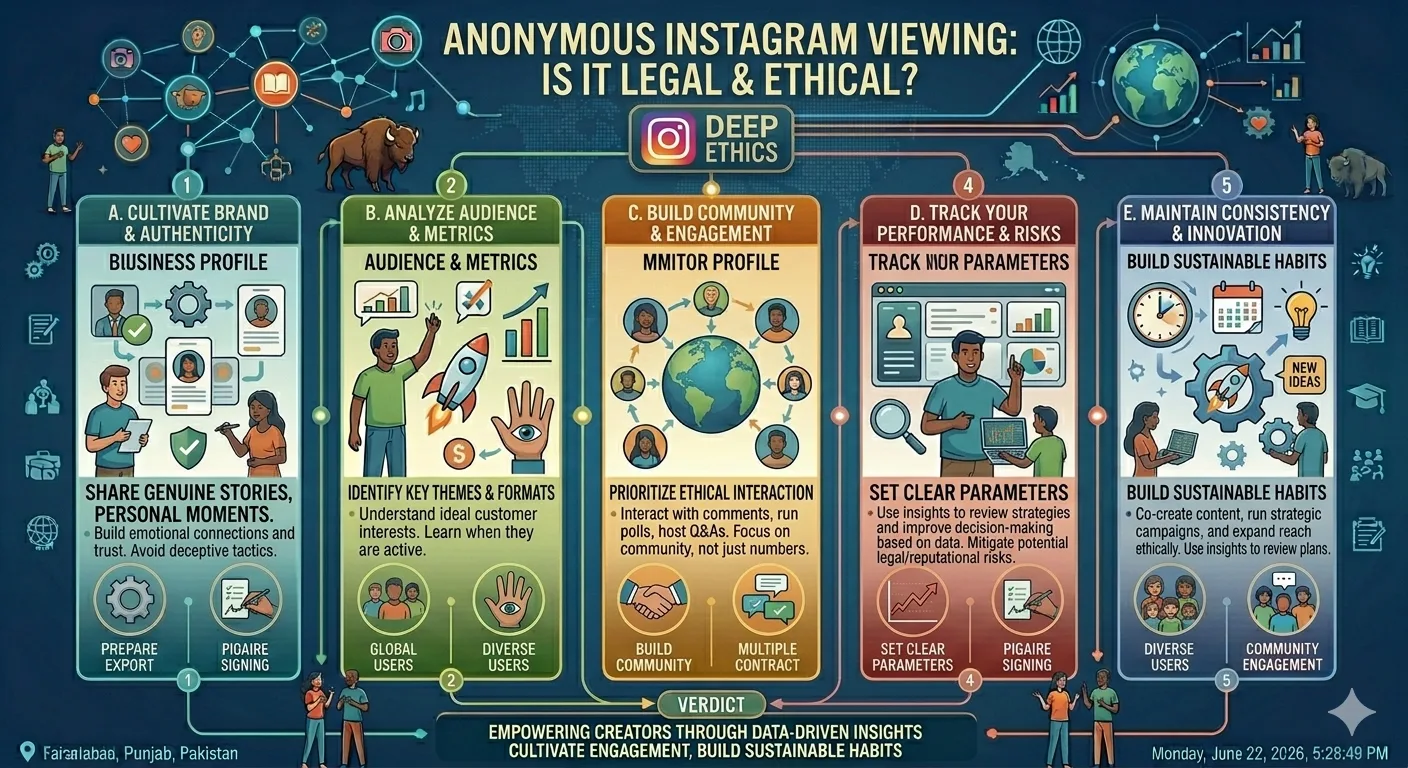
Throughout this series, anonymous viewing has come up repeatedly as a practical tool for research, competitor analysis, and personal privacy. But it is worth addressing the question directly rather than assuming it. Is viewing Instagram content anonymously actually legal? And separate from the legal question, is it ethical?
This post answers both questions clearly, without hedging unnecessarily, while also being honest about where genuine boundaries exist.
The Legal Question
Viewing publicly available content on the internet is legal. This is not a special exception created for Instagram or for any particular tool. It is a general principle that applies across the internet. When a website or platform makes content publicly accessible, viewing that content does not require special permission, regardless of whether you are logged into an account on that platform.
Instagram public accounts are, by the account owner's own choice, set to be visible to anyone, including people without an Instagram account and people who are not logged in. This is the entire basis on which public profiles function. The account owner has made an active decision to share this content with the public.
Tools that access this publicly available content, including InstaPV and similar platforms, are not bypassing any restriction or accessing anything Instagram has not already made publicly available. They are simply presenting that public information through a different interface.
This is fundamentally different from attempting to access private account content, which is restricted at the platform level and would require circumventing an actual access control. No legitimate tool does this, and any tool claiming to unlock private accounts is either non-functional or operating in a way that should be avoided entirely, as discussed in Day 4's profile viewer safety post.
Why Anonymity Itself Is Not the Legal Issue
A common misconception is that anonymity itself is somehow the legally questionable part of this equation. It is not. There is no law requiring that your identity be disclosed to a website or account owner simply because you viewed their public content.
Consider an analogy. Walking past a storefront window and looking at a public display does not require you to identify yourself to the store owner. The same principle applies to viewing public content online. The fact that Instagram's own app happens to display viewer information to story creators is a feature of that specific app, not a legal requirement that applies universally to all methods of viewing public content.
The Ethical Question
Legal and ethical are not the same question, and it is worth addressing ethics separately and honestly.
Using anonymous viewing for legitimate purposes, research, competitor analysis, journalism, personal privacy, or simply curiosity about public content, is broadly understood as ethically unremarkable. People have always been able to observe public information without announcing themselves, long before social media existed.
The ethical line becomes more relevant when anonymous viewing is paired with intent to harm. Using anonymous access to monitor someone obsessively, to gather information for harassment, or to track an individual against their wishes in a way that causes them distress crosses into genuinely concerning territory, regardless of the legal status of the underlying viewing method.
The distinction is not about the tool itself but about the purpose and pattern of use. The same anonymous viewing capability that supports legitimate business research can, in a different context with different intent, support behavior that is harmful. This is true of many tools and is not unique to Instagram viewers specifically.
How This Applies to Common Use Cases
Competitor research, as covered throughout this series, involves viewing public business content for strategic purposes. This is standard, widely accepted business practice with no meaningful ethical concern attached to the anonymity itself.
Influencer evaluation involves reviewing a public professional account before a business decision. This is comparable to researching any potential business partner and carries no ethical concern.
Personal curiosity about a public figure's content, a public profile of someone you know, or general interest browsing falls within the same category as reading a public blog or news article. There is nothing inherently concerning about anonymous browsing in this context.
Monitoring a specific individual's personal account repeatedly and obsessively, particularly someone who has expressed discomfort with being watched or who you have reason to believe does not want this attention, moves into ethically concerning territory regardless of the legality of the underlying access method.
What Responsible Use Looks Like
Throughout this series, the recommended approach has consistently centered on using anonymous viewing tools for their intended legitimate purposes, research, business intelligence, journalism, and general public content browsing, rather than as a tool for targeting specific individuals with unwanted attention.
This is also reflected in how InstaPV and similar tools are designed. They work only with public accounts, provide no mechanism for accessing private content, and generate no notification or tracking mechanism that could be misused to monitor a specific person's private activity, since stories and Highlights from private accounts simply are not accessible through these tools at all.
Frequently Asked Questions
Q: Is it illegal for a business to research competitors anonymously on Instagram?
No. This is standard competitive research practice, comparable to monitoring a competitor's advertising or pricing, and carries no legal concern.
Q: Could using an anonymous viewing tool violate Instagram's terms of service?
Instagram's terms govern the use of Instagram's own platform and account holders' conduct on it. Tools that access publicly available content without logging into Instagram operate independently of Instagram's terms in the same way a search engine indexing public content does. This is a separate legal framework from any individual Instagram user's account terms.
Q: Does anonymous viewing become illegal if done repeatedly over time?
Repeated viewing of public content remains legal regardless of frequency. Legal concerns around repeated monitoring typically arise specifically in stalking or harassment contexts, which involve intent and pattern of harm rather than the act of viewing public content itself.
Q: Is there a difference between viewing anonymously and downloading content anonymously?
Viewing and downloading are related but distinct. As discussed in Day 3's story downloading guide, downloading content for personal research and reference is generally acceptable, while redistributing or commercially using downloaded content without permission raises separate copyright considerations unrelated to the anonymity of how it was accessed.
-
How to Do Competitor Analysis on Instagram in 2026
-
Instagram Hashtag Strategy: What Works in 2026
-
How to Export Instagram Data as CSV: A Simple Guide
Conclusion
Anonymous viewing of public Instagram content is legal, grounded in the same principle that allows anyone to view any publicly available content on the internet without disclosing their identity. The ethical considerations are separate from the legal ones and depend entirely on purpose and pattern of use rather than the act of anonymous viewing itself. Used for research, business intelligence, journalism, or general interest, anonymous viewing is a legitimate and widely practiced activity with no meaningful ethical concern attached.
Browse public Instagram content responsibly and anonymously on InstaPV →