Introduction
Publishing Reels without tracking their performance is like running an experiment without recording the results. You might get something right without knowing what it was, and you might repeat mistakes without realizing you are making them.
Reels analytics are the feedback system that turns content production into a learning process. Each Reel you publish generates data about how the audience responded, where they dropped off, how far the content traveled beyond your existing followers, and whether it drove the outcomes you care about. Reading that data correctly and applying what it tells you to future Reels is what separates accounts whose Reels performance improves over time from those that produce Reels at the same level indefinitely.
This guide covers every metric relevant to Reels performance, how to interpret each one, how they interact with each other, and how to build a Reels analytics review practice that genuinely improves your content over time.
Accessing Reels Analytics
For your own account, Reels analytics are available through Instagram Insights. Accessing them requires a business or creator account.
To see analytics for a specific Reel, open the Reel on your profile and tap the analytics icon or the view count displayed below the Reel. This opens a detailed breakdown of the specific Reel's performance metrics.
For aggregate Reels performance across all your Reels over a time period, the main Insights dashboard provides an overview view that allows comparing across multiple Reels simultaneously.
For researching Reels performance on public accounts you do not own, InstaPV's analytics provide the follower growth and engagement rate data that allows indirect assessment of how a given account's Reels strategy is driving overall account performance, even without direct access to that account's private Reels metrics.
The Primary Reels Metric: Watch Time and Completion Rate
As established in Day 11's Reels strategy guide, watch time and completion rate are the dominant signals in Instagram's Reels algorithm. They deserve the most attention in any Reels analytics review.
What Completion Rate Measures
Completion rate measures what percentage of viewers who started watching your Reel watched it all the way to the end. Instagram calculates this as the number of views that reached the final frame divided by the total number of views, expressed as a percentage.Instapv
A completion rate of 100 percent would mean every person who started watching finished the whole Reel. In practice, completion rates below 100 percent are universal since some viewer drop off occurs in every Reel regardless of quality.
What Counts as a Good Completion Rate
Completion rate benchmarks vary by Reel length since longer Reels naturally have lower completion rates than shorter ones, everything else being equal.
For Reels under 15 seconds, completion rates above 80 percent are achievable with strong content and indicate the Reel is holding attention effectively through to the end. For Reels between 30 and 60 seconds, completion rates above 60 percent represent strong performance. For longer Reels in the 60 to 90 second range, completion rates above 40 to 50 percent indicate the content is sustaining engagement well relative to its length.
These are approximate benchmarks that vary by niche and audience type. The most useful comparison is your own Reels' completion rates against each other rather than against external benchmarks, since this reveals which of your specific content approaches is holding attention most effectively for your specific audience.
Average Watch Time
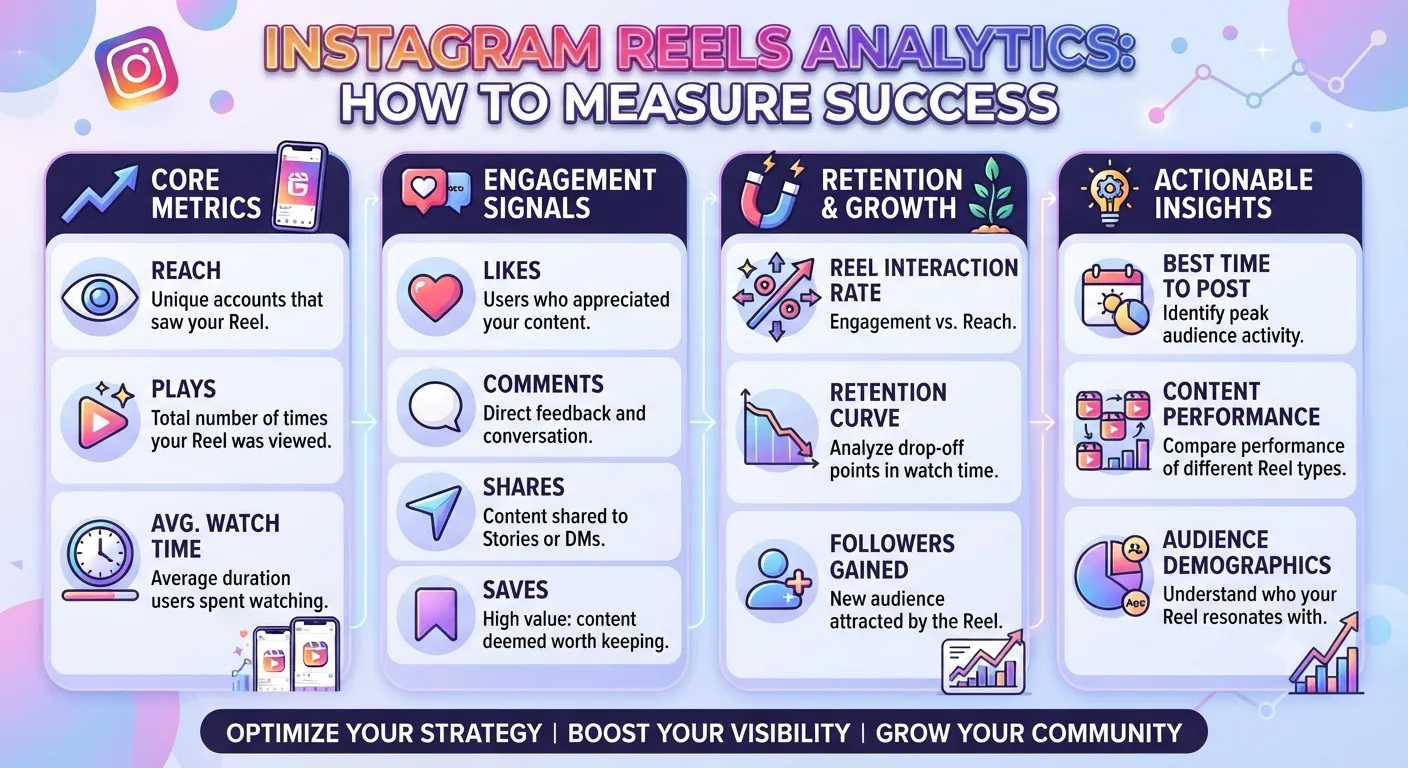
Average watch time shows, in seconds, how long the typical viewer watched before stopping. Combined with completion rate, it reveals roughly where in the Reel viewers are dropping off.
If your Reel is 45 seconds long and average watch time is 8 seconds, viewers are dropping off very early, which points to a hook problem as discussed in Day 11. If average watch time is 35 seconds on a 45 second Reel, viewers are watching most of the content but not quite finishing, which might indicate a strong middle but a weaker conclusion.
Replays
Replay count shows how many times the Reel was rewatched after the first viewing. As covered in Day 11, replay rate is a strong positive algorithmic signal suggesting the content was compelling enough to warrant more than one viewing. Educational content with dense information, visually impressive content worth watching again, and content with a twist or reveal that encourages rewatching tend to generate the highest replay rates.
Reach Metrics: How Far the Reel Traveled
Reach metrics reveal whether the Reel is achieving the primary purpose of the format: reaching audiences beyond your existing followers.
Total Reach
Total reach shows how many unique accounts saw the Reel during the measurement period. This is the unique viewer count rather than total views, which may be higher due to replays.
Reach by Source
Instagram breaks down where the reach came from: the main feed for followers, the Reels tab for non-followers discovering through algorithmic distribution, the Explore page, hashtag pages, direct shares, and the account profile. This breakdown is one of the most strategically useful pieces of Reels analytics data available.
A Reel where the majority of reach is coming from the Reels tab and Explore page is being distributed to non-followers at scale, which is the primary growth function of the format. A Reel where the majority of reach is coming from followers' main feeds is performing well for your existing audience but is not achieving significant non-follower discovery.
Understanding which of your Reels achieve non-follower distribution and which do not, and studying the content differences between these two groups, directly informs your understanding of what content the algorithm rewards with discovery distribution.
Engagement Metrics for Reels
Beyond watch time, several engagement signals contribute to how the algorithm treats a Reel's ongoing distribution.
Likes
Likes on Reels function as a basic positive signal. They are the lowest effort engagement action and carry less algorithmic weight than saves or shares as covered throughout this series, but they contribute to overall engagement rate calculations and provide a quick signal of general audience approval.
Comments
Comments on Reels indicate active audience engagement with the content. For Reels specifically, comments from non-followers discovered through algorithmic distribution are particularly valuable since they signal that the content resonated strongly enough with a new viewer to prompt an active response.
As covered in Day 12's caption guide, the quality of comment engagement matters alongside volume. Substantive, content specific comments indicate deeper engagement than generic responses.
Saves
Saves on Reels indicate that a viewer found the content valuable enough to return to later, as discussed throughout this series. For educational Reels specifically, a strong save rate is a meaningful performance signal that reflects lasting reference value beyond the initial viewing.
Shares
Shares are the strongest engagement signal for Reels, indicating that a viewer was compelled to send the content to a specific person or repost it to their own Story. High share rates directly drive secondary reach through the social graph, extending distribution beyond what the algorithm alone provides.
Profile Actions Driven by Reels
Reels analytics in Instagram Insights include data on actions taken beyond the Reel itself that indicate commercial or growth impact.
Profile Visits From Reels
Profile visits driven by a specific Reel show how many viewers were interested enough in the account behind the Reel to visit the profile. This metric directly measures the conversion from Reel viewer to profile visitor, which is the first step in converting a new viewer into a follower.
A high view count with a very low profile visit rate suggests the content is being watched without creating strong interest in the account behind it. This pattern might indicate content that performs well as entertainment without establishing a clear account identity that makes viewers want to see more.
Follows From Reels
Instagram Insights shows how many accounts followed as a direct result of a specific Reel. This is the most direct growth metric available for Reels and is the clearest measure of a Reel's contribution to follower growth.
Comparing the follows generated per 1,000 views across different Reels reveals which content approaches are most effective at converting viewers into followers, which is the primary commercial purpose of the format for growth focused accounts.
Building a Reels Performance Review Process
Reviewing individual Reels in isolation provides limited insight. A structured review process that looks across multiple Reels identifies the patterns that inform content decisions.
Monthly Reels Review
At the end of each month, review all Reels published during that period and record the key metrics: completion rate, average watch time, total reach, reach by source including Reels tab percentage, saves, shares, profile visits, and follows.
Organize these metrics in a simple spreadsheet with one row per Reel. Include columns for the Reel topic, format approach, length, and posting time alongside the performance metrics.
Pattern Identification
With a month or more of Reels data in one view, look for patterns across the performance metrics.
Which Reels generated the highest Reels tab reach percentage? What did those Reels have in common in terms of topic, hook approach, length, or format?
Which Reels generated the highest follow count per view? What characterized those Reels compared to lower converting ones?
Which Reels had the highest completion rates? Were they shorter, faster paced, or structured differently from lower completion Reels?
Which Reels generated the most shares? What emotional or informational trigger appeared to drive sharing behavior?
Applying Findings to Future Content
The patterns identified in the monthly review should directly influence the next month's Reel planning. If Reels with specific hooks consistently achieve higher Reels tab reach, plan more Reels opening with that hook structure. If Reels on a specific topic consistently generate more follows per view, plan more content in that topic area.
This pattern to planning to performance feedback loop is the core mechanism through which Reels analytics translate into progressively better Reels performance over time.
Diagnosing Common Reels Performance Problems
Specific metric patterns indicate specific performance problems that have specific solutions.
High Views, Low Completion Rate
The Reel is being started but not finished. As covered in Day 11's Reels strategy guide, this almost always indicates either a hook that overpromises relative to what the content delivers, or pacing problems in the middle of the Reel where the content loses momentum. Review the Reel critically for moments where the content could be tightened or where the promise made in the hook is delayed unnecessarily.
High Completion Rate, Low Reach
The existing audience is engaging well with the Reel but it is not being distributed to non-followers. This pattern suggests the content is strong for retention but lacks the initial signal strength from a new audience to trigger algorithmic non-follower distribution. Consider whether the hook is compelling enough to a completely cold audience who has no prior context about the account, since the algorithm makes distribution decisions partly based on how non-follower test viewers respond.
High Reach, Low Profile Visits and Follows
The Reel is reaching many people but not converting them into interest in the account. This often indicates content that works as standalone entertainment without clearly establishing what the account is about or why someone who enjoyed the Reel would want to see more. Review whether the Reel communicates the account's positioning as part of its content, not through a sales pitch but through the framing, expertise, and perspective expressed.
Low Saves Despite High Views
The content is being watched but not saved. For educational content specifically, low save rates relative to view counts suggest the content may be interesting in the moment but is not being perceived as reference worthy. Consider whether the educational content could be restructured to be more clearly actionable and preservable in a way that makes saving feel like a practical action rather than an optional one.
Comparing Reels Performance Against Organic Growth
The ultimate measure of Reels effectiveness for growth focused accounts is whether consistent Reel publishing is driving follower growth at a meaningful rate.
Track follower growth rate on a monthly basis alongside Reels publishing activity. Months where Reel production and quality are high should show corresponding follower growth acceleration. Gaps in Reel production or periods of lower quality Reels should show slower growth rates.
This correlation between Reels activity and follower growth is the clearest validation that the format is functioning as a growth driver for the specific account, and the absence of this correlation is a clear signal that the Reels strategy needs reassessment.
-
How to Find and Follow Trending Topics on Instagram in 2026
-
How to Analyze an Influencers Audience Before Partnering
-
What Is a Public Instagram Profile? Everything You Should Know
Frequently Asked Questions
Q: How many Reels do I need to publish before analytics patterns become meaningful?
A minimum of 15 to 20 Reels provides enough data to identify reliable patterns, since individual Reel performance varies significantly due to factors including posting time, topical timing, and natural variation in algorithmic distribution. Drawing conclusions from fewer Reels risks overweighting the performance of individual outliers rather than identifying genuine patterns.
Q: Should I delete Reels that performed poorly?
Deleting underperforming Reels removes them as learning data and has no meaningful benefit for the account's algorithmic standing. Keeping them and understanding what drove the underperformance is more valuable than removing them from the record.
Q: How do I know if my Reels are reaching the right audience rather than just large numbers of people?
Profile visit rate and follow rate per view are the clearest signals of audience relevance. Reels reaching large numbers of people who have no interest in the account will show low profile visit and follow rates. Reels reaching genuinely relevant new audiences will convert a meaningful percentage of viewers to profile visitors and followers.
Q: Can I see Reels analytics for competitor accounts?
The specific Reels metrics described in this guide are available only through Instagram Insights for owned accounts. For competitor research, InstaPV provides follower growth trends and engagement rate data that allows indirect assessment of how a competitor's overall Reels strategy is affecting their account performance, without direct access to their private Reels analytics.
Conclusion
Reels analytics are the feedback system that makes Reel production progressively more effective over time. Watch time and completion rate reveal whether content is holding attention. Reach by source reveals whether the algorithm is distributing content to non-followers. Engagement metrics reveal how the audience is responding. Profile visits and follows measure how effectively the content is converting viewers into account growth.
Building a monthly review practice that identifies patterns across these metrics and applies findings directly to future content planning transforms Reels production from intuition driven content creation into a systematically improving evidence based process.
Research Reels performance patterns for top accounts in your niche on InstaPV →