Introduction
The most expensive mistake in influencer marketing is not overpaying for a partnership. It is paying any amount for a partnership with an influencer whose audience is not actually your target customer.
An influencer can have impressive follower counts, strong engagement rates, and genuinely compelling content, and still be the wrong partner for a specific brand if their audience demographics, interests, geographic distribution, or purchase behavior do not align with what the brand is trying to achieve. Discovering this misalignment after the campaign has run and the budget has been spent is a frustrating and avoidable outcome.
Thorough audience analysis before a partnership commitment is the practice that prevents this outcome. This guide covers exactly what to look for in an influencer's audience, how to access and interpret the available information, and how to make partnership decisions that are grounded in audience reality rather than surface level impressions.Instapv
Why Audience Analysis Is Separate From Influencer Analysis
Throughout this series, particularly in Day 7's influencer research walkthrough and Day 5's influencer tracking guide, the focus has been on analyzing the influencer's own account metrics: follower growth trends, engagement rates, content quality, and posting consistency.
Audience analysis is a distinct but complementary process. It looks not at the influencer's performance but at who is actually in the audience that performance has attracted. An influencer can be growing rapidly and generating strong engagement from an audience that bears no demographic resemblance to your target customer. Without audience analysis, this misalignment is invisible until after the campaign fails to perform.
The combination of influencer performance analysis, covered in Day 7, and audience analysis, covered in this guide, gives you a complete picture of both the vehicle and the passengers before deciding whether to invest in reaching that audience through that influencer.Read blog
The Audience Data You Need
Before getting into how to access audience data, it is worth being specific about what you are trying to learn.
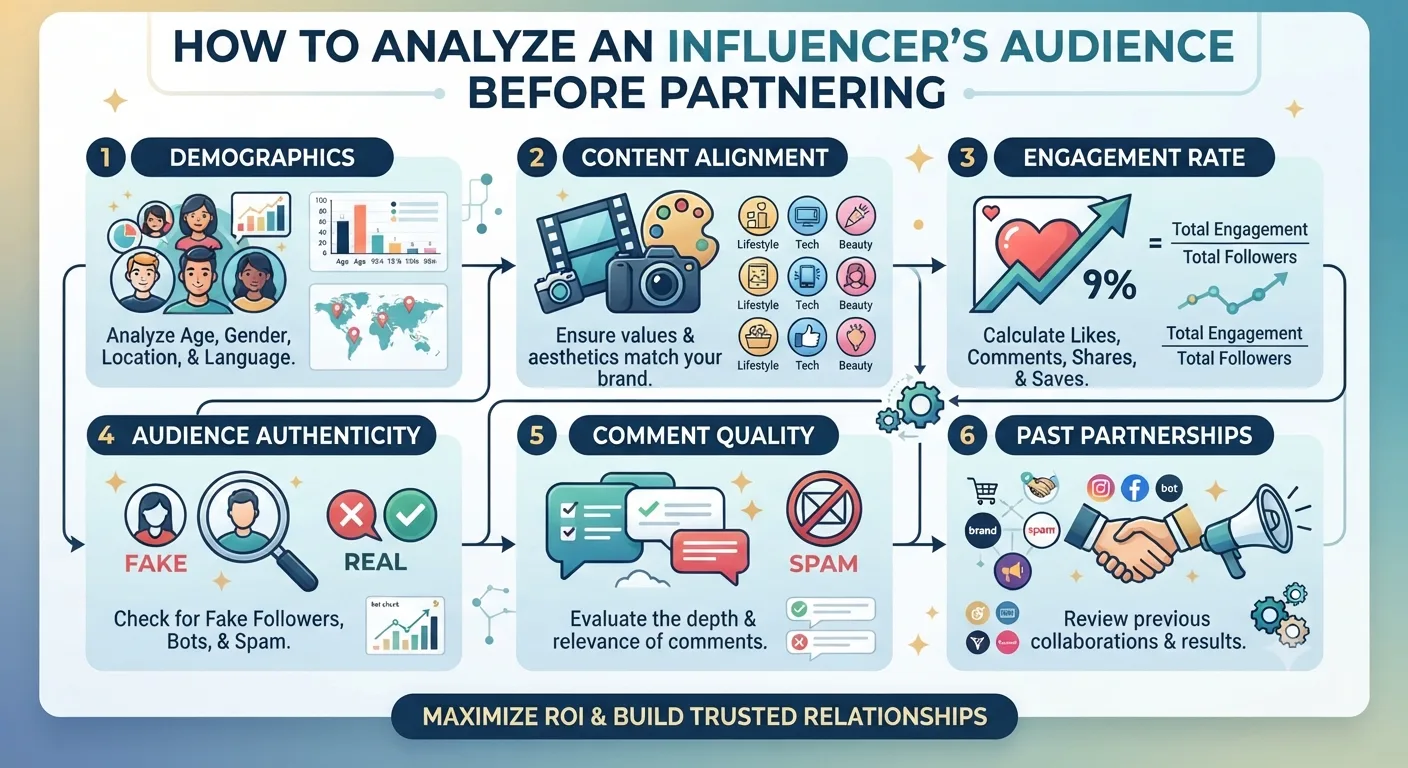
Geographic Distribution
Where is the audience actually located? This is critical for any brand with geographic constraints on its market. A local service business partnering with an influencer whose audience is 80 percent in a different country is reaching people who cannot become customers regardless of how compelling the content is. Even for national brands, audience geography matters if the campaign has regional objectives or if the brand's product availability is limited to specific markets.
Age and Gender Demographics
Does the audience age and gender breakdown match the brand's target customer profile? As covered in Day 11's demographics guide, the actual audience demographics of an Instagram account often differ from what the content superficially suggests. An influencer creating content that appears to target young professionals may actually have accumulated an audience that skews significantly older or younger based on how they have been discovered and shared across the platform.
Audience Interests and Affinities
Beyond demographic characteristics, what else does the influencer's audience care about? Audience interest data reveals whether the audience is likely to have genuine interest in your product category based on what they engage with beyond this influencer's content. An influencer in the fitness space whose audience shows strong affinity for nutrition, wellness products, and active lifestyle content has an audience with high commercial relevance for a supplement brand. An influencer with comparable metrics but an audience whose primary affinities are entertainment and gaming has a much lower likelihood of genuine interest in the same product.
Audience Authenticity
What proportion of the audience appears to be genuine, active human beings rather than bots, inactive accounts, or purchased followers? As covered in Day 11's fake account detection guide, the signals for inflated follower quality are detectable and should be reviewed before any partnership commitment.
Engagement Quality
What is the character of engagement the audience generates? As covered in Day 12's caption guide and Day 11's fake account guide, the difference between substantive, content specific engagement and generic low effort engagement is a meaningful indicator of genuine audience investment.
How to Access Influencer Audience Data
Audience data for influencer accounts comes from two primary sources: information the influencer can share from their own Instagram Insights, and publicly available signals that can be analyzed without direct data access.
Data the Influencer Can Share
Instagram Insights provides account owners with demographic data about their followers including age range distribution, gender split, and top geographic locations by country and city. An influencer who is genuinely interested in a mutually beneficial partnership should be willing to share a screenshot or export of their audience demographic data for the relevant date range.
This direct data access is the most accurate source for demographic information and should be requested for any partnership involving significant investment. An influencer who refuses to share basic demographic insights should prompt questions about why, since this information is readily available to them and sharing it involves no significant risk or effort on their part.
Publicly Available Signals
When direct data access is not available or needs supplementary verification, several publicly available signals allow reasonable audience inference.
Content and comment analysis, as described in earlier sections of this guide, provides qualitative audience insight. The language, cultural references, and personal context in comment sections reveal significant information about who the audience is.
Geographic signals embedded in content, including location tags, regional references, and cultural context specific to particular markets, allow geographic audience inference.
Engagement pattern analysis available through InstaPV's analytics, combined with content review, gives the most complete picture of publicly available audience quality signals.
Reading Comment Sections for Audience Intelligence
Comment sections are one of the richest publicly available sources of audience intelligence and deserve systematic analysis rather than casual scanning.
Language and Vocabulary
The vocabulary, writing style, and language used in comments carries significant demographic information. Professional terminology versus casual language, formal versus informal tone, and specific cultural references all provide signals about the audience's age range, educational background, and professional context.
Topics and Personal Contexts Mentioned
When commenters share their own context in relation to the content, they reveal significant audience intelligence. Comments referencing personal situations, professional roles, family situations, or life stages give direct demographic signals that aggregate into a meaningful audience picture across a sufficient sample of comments.
Geographic Indicators
Comments referencing local places, using specific national expressions, or written in languages other than the apparent primary language of the account reveal geographic audience distribution signals that complement any direct data the influencer provides.
Interaction Patterns With the Influencer
How the audience interacts with the influencer, whether they address them personally, reference specific past content, or treat them as a trusted advisor versus a distant entertainer, reveals the depth and nature of the audience relationship that determines how receptive the audience is likely to be to the influencer's recommendations.
Using InstaPV for Audience Quality Analysis
While InstaPV does not provide access to private demographic data from an influencer's Insights dashboard, it provides the publicly available analytics that support a complete audience quality assessment.
Follower Growth Pattern Analysis
As covered in Day 5's influencer tracking guide and Day 7's influencer research walkthrough, the shape of the follower growth curve reveals whether the audience was built organically through content merit or artificially through purchased growth. This matters for audience analysis because purchased followers represent an audience of zero: people who will never engage with content, never see sponsored posts, and never convert into customers.
Engagement Rate Relative to Follower Count
As covered throughout this series, engagement rate calibrated against account size reveals whether the audience is genuinely active. A meaningful gap between expected and actual engagement rate for an account's size is the clearest quantitative signal of an inflated audience with poor genuine engagement.
Posting Frequency and Content Consistency
An account with highly inconsistent posting history may have accumulated a disengaged audience that followed during more active periods and has since lost interest. Audience recency matters for partnership value, and a current, actively engaged audience is more commercially valuable than a historically accumulated audience that has drifted into passivity.
Audience Alignment Scoring
A practical tool for comparing multiple influencer candidates against audience alignment criteria is a simple scoring framework that assesses each dimension of audience fit.
For each candidate, assess the following dimensions and assign a rating from one to five.
Geographic alignment: How well does the estimated or reported geographic distribution of the audience match the brand's target market?
Demographic alignment: How closely does the audience age and gender breakdown match the brand's target customer profile?
Interest alignment: How strong is the apparent affinity between the audience's demonstrated interests and the brand's product category?
Audience authenticity: How clean does the follower base appear based on engagement rate analysis and growth pattern review?
Engagement quality: How substantive and genuine does the comment activity appear based on comment section analysis?
Summing the scores across these five dimensions gives a composite audience alignment score that allows direct comparison between candidates regardless of follower count differences, keeping the evaluation focused on audience quality rather than audience size.
Red Flags in Audience Analysis
Several specific signals during audience analysis warrant concern significant enough to reconsider or abandon a potential partnership.
Geographic mismatch between the influencer's apparent niche and their actual audience location is a common and serious issue. An influencer presenting content that appears to target a specific national market but with an audience predominantly located elsewhere may have grown through international content distribution that has not resulted in a commercially relevant local audience for your brand.
Sudden demographic shifts visible through account history analysis, where the audience composition has changed significantly in ways that suggest a content pivot that attracted a different audience without the previous audience remaining, affect the commercial relevance of current audience data versus historical data.
Very low engagement rate relative to account size that cannot be explained by the account size benchmarks discussed throughout this series strongly suggests an inflated follower base with poor genuine audience quality.
Comment sections dominated by generic engagement with no personal context, as discussed in Day 11's fake account guide, indicate engagement quality problems that would make sponsored content placement less effective.
Making the Partnership Decision
With audience analysis complete alongside the influencer performance analysis from Day 7's walkthrough, the partnership decision should be based on a clear assessment of three questions.
Does this influencer's audience genuinely contain a meaningful concentration of your target customers? This is the fundamental commercial viability question that all audience analysis is designed to answer.
Is the audience size and quality sufficient to justify the investment given your campaign goals? Even strong audience alignment does not guarantee commercial outcomes if the audience is too small or too disengaged to generate the reach and response your campaign requires.
Does the audience relationship with the influencer suggest sufficient trust and receptiveness to make a sponsored recommendation credible? The strongest audience demographics are less valuable if the audience does not have a trust relationship with the influencer that makes their recommendations influential rather than recognized as purely commercial.
-
What Is afluencers Audience Before Partnering
-
Instagram Reels Analytics: How to MeasurSuccess
-
How to Find and Follow Trending Topics on Instagram in 2026
Frequently Asked Questions
Q: How much demographic data should I require from an influencer before committing to a partnership?
At minimum, top audience locations by country, age range distribution, and gender split from the influencer's own Insights data. For larger partnerships, city level geographic breakdown and engagement rate by content type adds useful precision to the alignment assessment.
Q: What if an influencer refuses to share their audience demographic data?
This warrants concern. Legitimate influencers with genuine audiences have no particular reason to withhold demographic data that is straightforwardly available to them. Refusal may indicate awareness that their audience demographics would not support the partnership case, or simply an inexperienced influencer unfamiliar with the expectation. Clarifying why the data is needed and offering to sign a simple confidentiality agreement if they have concerns about data sharing is a reasonable next step.
Q: Can I use InstaPV to get audience demographic data for influencer accounts I am researching?
InstaPV provides publicly available analytics including follower growth trends and engagement rate data for any public account, which supports audience quality assessment. The specific demographic breakdown of an influencer's audience, including age, gender, and location percentages, is private data available only through the influencer's own Insights dashboard and is not accessible through any third party tool including InstaPV.
Q: How do I assess audience purchase behavior if I cannot see direct data on it?
Content and comment analysis provides indirect signals. Audiences that discuss specific products, reference purchase decisions, and engage with commercial content in their comments are demonstrating purchase behavior that suggests commercial receptiveness. Audiences that primarily engage with entertainment or aspirational content without any commercial context in their discussion patterns may have lower purchase intent regardless of demographic alignment.
Conclusion
Audience analysis before an influencer partnership is not optional due diligence. It is the core evaluation that determines whether a partnership is commercially viable for your specific brand and objectives. Influencer performance metrics tell you whether the influencer is good at their job. Audience analysis tells you whether their job reaches your customer.
The combination of direct demographic data from the influencer's own Insights, comment section analysis for qualitative audience intelligence, and publicly available analytics through InstaPV for audience quality signals gives you the most complete pre-partnership picture available. Partnerships built on this foundation consistently outperform those built on follower count and a quick look at recent posts.
Research influencer account quality and growth trends on InstaPV →