Introduction
The Instagram versus TikTok debate has been running since TikTok's rapid rise disrupted the social media landscape and forced Instagram to rebuild significant portions of its product around short form video competition. In 2026 the question is no longer hypothetical for most creators. Both platforms are mature, both have established monetization pathways, and both have distinct algorithmic personalities that reward different types of content and creator behavior.
For creators deciding where to invest their primary effort, or for those already on both platforms trying to understand how to allocate time and resources, having a clear, honest comparison of what each platform actually offers right now is genuinely useful.
This guide compares Instagram and TikTok across every dimension that matters for creators: reach and discovery, audience demographics, content formats, monetization options, algorithm behavior, community building, and long-term strategic positioning.
Reach and Discovery: How Easily Can New Audiences Find You
As covered extensively throughout this series, Instagram's primary discovery format is Reels, which distribute content to non-followers through the Reels tab, Explore page, and main feed Reels section. The platform also offers discovery through hashtags, location tags, and Explore page placement for feed posts.Instapv
Instagram's discovery system is strong but has a lower organic reach ceiling than TikTok for most creators. The platform's more established, larger user base means more competition for algorithmic distribution, and Instagram's algorithm has a more complex set of signals to process before distributing content broadly.Read blog
TikTok
TikTok's core competitive advantage has always been its For You Page, which distributes content to non-followers by default rather than primarily to followers. Every TikTok is initially tested with a small audience, and content that performs well within that test group gets progressively wider distribution regardless of the creator's follower count.
This means a creator with zero followers on TikTok can reach millions of viewers with a single video that resonates with the algorithm's test audience. This level of zero-follower organic reach is not replicated on Instagram at the same scale or with the same frequency.
For pure discovery potential and the ability to go viral from a standing start, TikTok still maintains a meaningful advantage over Instagram in 2026.
Audience Demographics: Who Is on Each Platform
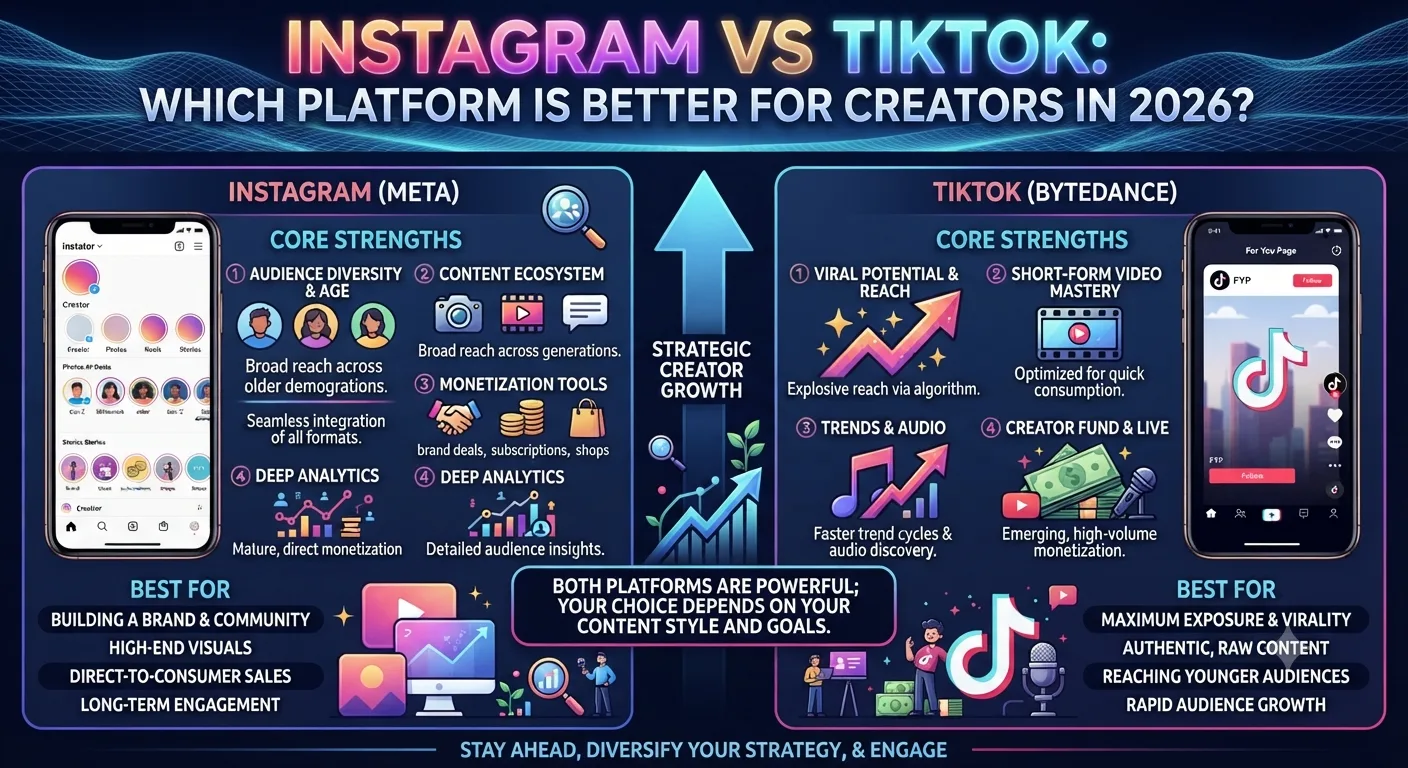
Instagram's user base skews slightly older than TikTok's. The platform has strong concentration in the 25 to 44 age range alongside significant presence in the 18 to 24 range that has been on the platform for years. Instagram also has stronger representation of professional and business users, higher income demographics, and is particularly strong in markets outside the United States across Europe, Latin America, and Southeast Asia.
TikTok
TikTok's user base remains younger on average than Instagram's, with particularly strong concentration in the 16 to 24 range though older demographic segments have grown substantially as the platform has matured. TikTok's US and European audience skews younger and more entertainment focused than Instagram's equivalent audience.
For creators targeting younger audiences, TikTok's demographic concentration is a genuine advantage. For creators targeting professional, business, or older consumer audiences, Instagram's demographic profile is often more aligned with their target customer.
Content Formats: What Works on Each Platform
As covered throughout this series, Instagram supports a wide range of content formats: Reels, carousel posts, single images, Stories, and live video. This format diversity means Instagram works effectively for creators across many different content styles, from highly visual photography to text-heavy educational carousels to short form video.
The carousel format, which has no direct equivalent on TikTok, is a distinctive Instagram strength for educational, reference, and multi-point content that benefits from the multi-slide structure.
TikTok
TikTok is fundamentally a short to medium length vertical video platform. While TikTok has expanded its format offerings, including longer video capability and photo carousel features, the platform's identity and algorithm remain centered on video. Creators who do not primarily produce video content are working against the platform's fundamental nature on TikTok in a way they are not on Instagram.
For video-first creators, TikTok's format constraints are not constraints at all. For creators whose content naturally takes other forms, Instagram's format breadth is a meaningful practical advantage.
Algorithm Behavior: How Each Platform Distributes Content
As covered in detail in Day 7's algorithm guide, Instagram uses multiple distinct ranking systems for different platform surfaces. The main feed prioritizes relationship strength and interest prediction. The Reels tab prioritizes watch time and completion rate. The Explore page uses a two-stage ranking process. Stories are ranked by relationship and interaction history.
Instagram's algorithm is relationship-weighted, meaning existing audience engagement history plays a significant role in how widely content is distributed. This creates a compounding effect where accounts that have built strong audience relationships get progressively better distribution over time.
TikTok
TikTok's For You Page algorithm is interest-weighted rather than relationship-weighted, meaning the platform prioritizes matching content to likely-interested viewers regardless of whether they follow the creator. This makes follower count less central to reach on TikTok than on Instagram and creates the explosive discovery potential discussed above.
The tradeoff is that TikTok's algorithm produces less predictable, less stable reach than Instagram's. A creator can have a video with millions of views one week and videos with thousands of views the next, since each video is evaluated relatively independently by TikTok's algorithm rather than being buffered by a stable follower engagement history.
Monetization: How Creators Make Money on Each Platform
Instagram's monetization options have expanded significantly and include multiple pathways.
Creator subscriptions allow creators to charge followers a monthly fee for exclusive content access. Badges allow followers to purchase support during live videos. Instagram Shopping allows direct product sales through the platform. Brand partnerships through sponsored content remain the dominant monetization path for most creators. Affiliate commission through Instagram's affiliate program links product recommendations to trackable earnings.
Instagram's creator monetization is generally considered more mature and more favorable for mid-tier and larger creators than TikTok's current offerings, particularly for brand partnership rates.
TikTok
TikTok's monetization options include the Creator Rewards Program, which pays creators based on video performance metrics, brand partnerships through the TikTok Creator Marketplace, live gifts from followers during live streams, and TikTok Shop which provides direct commerce functionality.
TikTok's Creator Rewards Program payouts have been a consistent source of creator frustration, with rates that most creators consider inadequate relative to the effort required to generate significant view counts. Brand partnership rates on TikTok have historically been lower than equivalent Instagram partnerships, though this gap has been closing as TikTok's commercial value has become better established with brand advertisers.
For most creators whose primary monetization comes from brand partnerships, Instagram currently offers higher rates and a more established influencer marketing ecosystem.
Community Building: Which Platform Builds Deeper Audience Relationships
Instagram's combination of Stories, direct messages, comments, live video, and broadcast channels creates multiple touchpoints for deep audience relationship building. As covered in multiple posts throughout this series, Stories in particular drive the kind of daily connection and two-way interaction that builds loyal, invested audiences over time.
The permanence of Instagram's content, particularly feed posts and Highlights, also contributes to community building by giving new followers a rich archive of content to discover and engage with when they first find an account.
TikTok
TikTok's community building is concentrated primarily in comments and live interactions, with less of the multi-format relationship infrastructure that Instagram provides. The For You Page's interest-based distribution also means TikTok audiences tend to be less stable than Instagram audiences, since each video can reach a different slice of the potential audience rather than building consistent engagement with the same core group.
For creators prioritizing the depth of audience relationship over its breadth, Instagram's relationship infrastructure provides stronger community building tools than TikTok's primarily entertainment-focused interaction model.
Content Longevity: How Long Does Content Stay Relevant
Instagram feed posts and Reels accumulate engagement and reach over extended time periods. A well-performing Reel can continue receiving views and engagement for days or weeks after posting. Carousels can be re-served to non-engagers by the algorithm. Highlights give content indefinite life on the profile. This content longevity means each piece of Instagram content can generate value well beyond its initial posting moment.
TikTok
TikTok content can have longer viral life than most social media content when the For You Page algorithm decides to resurface older videos to new audiences, which happens regularly. However, the average TikTok video's active reach window is shorter than Instagram's, with most views concentrated in the first 24 to 48 hours after posting for content that does not achieve significant viral distribution.
Platform Stability and Long-Term Risk
Instagram is owned by Meta, one of the largest technology companies in the world, giving it significant structural stability. While platform changes, algorithm updates, and feature shifts create ongoing uncertainty for creators, the existence of the platform itself is not a near-term risk that most creators need to factor into their decisions.
TikTok
TikTok has faced ongoing regulatory scrutiny in the United States and several other markets due to its ownership by the Chinese company ByteDance. The potential for forced divestiture or platform restrictions in key markets represents a platform risk that Instagram does not carry to the same degree. For creators whose primary audience is in affected markets, this risk is worth factoring into platform investment decisions.
Which Platform Is Right for You
Rather than a single universal answer, the platform choice depends on specific creator circumstances.
Choose Instagram as your primary platform if your content is not exclusively video, if your target audience is older or more professional, if community depth and long-term audience relationship are priorities, if brand partnership monetization is your primary revenue goal, or if you operate in markets where Instagram has stronger user concentration than TikTok.
Choose TikTok as your primary platform if you create primarily video content and want the maximum organic discovery potential, if your target audience is younger, if entertainment-first content is your primary mode, or if you are starting from zero followers and want the fastest possible path to initial audience building.
Build a presence on both platforms if your content translates naturally across both, if you have the production capacity to create consistently on multiple platforms, or if audience diversification across platforms is a strategic risk management priority for your content business.
The Cross-Platform Approach
Many creators have found that a coordinated cross-platform approach, using TikTok for its discovery potential and Instagram for deeper audience relationship building and monetization, produces better overall outcomes than either platform alone.
Content created primarily for TikTok can often be adapted for Instagram Reels with minimal additional effort, as long as TikTok watermarks are removed before reposting since Instagram's algorithm deprioritizes watermarked content as covered in Day 11's Reels guide.
The audiences built through TikTok discovery can be directed toward Instagram for the relationship-building and monetization advantages Instagram's ecosystem provides, creating a discovery to relationship pipeline that uses each platform for what it does best.
Frequently Asked Questions
Q: Can I grow faster on TikTok than on Instagram if I am starting from zero?
Generally yes. TikTok's For You Page provides significantly higher organic discovery potential for creators starting from zero followers than Instagram's more relationship-weighted distribution system. Initial audience building tends to happen faster on TikTok than on Instagram for video-first creators.
Q: Is it better to post the same content on both platforms or create platform-specific content?
Platform-specific content almost always outperforms repurposed cross-platform content because each platform's audience has distinct expectations and each algorithm has different content signals. Where production constraints require cross-posting, adapting content for each platform's specific norms, removing watermarks, adjusting captions, and optimizing for the specific format, produces better results than direct reposts.
Q: Do Instagram and TikTok audiences overlap significantly?
There is meaningful audience overlap, particularly in younger demographic segments, but the two platforms attract distinct usage modes. Instagram users are often in a browsing and connection mode. TikTok users are often in an entertainment and discovery mode. Even overlapping users often engage differently on each platform, which is part of why platform-specific content approaches outperform cross-posting.
Q: How can I research what is working for creators in my niche on Instagram before deciding where to focus?
Using InstaPV to review the growth trends and engagement rates of successful creators in your niche gives you a current picture of what Instagram performance looks like for accounts in your specific space, which provides useful context for evaluating the platform's potential for your specific content approach.
-
How to Monitor Your Brand Mentions on Instagram for Free
-
What Are Instagram Close Friends Stories and How to View Them?
-
How to Create Viral Instagram Stories (With Real Examples)
Conclusion
Instagram and TikTok in 2026 are genuinely distinct platforms with different strengths, different audiences, and different algorithmic personalities that reward different creator behaviors. Neither is universally better. Each is better for specific types of creators pursuing specific goals with specific audiences.
Instagram's format breadth, community building infrastructure, monetization maturity, and platform stability make it the stronger choice for creators prioritizing audience depth, brand partnerships, and long-term relationship building. TikTok's organic discovery potential and younger audience concentration make it the stronger choice for creators prioritizing rapid initial audience growth and entertainment-first video content.
Understanding where your specific content, audience, and goals align within this comparison is the foundation for making a platform allocation decision that actually fits your situation rather than following generic advice that may not apply to it.
Research what is working for creators in your niche on Instagram right now using InstaPV →