Introduction
Most writing about Instagram's algorithm falls into one of two categories. The first is platform-official communication: carefully worded statements from Instagram that explain the algorithm at a high level without revealing the specific weights, thresholds, or mechanics that would allow gaming. The second is speculation and anecdote: observations from creators about what seems to be working, theories about why, and advice that extrapolates from limited personal experience to universal principles.
Both categories contain useful information, but neither is the same as a rigorous, evidence-based understanding of how the algorithm actually functions. This guide attempts something different: a synthesis of what is verifiably known about Instagram's ranking systems from official disclosures, academic research, published technical documentation, and systematic analysis, clearly distinguished from what remains uncertain or speculative.Instapv
The goal is not a complete technical specification of Instagram's algorithm, which Instagram has never published and which would require access to proprietary systems to verify. The goal is the most accurate, evidence-grounded understanding of the algorithm that is achievable from publicly available information in 2026.
What Instagram Has Officially Disclosed
Instagram has published several detailed explanations of how its ranking systems work through its official blog, its creator help center, and public statements from executives including Adam Mosseri, Instagram's head. These disclosures are the most authoritative starting point for understanding the algorithm because they come from the source.
The Core Principle
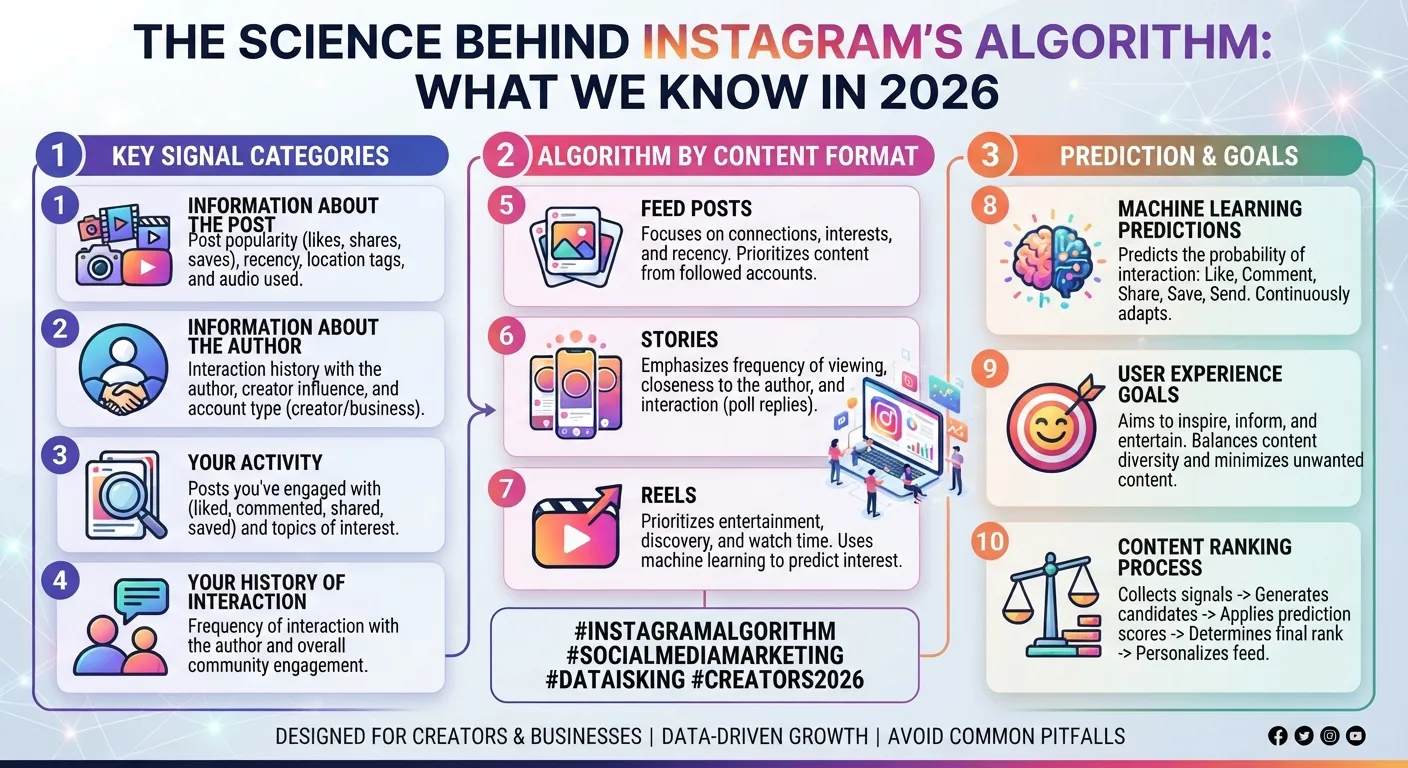
Instagram has stated explicitly that it does not have a single algorithm. Instead it uses multiple ranking systems tailored to different surfaces of the platform: the main feed, Stories, Explore, and Reels each use distinct signals and ranking logics. This is consistent with how most sophisticated recommendation systems at scale are actually built, and it means advice about the algorithm that does not distinguish between surfaces is inherently imprecise.Read blog
The Stated Goal
Instagram has stated that the goal of its ranking systems is to show people content they are most likely to enjoy and find value in. This framing reveals the fundamental orientation of the algorithm: it is optimizing for predicted user satisfaction rather than for any content creator's distribution goals. Understanding this goal helps explain why many algorithmic behaviors that seem counterintuitive from a creator's perspective make sense from a user satisfaction optimization perspective.
Officially Confirmed Signals
Instagram has officially confirmed several categories of signals that its ranking systems use.
For the main feed, confirmed signals include past engagement patterns with the poster, the type of content it is such as photo, video, or carousel, how many likes and comments similar posts have received, and how quickly people engage when they see something from a specific account.
For Reels specifically, Instagram has confirmed that it considers predicted probability of rewatching, probability of sharing, probability of liking, probability of commenting, and probability of going to audio page as ranking signals. Watch time and completion rate are confirmed as significant signals.
For Explore, Instagram has confirmed a two-stage process: first identifying candidate content likely to be relevant, then ranking that candidate content by predicted engagement likelihood.
For Stories, Instagram has confirmed that people whose stories you have interacted with in the past are ranked higher, and that stories from people you follow closely are prioritized.
What Academic Research Reveals
Beyond official disclosures, academic researchers have studied Instagram's algorithmic behavior through systematic experimentation, analysis of platform data, and reverse engineering approaches. Several findings from this research body are worth noting.
The Engagement Velocity Effect
Multiple research groups have documented what can be described as an engagement velocity effect: the rate at which content accumulates engagement in the first period after posting is a stronger predictor of ultimate reach than the eventual total engagement. Content that reaches a specific engagement threshold quickly receives significantly more algorithmic distribution than content that reaches the same threshold slowly.
This finding provides scientific grounding for the commonly observed phenomenon where posts that perform strongly in the first hour significantly outperform posts with comparable eventual engagement but slower initial accumulation. It also supports the strategic recommendation in Day 4's growth hacks guide regarding timing Story activity before feed posts to prime engagement momentum.
The Relationship Signal Compounding Effect
Research has documented that relationship signals between accounts compound over time rather than resetting with each interaction. An account that has consistently engaged with another account's content over an extended period has a stronger relationship signal than one that interacted intensively in a short recent period, even if the recent total engagement count is higher.
This finding suggests that sustained, consistent engagement over time builds stronger algorithmic relationships than burst activity, which has implications for community engagement strategies and for how quickly newly followed accounts begin appearing prominently in followers' feeds.
The Content Category Clustering Effect
Research on recommendation system behavior, including systems similar to Instagram's, has documented category clustering: the algorithm tends to group similar content together in what it shows users, meaning content that is clearly categorized within a recognizable niche tends to receive more consistent distribution than content that spans multiple unclear categories.
This finding provides evidence-based support for the content pillar and niche consistency recommendations throughout this series. Accounts with clear, consistent content focus are easier for the algorithm to categorize and therefore easier for it to match with users who have demonstrated interest in that category.
The Recency Window Effect
Research has documented a recency window effect in Instagram's feed algorithm: content receives elevated distribution during a specific window after posting that varies based on the account's historical performance and the content's initial engagement velocity. Content that does not accumulate sufficient engagement during this window receives significantly reduced ongoing distribution.
This finding is consistent with Instagram's official statement that recency is one of the signals used in feed ranking and provides scientific grounding for why posting time matters even in an algorithmic rather than chronological feed.
What Technical Analysis Reveals
In addition to official disclosures and academic research, technical analysis of Instagram's observable behaviors has revealed additional algorithmic patterns that are not officially confirmed but are consistent with the documented behaviors of similar recommendation systems.
Multi-Armed Bandit Testing
Behavioral patterns consistent with multi-armed bandit optimization have been observed in Instagram's content distribution. In this type of machine learning approach, new content is initially shown to a small test audience to measure engagement signals, and then distributed more broadly in proportion to how well it performed with the test audience.
This framework is consistent with observations that Reels and feed posts seem to reach an initial small audience regardless of account size, and that this initial performance window determines subsequent distribution. It also explains why the first hour engagement velocity documented in research has such a strong effect on ultimate reach: the test audience phase is concentrated in this early period.
Diversity Injection
Analysis of feed behavior has identified what appears to be diversity injection: the algorithm periodically introduces content outside a user's typical engagement patterns to test whether their interests are evolving. This prevents the recommendation system from converging too narrowly on only the most historically preferred content, which would reduce the algorithm's ability to surface new relevant content as user interests change.
Diversity injection explains why some posts reach users who would not typically be predicted to engage with that content based on their history, and why occasional unexpected reach spikes occur even on accounts with stable historical performance patterns.
Negative Signal Weighting
Technical analysis suggests that negative engagement signals, specifically when a user hides a post, reports content, or actively moves away from content quickly after it begins playing, are weighted strongly in the algorithm's assessment of content quality. A single strong negative signal may outweigh multiple positive signals of equivalent magnitude.
This asymmetry between positive and negative signal weighting is consistent with the academic research finding that user satisfaction optimization systems tend to weight negative feedback more heavily than positive to prevent recommendation systems from surfacing content that a subset of users loves but that many others find objectionable or low quality.
What Remains Genuinely Uncertain
Intellectual honesty about the algorithm requires acknowledging what is not known as clearly as what is.
Exact Signal Weights
The relative weights of different signals in Instagram's ranking calculations are not publicly disclosed and cannot be determined from external observation alone. Knowing that engagement velocity, relationship strength, content category, and recency all contribute to feed ranking does not tell us whether a save is worth ten times or two times a like, or whether a comment contributes five times or twenty times more than a like to the ranking calculation.
Threshold Values
The specific thresholds at which algorithmic behaviors change, such as the engagement velocity level that triggers broader distribution or the recency window duration that determines how long a post's elevated distribution persists, are not publicly known and vary based on account history and content category in ways that make them essentially impossible to determine from external observation.
Algorithm Update Timing and Content
Instagram updates its ranking systems continuously rather than through discrete version releases. The specific nature and timing of these updates is not publicly disclosed, which means that observations from a specific time period may not accurately reflect current algorithm behavior. This is a fundamental limitation of all algorithm analysis that is worth acknowledging explicitly.
The Interaction Effects Between Signals
How different signals interact with each other within the ranking calculation is not publicly known. Whether a high engagement velocity compensates for weaker relationship signals, whether content category clarity amplifies the effect of relationship signals, or how recency and engagement velocity trade off against each other in the ranking calculation are questions that cannot be answered from public information.
Implications for Content Strategy
What the verified science of Instagram's algorithm tells us about content strategy is worth summarizing explicitly, distinguishing between what is well-supported by evidence and what remains more speculative.
Well-supported by evidence: Posting during audience peak activity windows improves early engagement velocity, which has documented downstream effects on reach. Consistent content focus within a recognizable niche supports algorithmic categorization and matching. Building genuine, sustained engagement relationships with followers through consistent content quality accumulates relationship signal that compounds over time. Content that generates shares and replays sends stronger signals than content generating passive likes. Negative signals including hide and report actions are weighted heavily and should be considered a risk in content strategy.
Less certain and more speculative: Specific posting frequencies having algorithmic advantages beyond the consistency effects. Particular hashtag counts or placements having direct algorithmic effects beyond their role in content discovery. Account type switching affecting organic distribution. The proportion of followers who see any given post being controllable through specific tactics beyond improving content quality and engagement velocity.
-
10 Instagram Accounts to Follow for Social Media Inspiration
-
InstaPV Pro vs Free: Which Plan Is Right for You?
-
How to Build an Instagram Report for Clients as a Social Media Manager
Frequently Asked Questions
Q: Does Instagram's algorithm actually penalize accounts for not posting for a while?
Instagram has not officially confirmed any direct penalty for posting gaps. The observed effects of posting inconsistency on reach are more likely explained by the relationship signal compounding effect, where followers who have not seen content from an account recently have weaker relationship signals than active, consistent engagers, which reduces predicted engagement probability and therefore algorithmic distribution. The practical effect looks like a penalty but the mechanism is more accurately described as signal decay rather than active penalization.
Q: Is it true that Instagram limits organic reach to force advertisers to pay for ads?
Instagram has explicitly denied any such policy. The competitive nature of the feed, where a finite number of positions must be shared among many content creators, naturally limits the reach percentage of any individual account regardless of advertising considerations. The practical observation that reach percentages have declined over time reflects the growth of content creation on the platform rather than deliberate reach limitation.
Q: Do engagement pods still work?
Instagram has documented that it actively works to identify and discount coordinated inauthentic engagement. The multi-armed bandit testing framework means that engagement primarily from accounts that the algorithm identifies as systematically coordinating across many posts is likely to receive lower signal weighting than organic engagement from genuinely interested accounts. Whether specific engagement pods are effectively identified and discounted depends on the sophistication of Instagram's detection, which is not publicly disclosed.
Q: How quickly does the algorithm update its model of what a user is interested in?
Research on similar recommendation systems suggests a combination of short-term recency signals, reflecting very recent engagement behavior, and longer-term preference models, reflecting sustained engagement patterns over weeks and months. The relative weighting between recent and historical behavior is not publicly documented for Instagram specifically.
Conclusion
Understanding Instagram's algorithm through the lens of verified evidence rather than speculation and anecdote produces a more accurate and more useful strategic foundation than either official vagueness or community speculation provides alone.
The core verified findings: multiple distinct ranking systems for different surfaces, engagement velocity effects in the early distribution window, relationship signal compounding over time, content category clustering benefits, and strong negative signal weighting all have direct strategic implications that are grounded in evidence rather than assumption.
The areas of genuine uncertainty, including exact signal weights, threshold values, and interaction effects between signals, are worth acknowledging explicitly to avoid overconfident strategic decisions based on precise algorithmic claims that cannot actually be verified from outside the system.