Introduction
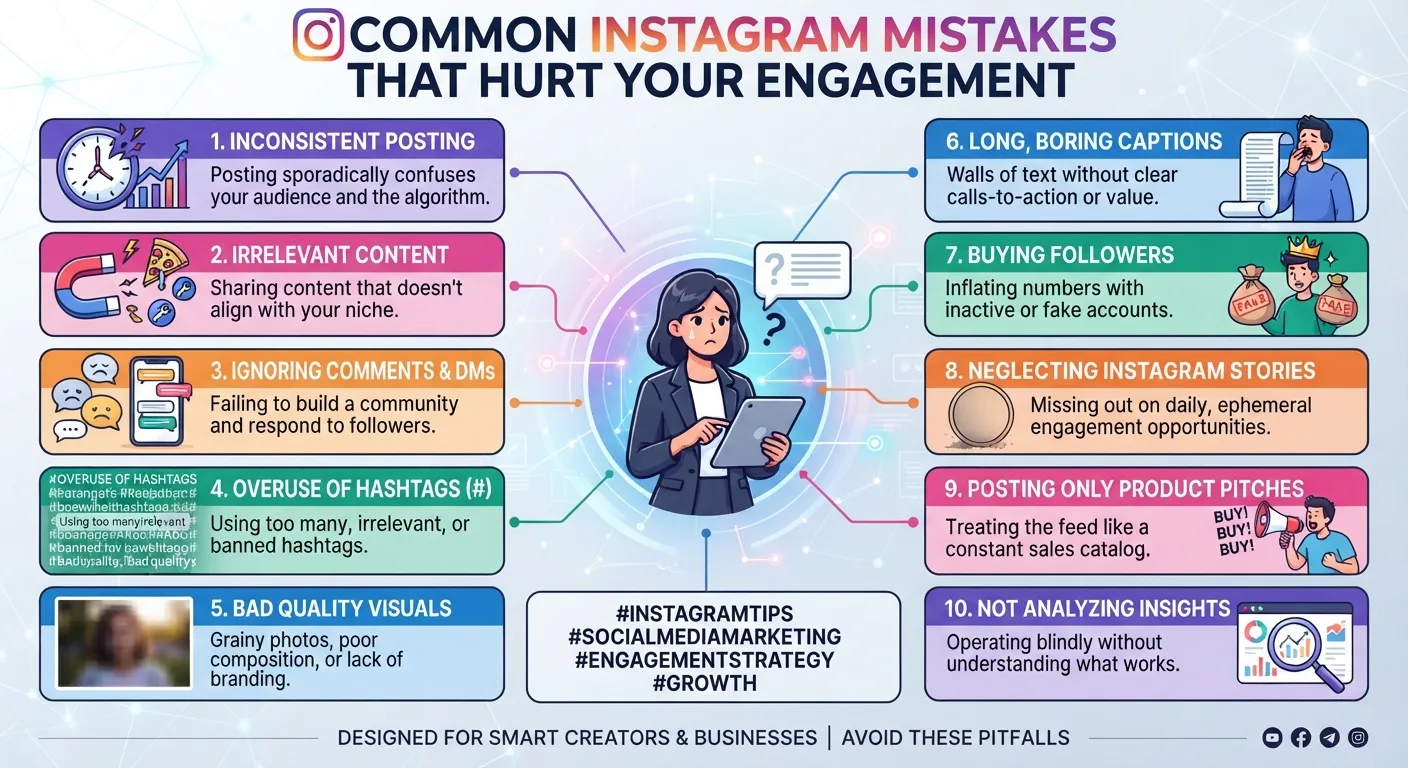
Low engagement on Instagram is rarely caused by one dramatic failure. It is almost always the accumulation of several smaller, correctable mistakes that compound over time into an account that consistently underperforms relative to its potential.
The frustrating thing about these mistakes is that many of them feel like the right thing to do. Posting frequently feels productive. Using maximum hashtags feels thorough. Following back everyone who follows you feels community-minded. But the data and the algorithm consistently produce different conclusions than these intuitions suggest.
This guide identifies ten of the most common engagement-hurting mistakes, explains why each one damages performance through the specific mechanisms covered throughout this series, and provides the direct fix for each one.Instapv
Mistake 1: Posting Without a Clear Content Focus
The most fundamental engagement mistake is not a single decision but an ongoing pattern: publishing content without a clearly defined content focus that gives followers a consistent expectation of what the account delivers.
As covered in Day 10's small business guide and Day 11's personal brand guide, content pillar clarity is the foundation of sustainable engagement. When followers are not sure what an account is about or what kind of content to expect next, they engage less consistently because no reliable expectation has been established.
The algorithm compounds this problem. As covered in Day 20's algorithm science post, Instagram's categorical understanding of an account affects how efficiently it distributes content to interested audiences. An account without clear topical focus is harder for the algorithm to categorize and distribute than one with consistent content themes.Read blog
The Fix: Define two to four specific content pillars that reflect your account's genuine focus area. Review the last thirty posts and categorize them. If the distribution across categories is highly varied with no clear concentration, develop a more focused content mix for the next thirty days and track whether engagement rate improves.
Mistake 2: Weak Caption Endings
As covered extensively in Day 12's caption guide, the closing of a caption is one of the most powerful drivers of comment activity. Accounts that end captions with weak, generic calls to action consistently generate fewer comments than those with specific, immediately accessible questions.
Generic endings like "let me know your thoughts," "what do you think," or "drop a comment below" give followers nothing concrete to respond to. Most people read these prompts and feel no particular pull to engage because the question is too vague to trigger a specific response.
The Fix: End every caption with a single, highly specific question that your target audience has an immediate concrete answer to. As covered in Day 12, the specificity of the question is directly correlated with the response rate. "What is the one thing on your desk right now that you could not work without?" generates more responses than "What is your favorite thing about your workspace?"
Mistake 3: Ignoring Comments After Posting
As covered in Day 4's growth hacks post and Day 20's algorithm science post, the early engagement velocity in the first hour after publishing is one of the strongest signals influencing algorithmic distribution. Comment responses from the account owner count as engagement on the post, which contributes to this early velocity.
Accounts that publish content and then disappear, not responding to comments for hours or days, lose the engagement compounding effect that active participation in early comment activity creates. They also signal to followers that the account is a broadcast channel rather than a community, which reduces the motivation to comment in the first place.
The Fix: Plan to be available for active comment engagement for at least the first 60 to 90 minutes after publishing significant posts, as covered in Day 4. Respond specifically and substantively to early comments rather than with generic acknowledgments. Each response adds engagement to the post and encourages further comment activity from the original commenter and others observing the conversation.
Mistake 4: Posting at the Wrong Times Consistently
As covered in Day 21's posting time data analysis, posting time matters because it affects early engagement velocity through the mechanism of audience activity. Publishing when your audience is largely inactive means content accumulates minimal engagement in the critical first hour, which reduces the algorithmic distribution signal that determines how broadly the post is shown.
Many accounts default to posting whenever content is ready rather than scheduling for audience activity peaks. This convenience-first approach consistently underperforms a schedule aligned with when the specific audience is most active.
The Fix: As covered in Day 21, use your Instagram Insights audience activity data to identify your specific audience's peak active periods by day and hour. Build your posting schedule around these windows rather than around when content is convenient to publish. Run the structured test described in Day 21 to validate which specific times within your peak windows produce the strongest early engagement.
Mistake 5: Using Irrelevant or Overly Competitive Hashtags
As covered in Day 9's hashtag strategy guide and Day 22's hashtag tracking guide, hashtag strategy has evolved significantly from the maximum hashtag, broad reach approach. Accounts that still use overly broad, highly competitive hashtags, or that use hashtags with minimal topical relevance to the specific post's content, are investing in a strategy that produces minimal discovery return.
A post with hashtags that have hundreds of millions of posts is essentially invisible in those hashtag feeds because the content is immediately buried by the enormous volume of subsequent posts. A post using hashtags with no genuine relevance to its content reaches an audience with no genuine interest in it, producing poor engagement even when it does achieve some visibility.
The Fix: As covered in Day 9, build a set of niche-specific hashtags in the 10,000 to 200,000 post range that are specifically relevant to your content area. Rotate between several different sets across posts. Use the tracking method from Day 22 to measure whether the hashtag sets you are using are actually producing discovery, and adjust based on this data rather than assumption.
Mistake 6: Inconsistent Posting Frequency
As covered in Day 4's growth hacks post and Day 7's algorithm guide, the algorithm rewards consistent posting patterns with more predictable distribution. Accounts that post five times one week and once the next, or that post actively for a month and then disappear for three weeks, undermine the algorithmic momentum that consistent posting builds.
Beyond the algorithmic effect, inconsistent posting disrupts audience expectations. Followers who have come to expect content on a predictable schedule disengage when that schedule is not maintained. Re-engaging a disengaged follower is harder than maintaining engagement with an active one.
The Fix: As covered in Day 4, choose a posting frequency that is genuinely sustainable over a long time period rather than one that is optimal in ideal conditions but unsustainable during busy periods. A consistent three times per week for six months outperforms daily posting for one month followed by sporadic posting for five months across virtually every engagement and growth metric.
Mistake 7: Visually Inconsistent Content
As covered in Day 10's analysis of the most followed accounts and Day 6's bio optimization guide, visual consistency across a profile is a significant factor in both the first impression for new profile visitors and the cumulative brand recognition that builds over time with existing followers.
Accounts that switch between dramatically different visual styles, editing approaches, or content formats without a consistent thread create a profile that feels random and unprofessional to new visitors, and that lacks the recognizable aesthetic that makes each new post feel familiar and expected to existing followers.
The Fix: Develop a simple visual style guide as covered in Day 11's personal brand guide. This does not require professional design expertise. Choosing a consistent color palette, editing style, and basic photography approach, and applying it consistently across content, creates the visual coherence that signals intentionality and builds recognition over time.
Mistake 8: Only Posting Promotional Content
As covered throughout this series, particularly in Day 14's e-commerce guide and Day 10's small business guide, accounts that publish exclusively promotional content give followers no ongoing reason to engage between purchase decisions. An account that only posts sales, product showcases, and promotional announcements is functioning as an advertising channel rather than a community, and audiences respond to it as such.
The algorithm also responds to the engagement signals that promotional-only content typically generates, which tend to be lower than content that provides genuine value. Lower engagement signals reduce distribution, which further reduces the reach of even the promotional content the account is trying to get in front of audiences.
The Fix: As covered in Day 10, structure content around content pillars that include educational, entertainment, and community content alongside commercial content. The ratio that works best varies by niche and audience, but accounts that genuinely serve their audience with valuable non-promotional content alongside commercial content consistently outperform those that only post promotional material.
Mistake 9: Neglecting Stories Entirely
As covered in Day 6's Stories versus posts comparison and Day 8's Stories best practices guide, Stories serve a specific and irreplaceable function in building daily connection with existing followers that feed posts cannot replicate. Accounts that post only to the feed without any Story activity miss this daily touchpoint and gradually lose the relationship depth with their audience that drives the comment quality and engagement consistency that strong feed engagement requires.
The algorithm reinforces this: as covered in Day 7's algorithm guide, Instagram ranks Stories for each user based on relationship signals including recent Story interaction history. Accounts that do not post Stories consistently lose placement in followers' Stories bars, reducing the visibility of their Stories content when they do occasionally publish one.
The Fix: As covered in Day 8, build a consistent Stories habit alongside feed content. Stories do not need to match the production quality of feed content. Behind-the-scenes moments, quick updates, polls, and candid content all serve the relationship-building function of Stories effectively.
Mistake 10: Never Analyzing What Is Working
The most sustained engagement mistake is also the most avoidable: publishing content without ever systematically reviewing which content generates the strongest engagement and adjusting strategy based on this data.
As covered in Day 10's content planning guide and Day 19's KPI tracking guide, accounts that use analytics to identify what is working and produce more of it consistently improve engagement rate over time. Accounts that never review their analytics repeat the same content patterns indefinitely, including whatever is not working, without any mechanism for identifying and correcting the problem.
The Fix: Build the monthly analytics review process from Day 10 and Day 19 into a consistent practice. Identify the top 20 percent and bottom 20 percent of recent posts by engagement rate. Look for patterns in both groups. Produce more content that matches the characteristics of the top performers and adjust or eliminate content that matches the characteristics of the bottom performers.
-
Instagram for Food Bloggers: Tips, Analytics, and Growth Strategies
-
How to Monitor a Celebritys Instagram Activity With InstaPV
-
How to Track Instagram Hashtag Performance Without Third-Party Apps
Frequently Asked Questions
Q: How quickly will fixing these mistakes improve engagement?
The timeline for improvement varies by mistake and by how consistently the fix is applied. Changes to caption structure, posting time, and comment engagement can produce visible improvements within two to four weeks. Changes to content focus and visual consistency take longer to compound, typically requiring six to twelve weeks of consistent application before the full effect is visible in engagement data.
Q: Which of these mistakes is most damaging to engagement?
Lack of content focus and weak caption endings tend to have the broadest impact because they affect every piece of content the account publishes rather than only specific posts. Fixing these two first often produces the most noticeable improvement. However, the relative impact depends on which mistakes the specific account is making most severely.
Q: Can I research how high-performing accounts in my niche avoid these mistakes?
Yes. Using InstaPV to review the content, caption structure, posting patterns, and Highlight organization of accounts with strong engagement rates in your niche provides direct evidence of how successful accounts in your space avoid these mistakes in practice. The patterns visible across multiple high-performing accounts reveal the niche-specific conventions that work in your space.
Q: If I have been making several of these mistakes for a long time, do I need to delete old content?
Deleting old content is generally not necessary or recommended. Old content that performed poorly does not meaningfully suppress current content performance, and deleting it removes any residual discovery value it may still have through search and hashtag pages. Focus on improving future content rather than editing the historical record.
Conclusion
Engagement problems on Instagram are almost always diagnostic rather than mysterious. Each of the ten mistakes in this guide has a clear mechanism through which it damages engagement, and each has a specific, actionable fix. The challenge is not identifying what to change but committing to making changes consistently enough for the improvements to compound into meaningful engagement rate improvement over time.
Start with the two or three mistakes that most accurately describe your current account's patterns. Apply the fixes consistently for at least four to six weeks. Review the engagement data to assess whether improvement is occurring. Then move to the next most significant mistake and repeat the process.