Introduction
Hashtag strategy, as covered in Day 9's comprehensive guide, has evolved significantly from the days when using the maximum 30 hashtags was universally recommended. In 2026, the approach favors precision over volume, niche specificity over broad reach, and quality over quantity. But knowing which specific hashtags are actually driving discovery for your content, rather than simply using a set of hashtags and hoping for the best, requires tracking performance over time.
The challenge is that comprehensive hashtag analytics have traditionally required paid third-party tools. Most creators and small businesses are not in a position to justify a dedicated hashtag analytics subscription, and the most expensive tools are designed for enterprise marketing teams with budgets that do not reflect the typical Instagram creator's situation.
The good news is that meaningful hashtag performance tracking is achievable through Instagram's own native tools and systematic manual observation, without any paid software. This guide covers exactly how to do it.Instapv
What Hashtag Performance Actually Means
Before getting into tracking methods, it is worth being precise about what you are actually trying to measure when you track hashtag performance.
The fundamental question hashtag performance tracking should answer is: are the hashtags I am using contributing to content discovery beyond my existing followers? A hashtag that is driving meaningful reach to non-followers is performing well. A hashtag that is not generating any additional discovery is not providing value regardless of how relevant it might seem.
The secondary question is: which specific hashtags within the set I use are most actively driving this discovery? This allows optimization of hashtag sets by dropping underperforming hashtags and keeping or adding hashtags that demonstrably contribute to discovery.Read blog
Method 1: Instagram Insights Reach by Source
The most direct native tool for assessing whether hashtags are contributing to reach is the reach by source breakdown in Instagram Insights, available for business and creator accounts.
How to Access Reach by Source
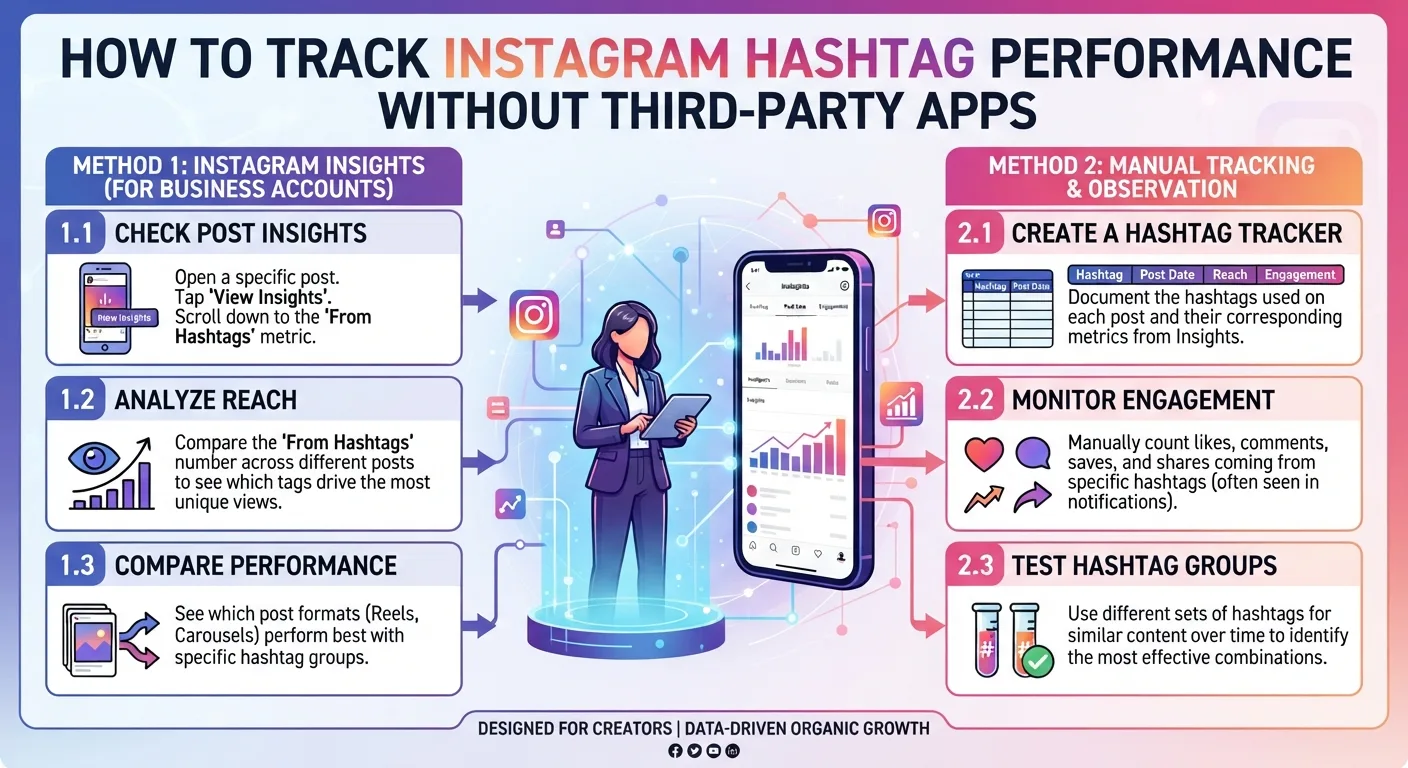
For any individual feed post, tap the View Insights option below the post image. In the Insights view, look for the reach section which shows the total accounts reached and a breakdown of where those accounts came from: home feed for existing followers, Explore, hashtags, profile, and other sources.
The hashtag row in this breakdown shows how many accounts discovered the post specifically through hashtag pages. This is the most direct available measurement of hashtag-driven discovery for each post.
Interpreting the Hashtag Reach Figure
A hashtag reach figure of zero or very close to zero indicates that the hashtags used on that post did not contribute meaningfully to discovery. This could mean the hashtags used were too competitive for the post to appear in their top posts, that the audience browsing those hashtags did not engage with the post, or that the hashtags were not well matched to the content.
A meaningful hashtag reach figure, which varies substantially based on account size and niche, indicates that at least some discovery is happening through hashtag pages. What counts as meaningful varies by account: for a small account, even 50 to 100 additional reaches through hashtags represents genuine additional discovery that hashtag strategy is producing.
Building a Hashtag Reach Tracking Log
Recording the hashtag reach figure from each post's Insights view into a tracking spreadsheet alongside the specific hashtags used on that post builds a dataset over time that reveals patterns.
Create columns for: post date, post topic or format, total reach, hashtag reach, percentage of total reach from hashtags, and the specific hashtag set used. After several weeks of consistent recording, sort by hashtag reach to identify whether specific hashtag sets consistently produce more or less hashtag-driven discovery than others.
This manual tracking approach requires consistent data entry after each post but produces genuine performance intelligence without any paid tool.
Method 2: Systematic A/B Testing of Hashtag Sets
Rather than using the same hashtag set on every post, deliberately rotating between different hashtag sets and tracking the resulting hashtag reach allows comparison of which sets are performing better.
Setting Up the Test
Prepare two or three distinct hashtag sets for your niche, as covered in Day 9's hashtag strategy guide. These should be meaningfully different from each other, not just variations with one or two hashtags swapped, so the comparison produces actionable insight about different strategic approaches.
For example, Set A might focus on broad niche hashtags in the 100,000 to 500,000 range. Set B might focus on tighter niche hashtags in the 10,000 to 100,000 range. Set C might focus on micro-niche hashtags under 10,000 posts.
Running the Test
Alternate between hashtag sets across comparable posts, keeping all other variables as consistent as possible. Compare the content type, posting time, and content quality across test posts to minimize variables that could explain performance differences independently of the hashtag sets being tested.
Analyzing Results
After three to four weeks with several posts per hashtag set, compare the average hashtag reach across posts using each set. The set that consistently produces higher hashtag reach relative to the post's total performance is your stronger performer and should become the default approach while you continue testing variations.
Method 3: Hashtag Page Observation
A complementary tracking approach that does not require Insights data is direct observation of hashtag pages to assess whether your content is achieving visibility within those hashtags.
Checking Top Posts Status
After publishing a post with a specific hashtag set, visit the hashtag pages for the most relevant hashtags you used and check whether your post appears in the Recent Posts section and whether it is surfaced in the Top Posts section.
Appearing in Recent Posts confirms the post was published with that hashtag but does not indicate strong performance. Appearing in Top Posts indicates that the post has generated above-average engagement relative to other recent content in that hashtag, which drives additional discovery from people browsing the hashtag.
Timing of Checks
The most useful time to check hashtag page status is within the first two to four hours after publishing, when the post is most likely to appear in both Recent and potentially Top Posts if it is performing well. Checking at this window, before the post has been buried in Recent Posts by subsequent content, gives you the clearest view of whether initial performance is strong enough to achieve Top Posts placement.
What to Record
Note which specific hashtags you appear in Top Posts for, and which you do not. Over multiple posts, patterns emerge showing which hashtags are realistically competitive for the account at its current size and engagement level versus which are too competitive to achieve any meaningful visibility.
Method 4: Follower Source Tracking
While Instagram does not provide a direct breakdown of which new followers came from specific hashtags, combining hashtag reach data with follower growth timing provides indirect evidence of whether hashtag-driven discovery is converting to followers.
Correlating Hashtag Reach Spikes with Follower Growth
When a post achieves unusually high hashtag reach, check whether follower growth shows a corresponding increase in the days following that post. If posts with strong hashtag reach consistently correlate with follower growth spikes while posts with minimal hashtag reach correlate with flat growth, this provides evidence that hashtag discovery is meaningfully contributing to audience building rather than only adding reach that does not convert.
This correlation analysis is imperfect because follower growth is affected by many factors simultaneously. But across multiple data points over several months, consistent patterns between hashtag reach and follower growth provide useful directional evidence.
Method 5: Story View Source Analysis
For accounts that use hashtags in Stories, which Instagram supports through hashtag stickers, similar reach source tracking is available through Story analytics.
When viewing Story analytics for a specific Story frame that included a hashtag sticker, the viewer source data shows how many views came from hashtag discovery versus other sources. This provides direct measurement of Story hashtag performance similar to the feed post reach by source analysis.
Story hashtag performance tends to be more limited than feed post hashtag performance for most accounts, since Story hashtag discovery is a less prominent feature than feed post hashtag pages. But for accounts whose Stories strategy is a significant part of their overall approach, tracking this data provides complete performance visibility across all formats where hashtags are used.
Building Your Hashtag Performance Dashboard
Combining the tracking methods above into a simple monthly dashboard creates a structured view of hashtag performance trends over time.
The dashboard should include a monthly summary of average hashtag reach across all posts, average hashtag reach as a percentage of total reach, which hashtag sets were used and their respective performance, any Top Posts appearances noted during the month, and notes on any hashtag strategy changes made during the period.
Reviewing this dashboard monthly as part of the broader analytics review covered in Day 19's KPI tracking guide reveals whether hashtag strategy is improving, stable, or declining over time and informs specific adjustments to the hashtag approach for the following month.
What to Do When Hashtag Performance Is Low
If your tracking data consistently shows minimal hashtag reach, several diagnoses and corresponding adjustments are worth considering.
Hashtags May Be Too Competitive
If the hashtags you are using have very high post volumes, the recent posts section moves too quickly for your content to gain visibility before it is buried. As covered in Day 9's hashtag guide, shifting to less competitive niche-specific hashtags in the 10,000 to 200,000 range typically produces better performance than broad hashtags with hundreds of millions of posts.
Content Quality May Not Be Competitive for Top Posts
If your content is consistently not appearing in Top Posts for relevant hashtags, the engagement your content generates relative to other content in those hashtags may not be strong enough to compete for placement. Improving the early engagement of content, through better hooks, posting time optimization, and community engagement building as covered throughout this series, improves the competitive position for Top Posts placement.
Hashtag Relevance May Be Poor
Hashtags that are nominally related to your content but do not match the specific community and audience of that hashtag will see poor performance because the audience browsing that hashtag is not interested in your specific content within their interest area. Ensuring that every hashtag in a set is specifically relevant to the exact content of the post, not just the general topic, improves matching.
The Niche May Simply Have Lower Hashtag Discovery
Some content niches are inherently less well served by hashtag discovery than others, either because niche-specific hashtag communities are less established or because the audience for that niche does not primarily discover content through hashtag browsing. If consistent tracking shows that hashtags produce minimal discovery across many posts with varied sets, the niche's hashtag discovery dynamics may limit the strategy's potential regardless of execution quality.
-
What Is Instagram Reach and How to Increase It
-
Instagram for Fashion Brands: Analytics and Strategy Guide
-
How to Download Instagram Profile Pictures in Full Resolution
Frequently Asked Questions
Q: How many posts do I need to track before hashtag performance patterns become meaningful?
A minimum of fifteen to twenty posts with documented hashtag reach data provides enough sample size for reliable pattern identification. With fewer posts, individual variation between posts can obscure the underlying patterns that multiple data points reveal.
Q: Should I use the same hashtags every post or rotate them?
As covered in Day 9's hashtag strategy guide, rotating between several different hashtag sets avoids the appearance of generic, repetitive hashtag use and allows performance comparison between different sets. The tracking methods in this guide are specifically designed to support this rotation approach by revealing which sets perform best over time.
Q: Does hashtag performance tracking work for Reels differently than feed posts?
The reach by source breakdown in Insights applies to both Reels and feed posts. The hashtag reach contribution tends to be smaller for Reels than for feed posts because Reels distribution is primarily driven by the algorithm through the Reels tab and Explore rather than hashtag browsing, as covered in Day 11's Reels strategy guide. However, tracking hashtag reach for Reels separately from feed posts provides useful format-specific performance intelligence.
Q: Is there a way to track which specific hashtag within a set is driving reach?
Instagram Insights shows aggregate hashtag reach from all hashtags used on a post combined rather than breaking down performance by individual hashtag. Determining which specific hashtag within a set is driving the most discovery requires either using single hashtags on test posts, which is impractical for regular content, or making inferences from Top Posts placement observation across individual hashtag pages.
Conclusion
Meaningful hashtag performance tracking does not require paid tools. The combination of Instagram Insights reach by source data, systematic hashtag set rotation and comparison, hashtag page observation for Top Posts status, and correlation analysis between hashtag reach and follower growth provides a complete performance picture using only native tools and consistent manual observation.
The investment is primarily time rather than money: a few minutes per post to record Insights data and check Top Posts status, and a monthly review session to analyze patterns and adjust the hashtag strategy accordingly. Over several months of consistent tracking, this produces genuinely actionable performance intelligence that improves hashtag strategy in ways that generic advice never can.
Research niche hashtag communities and high-performing accounts in your space on InstaPV →