Introduction
Food content has been a cornerstone of Instagram since the platform's earliest days. The phrase "don't forget to gram your food" was a cultural shorthand for the Instagram era, and the platform's visual format made it a natural home for food photography long before it developed into a serious content creation profession.
In 2026, food blogging on Instagram has evolved far beyond casually photographed restaurant meals. It is a competitive, sophisticated content space with established visual standards, complex monetization ecosystems, and audience expectations shaped by years of exposure to some of the most polished food photography and video production available anywhere.
For food bloggers building a presence on Instagram in this environment, understanding what the data shows about what works in the food niche specifically, rather than relying on generic Instagram advice, is the foundation for building a strategy that actually generates growth and monetization rather than just content output.
The Food Niche on Instagram: What the Data Shows
As covered in Day 6's niche engagement guide, food and recipe content consistently shows some of the highest save rates of any content category on the platform. This is not accidental. It reflects a specific behavioral pattern among food content audiences that shapes everything about what works in this niche.
The Save Behavior Pattern
When someone sees a recipe or food content they want to make, their immediate response is to save it for later reference. This behavioral pattern is extremely reliable and extremely useful for food content creators because it produces the high save rates that drive strong algorithmic distribution, as covered throughout this series.
The implication is that food content optimized for saving, meaning content that presents recipes and food ideas in ways that make viewers confident they will want to reference them when cooking, consistently outperforms food content optimized only for visual impact. A beautiful food photo with no recipe information generates likes. A beautiful food photo with a complete recipe in the caption generates saves. The second approach drives significantly stronger algorithmic performance.
The Share Behavior Pattern
Food content also shows unusually high organic sharing behavior, particularly through direct messages. People regularly send recipe posts to specific people they know, whether a partner they want to cook with, a friend with dietary preferences that match the recipe, or family members who would enjoy the dish.
This sharing behavior creates natural word-of-mouth distribution that amplifies reach beyond what algorithmic distribution alone provides. As covered in Day 17's viral content guide, designing content with specific sharing motivation in mind, asking "which specific person would a viewer send this to and why," helps food content creators build shareability into their content deliberately rather than relying on it occurring accidentally.Instapv
Content Strategy for Food Bloggers
The Content Pillars That Work in Food
The most successful food Instagram accounts are built around clear content pillars that give followers a consistent expectation of what the account delivers. As covered in Day 10's small business guide and Day 13's content calendar guide, pillar consistency is the foundation of sustainable Instagram growth.
For food bloggers, content pillars typically combine recipe categories with a distinctive angle or perspective that differentiates the account from the enormous volume of general food content on the platform.
A food blogger focused on quick weeknight dinners under 30 minutes has a clear, practical pillar. One focused on budget-friendly meal prep for families has another. A blogger documenting their journey learning traditional cuisine from their cultural heritage has a distinctive personal angle that generic recipe content cannot replicate.
The more specific the content pillar, the more precisely targeted the audience it attracts, and as covered throughout this series, specifically targeted audiences consistently show stronger engagement rates than broad, generic ones.
Recipe Presentation Formats That Drive Performance
Different formats for presenting food content perform differently in the food niche, and understanding which formats serve which purposes helps food bloggers allocate production effort efficiently.
Carousel posts showing step-by-step recipe processes consistently generate the highest save rates because they present information in a format that is genuinely useful for reference while cooking. As covered in Day 7's trends post and Day 11's format comparison guide, carousels have seen renewed strength across the platform, and in food specifically their reference value makes them particularly well-suited to the save behavior pattern that characterizes food audiences.
Short Reels showing cooking processes in satisfying, fast-paced formats generate the strongest non-follower reach for food creators. The combination of visual appeal, the inherently satisfying nature of watching food preparation, and the short-form format's compatibility with the Reels tab's distribution system makes cooking process Reels one of the highest-reach formats available to food creators.
Single image posts with complete recipes in the caption occupy a middle ground: they do not have the reference value of carousels or the reach potential of Reels, but they are the fastest to produce and work well for maintaining posting consistency between more production-intensive content.
Stories work differently in food than in many other niches. Food Stories that show behind-the-scenes cooking moments, kitchen failures and successes, ingredient sourcing, and the real day-to-day experience of food blogging build the authentic connection with the audience that makes the polished feed content feel grounded in genuine passion rather than pure content production.
The Recipe Caption Strategy
As covered in Day 12's caption guide, caption quality is directly tied to engagement quality. For food bloggers specifically, caption strategy should balance the complete recipe information that drives saves with the engaging, personal writing that drives comments and shares.
The most effective food blogger caption structure typically begins with a hook that communicates what makes this specific recipe worth making, moves through a brief personal note about the recipe's origin, occasion, or significance, presents the complete recipe or a link to the full recipe, and closes with a specific question that invites comment activity.
The question at the end of a food caption that consistently generates the most comment activity is highly specific and immediately accessible: "What is the one recipe you make every single week without fail?" or "What is your go-to ingredient that makes everything better?" drive responses because virtually everyone has an immediate, concrete answer rather than needing to think abstractly.
Visual Quality in Food Content
Food photography is the area where the gap between casual and professional food content is most visible and most consequential. As covered in Day 22's fashion brand guide in the context of visual standards, food photography has its own high baseline expectation that reflects years of audience exposure to professional-grade food imagery.
The Fundamentals of Strong Food Photography
Lighting is the single most important factor in food photography quality. Natural light, particularly the soft, diffused light of a cloudy day or indirect window light, is the baseline standard for food content that looks professional without professional equipment. Direct sunlight and harsh artificial light create unflattering shadows and washed-out colors that immediately signal amateur photography to audiences trained by years of high-quality food content.
Composition decisions, specifically the choice of overhead versus three-quarter angle, tight versus wide framing, and the use of props and backgrounds, create the visual context that makes food look as appetizing as possible. The overhead angle that has become associated with flat-lay food photography works particularly well for dishes with interesting pattern and color when viewed from above. The three-quarter angle that shows depth and texture works better for dishes where height and three-dimensional structure are part of the visual appeal.
Color management, ensuring that food colors appear accurate and appetizing rather than washed out or artificially enhanced, requires consistent editing approach across content. Many successful food bloggers develop a personal editing style through a consistent Lightroom preset or editing workflow that applies their visual signature across all content, creating the visual consistency covered in Day 6's bio optimization guide as central to strong profile presentation.
Balancing Aspirational and Accessible
Food content faces a specific tension that other visual niches do not face as acutely: the aspiration versus accessibility balance. Highly aspirational, perfectly styled food content can be beautiful but can also make viewers feel the recipes are beyond their own cooking skill level, which reduces the save and try behavior that drives the deepest engagement with food content.
The most engaging food bloggers typically maintain high visual quality while signaling that their recipes are genuinely achievable for the audience through caption language, the occasional authentic imperfect shot, and the honest acknowledgment of when recipes have been simplified or adapted for practical home cooking.
Analytics for Food Bloggers
The Metrics That Matter Most in Food
As covered in Day 19's KPI guide, the most important metrics depend on the specific goals of the account. For food bloggers, several category-specific metrics are particularly informative.
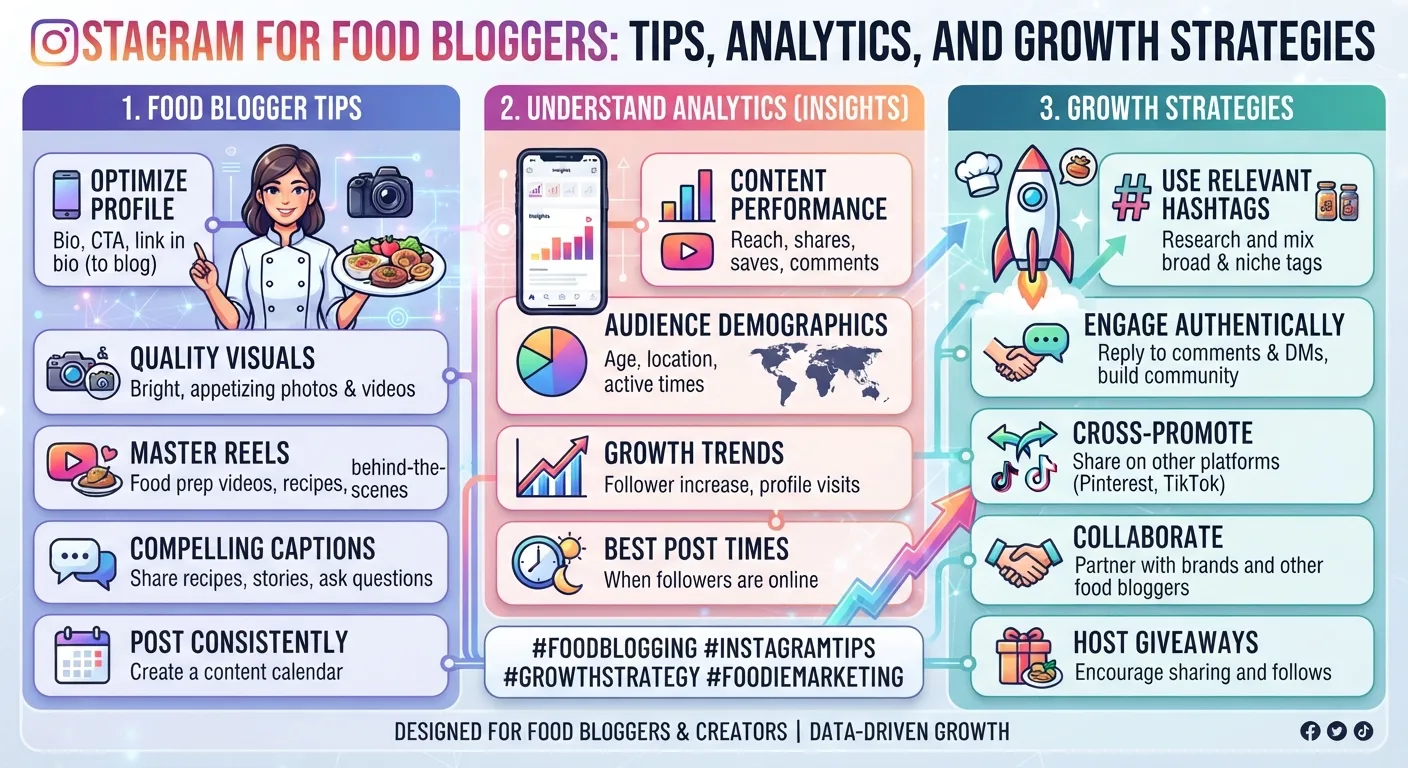
Save rate is the single most important performance metric for food content because it directly measures the behavior that drives both algorithmic distribution and audience utility. As covered in Day 16's content types guide, food and recipe content consistently generates the highest save rates of any content category. Tracking average save rate across recent posts and identifying which recipe types, formats, and presentations generate the highest save rates provides the most actionable creative direction in this niche.
Recipe engagement depth, measured by whether followers are asking questions about recipes, sharing modifications, and reporting back on results in comments, reveals whether the audience is actually cooking from the content rather than just admiring it. Food bloggers who build communities where followers actively cook, experiment, and report back generate significantly stronger long-term audience loyalty than those whose content is consumed passively.
Profile visits from Reels, as covered in Day 15's Reels analytics guide, measure whether Reel content is converting viewers to profile visitors who then become followers. In food specifically, where Reels are often the primary discovery mechanism, this conversion rate tells you whether the content is effectively representing the account's value proposition to new audiences.
Competitive Research for Food Bloggers
Using InstaPV to research competitor food accounts provides the most directly applicable intelligence for food-specific strategy decisions. The specific elements worth studying in competitor food accounts include their save rate signals, visible through high engagement relative to follower count on educational recipe content, the format mix they use across different content types, the specific sub-niches or recipe categories that generate their strongest engagement, and how they balance aspirational and accessible content.
As covered in Day 19's research guide, the pattern identification that comes from studying five to eight competitor accounts through InstaPV provides a validated foundation for content decisions rather than requiring everything to be learned through individual trial and error.
Growth Strategies for Food Bloggers
Collaboration in Food
As covered in Day 14's organic growth guide, collaboration is one of the most effective growth mechanisms available. In food specifically, collaboration takes several forms that work particularly well.
Recipe swaps with complementary food bloggers, where each account creates a recipe using the other's signature ingredient or technique and features it on their own platform, create genuine content value for both audiences while introducing each creator's work to the other's followers.
Brand collaborations with food brands, kitchen equipment companies, and ingredient suppliers are the most common monetization path for food bloggers and simultaneously serve as discovery mechanisms when the brand partner shares the collaboration to their own audience.
Chef or professional collaborations, where food bloggers work with professional cooks or culinary educators to create content, lend credibility and provide content that neither party could create alone.
Seasonal and Trend Timing in Food
As covered in Day 22's fashion brand guide regarding seasonal content planning, and the trending topics guide from Day 15, food content benefits significantly from alignment with seasonal and cultural moments.
Holiday and seasonal recipe content consistently outperforms evergreen content for reach and shares because it is immediately relevant to what a large proportion of the audience is currently thinking about and planning for. Publishing seasonal content two to four weeks before the relevant occasion positions the content to reach people while they are in the planning phase rather than already committed to their approach.
Trend-aware food content, engaging with currently popular ingredients, dietary approaches, or cooking techniques at the early stage of their trend cycle rather than after saturation, produces the early discovery advantage covered in Day 15's trending topics guide.
Monetization for Food Bloggers
Instagram provides several monetization pathways for food bloggers that extend beyond the platform itself.
Brand partnerships with food and kitchen brands are the primary income source for most food blogger Instagram accounts. As covered in Day 7's influencer research walkthrough and Day 15's audience analysis guide, effective brand partnerships in food require strong save rates and genuine recipe engagement that demonstrates followers are actually cooking from the account's content rather than just following passively.
Affiliate marketing for kitchen equipment, specialty ingredients, and food subscription services can generate passive income from content that naturally references these products. As covered throughout this series, the authenticity of affiliate recommendations is critical: food bloggers whose affiliate recommendations reflect genuine product preference consistently outperform those whose affiliate content is obviously commercial.
Digital products including recipe e-books, meal planning templates, and cooking courses represent the highest-margin monetization available to food bloggers with engaged audiences. The audience trust and demonstrated expertise that strong Instagram presence builds creates the credibility that makes these products compelling purchases.
-
How to Track Instagram Hashtag Performance Without Third-Party Apps
-
How to Monitor a Celebritys Instagram Activity With InstaPV
-
10 Common Instagram Mistakes That Hurt Your Engagement
Frequently Asked Questions
Q: How important is posting frequency versus posting quality in food Instagram?
For food specifically, quality consistently matters more than frequency because of the save behavior pattern. A single high-quality recipe post with clear photography and a complete recipe generates more saves and more sustained algorithmic distribution than multiple lower-quality posts. That said, the accounts growing fastest typically manage to maintain both reasonable quality and reasonable frequency rather than treating them as mutually exclusive.
Q: How do I research which recipe categories are performing best in my niche?
Using InstaPV to review the recent content of three to five successful accounts in your specific food niche, noting which recipe posts appear to generate the strongest engagement relative to account size, provides the most directly applicable intelligence about what is resonating with the shared audience right now.
Q: Is video content necessary for food blogger growth on Instagram?
Reels have become sufficiently important to discovery, as covered in Day 11's Reels guide, that food bloggers focusing exclusively on static photography are missing the most significant non-follower reach mechanism available. That said, high-quality photography continues to perform strongly for engagement and saves within the existing audience. The most effective food Instagram strategies incorporate both rather than abandoning photography for video or vice versa.
Q: How do I handle dietary restrictions and allergies in my recipe content?
Clear, prominent labeling of dietary compatibility in recipe content, whether a post is vegan, gluten-free, nut-free, or otherwise, is both a practical service to the audience and a discovery mechanism. Many food Instagram users specifically search for or save content that fits specific dietary requirements, making clear dietary labeling a save rate and search discoverability strategy as well as a safety and accessibility consideration.
Conclusion
Food blogging on Instagram in 2026 rewards creators who understand the specific behavioral patterns of food audiences, particularly the save and share behaviors that make food content uniquely well-suited to Instagram's algorithmic distribution system, and who build their content strategy around these patterns rather than generic Instagram advice.
The combination of high-quality photography, recipe formats optimized for saves, authentic behind-the-scenes Stories, Reels for discovery, and community-building engagement creates the comprehensive food Instagram strategy that compounds over time into a genuinely significant presence in one of the platform's most established and most competitive content categories.
Research top food accounts and engagement patterns in your specific niche on InstaPV →