Introduction
Instagram is no longer just a platform for sharing photos and building personal brands. For journalists, investigators, and researchers, it has become one of the most valuable sources of public information available anywhere on the internet.
Public figures make statements in Stories that disappear within 24 hours. Eyewitnesses document events in real time through posts and live video. Brands and organizations communicate publicly through their profiles before issuing formal press releases. Community reactions to events play out visibly in comment sections. Geographic and demographic information embedded in posts provides context that traditional reporting methods cannot always access quickly.
The challenge for journalists working with Instagram as a research source is practical as much as ethical. Accessing and archiving public content efficiently, monitoring multiple accounts simultaneously, and doing all of this without tipping off subjects to journalistic interest requires tools and methods beyond what Instagram's native interface provides.
This guide covers how journalists and researchers are using Instagram viewer tools like InstaPV as part of their reporting workflow, the specific use cases where these tools add genuine value, and the ethical framework that responsible journalists apply when using public Instagram content in their work.
Why Instagram Has Become a Primary Journalism Source
Several characteristics of Instagram make it particularly valuable as a journalistic source.
Real-Time Public Documentation
Instagram Stories and posts are often among the first documentation of breaking news events. Eyewitnesses post video and photos from event locations in real time, frequently before any professional news crew arrives. Public figures respond to developing situations through Stories and posts before their communications teams can prepare formal statements. This real-time public documentation gives journalists access to primary source material at a speed and breadth that was not available through previous newsgathering methods.
Geographic and Temporal Context
Instagram posts frequently contain embedded geographic information through location tags, and the temporal sequence of posts provides a timeline of events that can be cross-referenced against other reporting. For investigative work, this geographic and temporal data embedded in public Instagram content can establish presence, sequence, and context in ways that support or challenge other sources.
Visual Primary Sources
For stories involving visual evidence, public Instagram posts provide direct visual documentation from participants and witnesses. A public figure's own Instagram posts showing their presence at a specific location, their response to a specific situation, or their stated position on a topic are primary source material that carries journalistic weight that secondhand descriptions cannot match.
Public Statements That Would Otherwise Disappear
The 24 hour lifespan of Stories creates a specific journalistic challenge. A public figure or organization making a significant statement through a Story needs to be documented before the window closes. Journalist tools that allow archiving of public Stories before they disappear are directly addressing a real newsgathering need.
Specific Use Cases for Journalists
Archiving Statements Before They Disappear
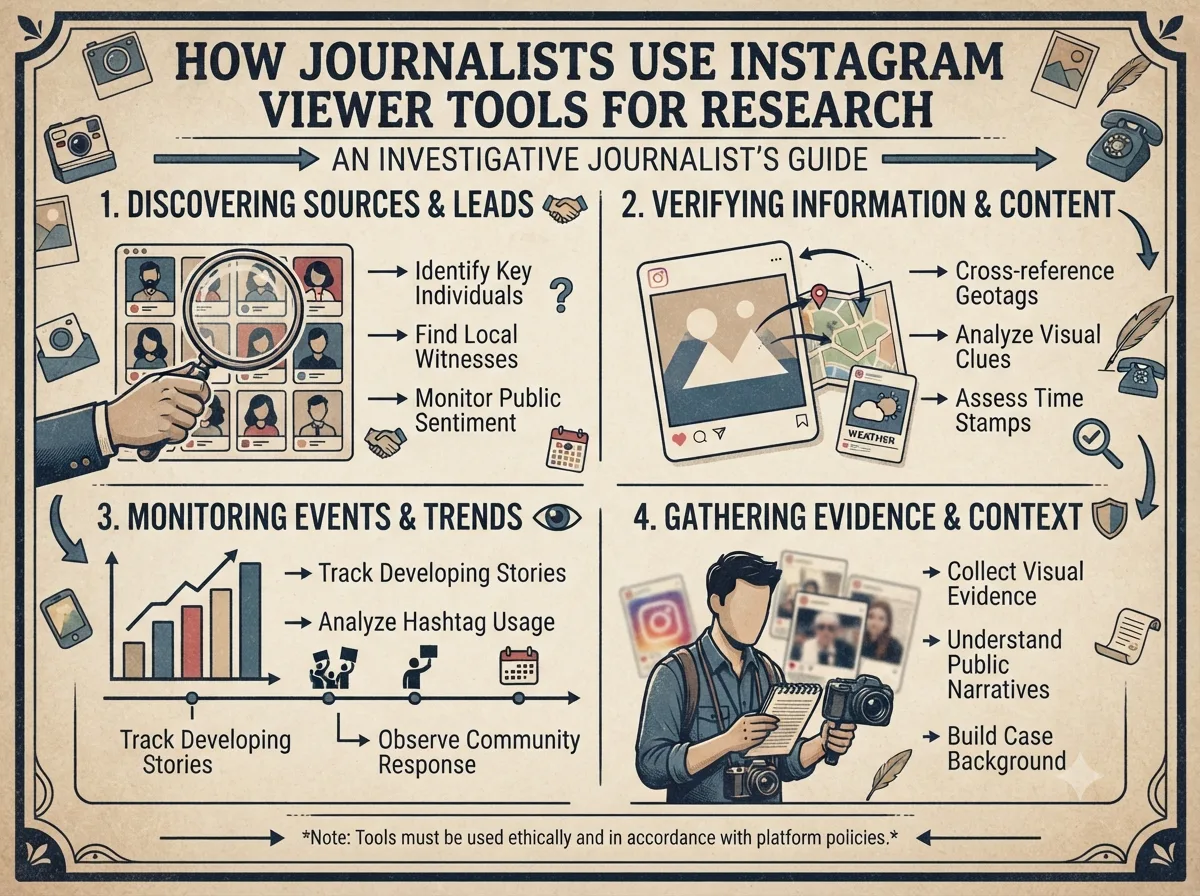
The most time critical journalism use case for Instagram viewer tools is archiving Stories content from public accounts before the 24 hour window closes.
When a public figure, organization, or eyewitness makes a significant statement or posts significant documentation through a Story, a journalist needs to be able to preserve that content as a reliable record. InstaPV's story viewing and download functionality allows journalists to access and archive public Stories content quickly and reliably, creating a documented record before the content disappears.
This archiving serves both immediate reporting needs and longer term accountability functions. A public statement made in a Story that is later denied, contradicted, or claimed to have been misrepresented is significantly harder to address without a preserved record of the original content.
Monitoring Public Figures Without Revealing Journalistic Interest
Journalists covering specific public figures, organizations, or ongoing stories often need to monitor Instagram activity continuously without revealing that they are doing so. As covered throughout this series, viewing Stories through Instagram's own platform while logged in creates a viewer record that the account owner can see. For journalists covering sensitive stories, this visibility can compromise source relationships, alert subjects to journalistic interest prematurely, or create other complications for ongoing reporting.
Using InstaPV to monitor public account activity anonymously removes this complication entirely. A journalist can check a subject's Instagram activity daily as part of their monitoring workflow without the subject knowing their Stories are being watched consistently.
Geographic and Temporal Verification
For verification work, reviewing a public figure's or organization's Instagram posting history alongside other evidence can support or contradict claimed timelines, locations, and activities. Instagram posts with location tags and timestamps provide geographic and temporal data points that can be used as part of a broader verification process.
InstaPV's profile viewer gives journalists quick access to a public account's posting history and profile information without needing to navigate Instagram's interface, making timeline review and cross-referencing faster as part of a verification workflow.
Background Research on Sources and Subjects
Before interviewing a source or profiling a subject, reviewing their public Instagram presence provides useful background context. Their content, interests, public statements, and audience relationships visible through their Instagram profile often reveal context that would take significantly longer to develop through other research methods.
This background research is most efficient when conducted anonymously, since a journalist reviewing a source's Instagram profile should not signal their interest until they have decided whether to pursue the contact.
Community and Public Reaction Research
For stories covering public events, social issues, or community responses to specific situations, Instagram comment sections and hashtag communities provide direct access to genuine public sentiment and reaction. Reviewing comment sections on relevant public posts gives journalists qualitative insight into public response that complements more formal survey or interview based reporting.
The Ethical Framework for Journalists Using Instagram Content
Using public Instagram content for journalism raises specific ethical considerations that responsible journalists address explicitly rather than assuming that public availability settles all questions.
Public Content vs Private Expectation
The fundamental ethical principle governing journalistic use of Instagram content is the same principle that applies to all public sources: information that a person has voluntarily made publicly available to the world is available for journalistic use. Instagram users who set their accounts to public have made a deliberate choice to share their content with anyone who encounters it.
This is distinct from content that was intended for a limited audience even if it became public through unintended means. Content published to a public Instagram account by the account owner's own choice is genuinely public source material.
Consent and Context
Even with genuinely public content, ethical journalism considers the context of publication. Content posted by a private individual documenting a personal moment that happened to become relevant to a news story should be treated with more sensitivity than content posted by a public figure making a deliberate public statement. The distinction between public figures exercising public roles and private individuals who happen to become newsworthy affects how journalists apply ethical judgment to the use of Instagram content.
Accuracy and Verification
A critical ethical obligation is not misrepresenting Instagram content. Screenshots and downloads of public content can be taken out of context, cropped misleadingly, or combined with other information in ways that distort the original meaning. Responsible journalism uses Instagram content in its proper context and verifies its authenticity before publication.
Verification of Content Authenticity
Journalists have a specific responsibility to verify that Instagram content is genuine before using it as a source. Fake accounts impersonating public figures, manipulated images, and context manipulation are all real concerns with Instagram content used as a journalistic source. Cross-referencing content against other sources, verifying account authenticity using the signals covered in Day 11's fake account guide, and applying standard journalistic skepticism to Instagram sourced material are essential practices.
Building an Instagram Research Workflow
For journalists and researchers who use Instagram regularly as a source, building a consistent research workflow makes the process more efficient and more reliable.
Setting Up a Monitoring List
Identify the public accounts most relevant to your ongoing reporting beats. Using InstaPV's saved profiles feature, organize these into collections by beat or by story, creating a structured monitoring system that can be reviewed efficiently rather than requiring individual searches each time.
Establishing an Archiving Practice
For any public Instagram content that may have journalistic relevance, establish a practice of archiving before the content disappears. This means regularly checking monitored accounts' Stories during their 24 hour window and using InstaPV's download functionality to preserve content that may be needed for reporting purposes.
Documentation Standards
Archived Instagram content should be documented with the account username, the date and time it was accessed, the date it was originally posted, and any relevant context about the content. This documentation creates a defensible record of when and how the content was accessed and in what form it appeared at the time of access.
Cross-Referencing with Other Sources
Instagram content used as a journalistic source should be cross-referenced against other available sources wherever possible. A public figure's statement in a Story is stronger as a source when it can be corroborated by other evidence, other accounts of the same events, or other statements by the same person.
-
10 Ways InstaPV Helps Social Media Managers Save Time
-
How to Write an Instagram Caption That Gets More Comments
-
Instagram Profile Audit: How to Review and Improve Any Account
Frequently Asked Questions
Q: Is it legal for journalists to use public Instagram content in their reporting?
Yes. As covered in Day 9's anonymous viewing legality post, accessing and using publicly available Instagram content is legal. Journalistic use of public source material is well established in both legal frameworks and professional ethical codes. Specific legal considerations around copyright, defamation, and privacy vary by jurisdiction and use case, and journalists working with Instagram content in sensitive contexts should consult legal guidance specific to their situation.
Q: Does using InstaPV for journalism research violate Instagram's terms of service?
InstaPV accesses publicly available content independently of Instagram's platform terms. Journalists using InstaPV to research public content are not bound by Instagram's terms in the same way that Instagram account holders are, since they are not operating through an Instagram account during the research process.
Q: How should journalists credit Instagram content used in published stories?
Standard practice is to credit the specific account and the platform, for example identifying content as posted to Instagram by a specific account on a specific date. Screenshot attribution and video sourcing attribution follow the same general journalistic standards applied to any sourced material.
Q: What should a journalist do if they discover content on a public Instagram account that may be evidence of illegal activity?
This raises specific legal and ethical obligations that vary by jurisdiction and by the nature of the content. Journalists in this situation should consult their publication's legal counsel and editorial leadership rather than relying on general guidance.
Conclusion
Instagram has become an indispensable primary source for journalism and research, providing real-time documentation, public statements, geographic context, and community reaction in a format and at a speed that supports modern newsgathering in ways that would have been impossible a decade ago.
Tools like InstaPV support this journalistic use by providing efficient, anonymous access to public content with archiving capabilities that address the specific challenge of ephemeral Story content. Combined with a clear ethical framework that respects the distinction between public and private content and maintains standard journalistic practices around verification and context, Instagram viewer tools are a legitimate and valuable component of a modern journalism research workflow.
Access and archive public Instagram content for research on InstaPV →