Introduction
The image or video in an Instagram post stops the scroll. The caption determines what happens next.
A weak caption lets a strong visual go to waste. A strong caption turns a passive viewer into an active commenter, share, or save. And as covered throughout this series, comments are one of the most valuable engagement signals available on Instagram, carrying significantly more algorithmic weight than a passive like and representing a level of genuine audience investment that casual scrolling never produces.
Most accounts treat captions as an afterthought, writing something quick and generic after spending significant time on the visual. This guide makes the case for treating captions as a primary creative investment and covers the specific techniques that consistently produce strong comment activity.Instapv
Why Comments Matter More Than Likes
Before getting into caption writing techniques, it is worth being clear about why comments specifically are worth optimizing for rather than just general engagement.
A like takes less than a second and requires no genuine engagement with the content. Someone can like a post while barely registering what it shows. A comment requires a viewer to formulate a thought, decide it is worth expressing, and take the time to type it out. This is a fundamentally different level of investment that reflects genuine content engagement.
From the algorithm's perspective, comments signal active conversation around a piece of content, which is a strong indicator of quality and relevance. As covered in Day 7's algorithm guide, comments are weighted more heavily than likes in Instagram's ranking systems. A post generating active comment threads is more likely to be distributed to wider audiences than one generating only likes.
From a community perspective, comments are where your audience relationship actually develops. The followers who regularly comment are almost always your most loyal and engaged audience members, the ones most likely to become customers, advocates, and long term community members.
The Single Most Important Caption Technique: Ask a Specific Question
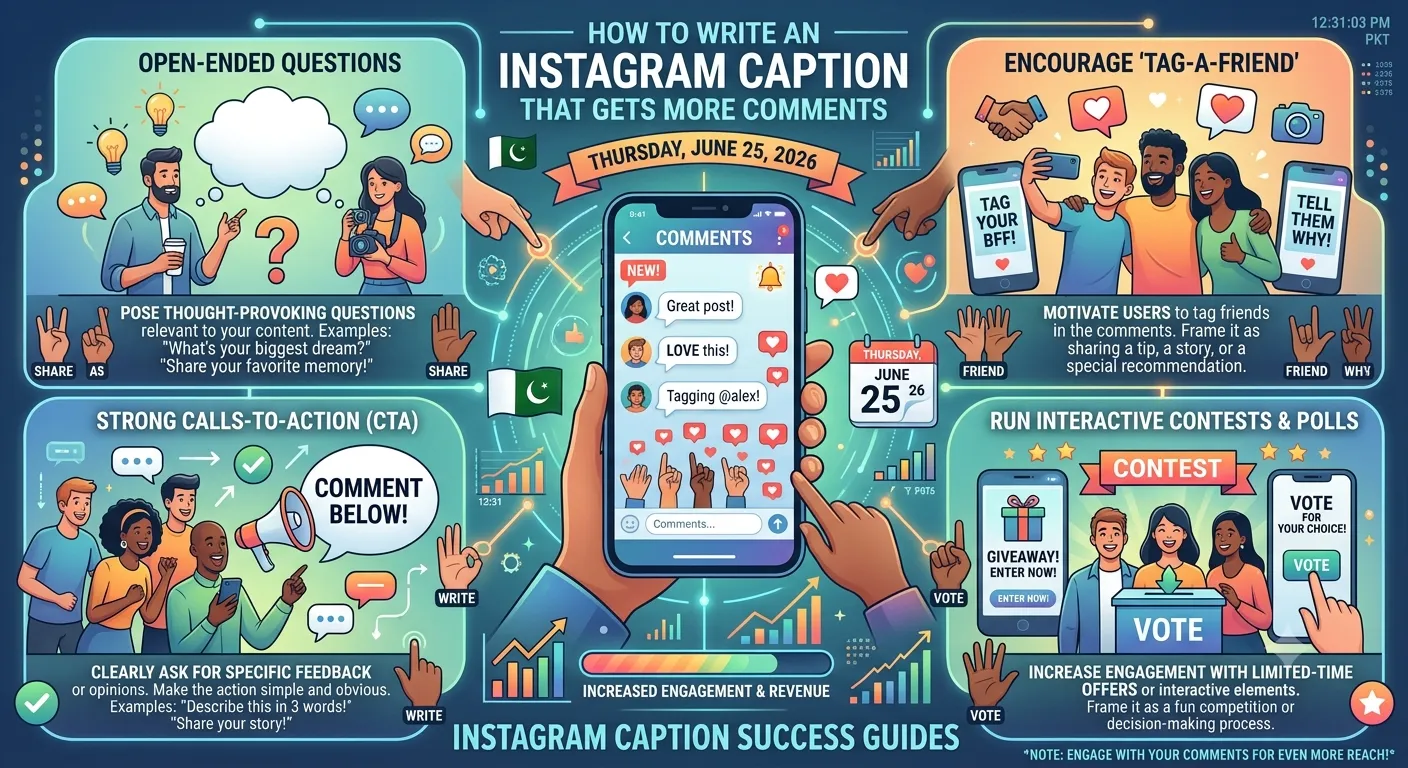
If there is one technique that consistently outperforms every other caption strategy for driving comments, it is ending the caption with a single specific, direct question.
The specificity matters enormously. Generic questions like "what do you think?" or "do you agree?" are so broad that they give viewers nothing concrete to respond to. Most people reading a generic question feel no particular pull to respond.
Specific questions that relate directly to the viewer's own experience or opinion give people something concrete to say. They trigger a specific thought or memory that the viewer then wants to share.
Compare these two versions of the same caption ending.
Generic: "What do you think about meal planning?"
Specific: "What is the one meal you make every single week without fail?"
The second version asks for something specific and personal that almost every follower has an immediate answer to. It requires no expertise and no particular investment in the topic. It just requires a brief personal reflection that takes less than a second to access.
The best caption questions share this characteristic. They are specific enough to trigger an immediate, concrete response but accessible enough that virtually anyone in the audience can answer without hesitation.
Caption Structure: How to Build Toward the Question
A caption that ends with a strong question still needs to earn the reader's attention through the preceding content. Here is a reliable structure that works across many content types.
The Hook Line
The first line of a caption is the only line visible before the viewer taps "more." This line needs to function like a headline, giving a compelling enough reason to expand the caption and read further.
The same hook principles that apply to Reels openings, as covered in Day 11's Reels guide, apply to caption first lines. A surprising statement, a specific counterintuitive claim, a highly relatable observation, or a direct address to the viewer's situation all work better than a slow, contextual opening that buries the interesting part.
The Body
The body of the caption delivers the content that justifies the hook. This might be the insight, the story, the useful information, or the perspective that the hook promised.
Caption length should match content requirements rather than any arbitrary target. Some content is well served by a single short sentence after the hook. Some content benefits from several paragraphs of genuine depth. The question to ask about every sentence in a caption body is whether it adds something the reader would miss if it were removed. Sentences that do not add something should be removed.
The Question
End with the specific question that invites the comment you want. One question works better than two or three. Multiple questions give readers too many options and often result in them answering none of them rather than any specific one.
Using Personal Stories to Drive Comment Empathy
One of the most reliable ways to generate substantial comment activity is sharing a personal story that a large portion of your audience can see themselves in.
When someone reads a post and thinks "that is exactly my experience," the instinctive response is often to say so. Comments like "this is literally me" or "I went through the exact same thing" are driven by recognition, the powerful feeling of seeing your own experience articulated by someone else.
Personal story captions work best when the specific details are vivid enough to be believable and real, but the underlying experience is universal enough that a large proportion of the audience has lived something similar.
The most effective format begins with a specific personal story, transitions to the broader insight or lesson that the story illustrates, and ends with a question that invites the reader to share their own parallel experience.
Taking a Clear Stance to Generate Discussion
Captions that express a clear, specific opinion on a relevant topic in your niche consistently generate more comment activity than captions that present balanced, hedge everything perspectives.
This does not mean being deliberately provocative or taking extreme positions for attention. It means genuinely sharing your actual perspective on something your audience cares about rather than softening every statement into something too safe to respond to.
When you express a clear opinion, readers who agree feel validated and want to say so. Readers who disagree feel compelled to respond with their own perspective. Both outcomes produce exactly the kind of substantive comment activity that benefits both algorithmic distribution and community building.
The key is ensuring the stance you take is genuine rather than manufactured for engagement. Audiences increasingly identify manufactured controversy, and the resulting comments tend to be hostile rather than productive.
Formatting for Readability
Even the best caption content will underperform if it is presented as a dense, unbroken block of text. Formatting affects whether people actually read what you write.
Line breaks between paragraphs create visual breathing room that makes captions significantly easier to scan and read. A line break after the hook line before the body content makes the hook stand out more clearly. A line break before the closing question gives it visual separation that increases the likelihood of readers noticing and responding to it.
Emojis used purposefully, as visual punctuation or to add tone where text alone falls flat, can improve scannability without adding clutter. Used excessively, they become noise that reduces rather than enhances readability.
Caption Length: Short vs Long
There is no universally correct caption length. Different content types and different audience relationships call for different approaches.
Short captions, sometimes a single sentence or even just the closing question, work well for visually dominant posts where the image or video carries the content and the caption simply invites response. They also work for brands with very established voices where brevity itself is a recognizable characteristic.
Longer captions work well for educational content, personal story content, and any post where the caption is doing significant value delivery beyond the visual. Longer captions tend to generate more comments when they are well written because they give readers more to respond to, but they need to earn the reader's attention through every line rather than relying on length alone to produce engagement.
The consistent finding across most accounts is that caption quality matters significantly more than caption length. A poorly written long caption consistently underperforms a well written short one.
Studying What Drives Comments in Your Niche
Beyond general caption techniques, studying what specifically drives comment activity in your niche provides the most directly applicable guidance for your own captions.
Using InstaPV, review the recent posts of high performing accounts in your space and pay specific attention to the captions on their highest engagement posts. Note the question types they use, the story structures they employ, and the stances they take. This niche specific observation gives you a grounded picture of what your shared audience responds to most strongly.
Common Caption Mistakes That Kill Comments
Writing captions entirely about the content rather than about the viewer is one of the most common engagement killers. Captions that describe what is in the image, summarize what was just said in the video, or explain what the account does without connecting to any viewer experience give readers nothing to respond to because the caption is entirely outward facing rather than creating any invitation for inward reflection.
Using weak closing calls to action like "let me know in the comments" without a specific question gives readers no concrete prompt. The vaguer the invitation, the weaker the response.
Asking multiple questions at once, as mentioned earlier, divides reader attention and often results in fewer responses than a single specific question would produce.
Writing captions under pressure at the last minute produces generic, low effort content that reflects the rushed conditions in which it was written. Treating captions as a primary creative investment rather than a quick final step in the content publishing process is one of the most impactful workflow changes available to most accounts.
Frequently Asked Questions
Q: How long should Instagram captions be for maximum engagement?
There is no universal answer since optimal length varies by niche, audience, and content type. The most reliable guidance is that captions should be exactly as long as they need to be to deliver their content and prompt a response, without padding for length or cutting for brevity at the expense of necessary content.
Q: Should every post end with a question?
Not necessarily every post, but the majority of posts aimed at building comment engagement should include some form of specific invitation to respond. Accounts that never ask questions in captions consistently generate less comment activity than those that do, across virtually every niche.
Q: Do hashtags in captions hurt readability?
Placing hashtags within caption text rather than separated at the end or in the first comment does reduce readability. As covered in Day 9's hashtag strategy guide, many accounts place hashtags in the first comment specifically to keep caption text clean and readable.
Q: How do I come up with specific questions that my audience will want to answer?
The most reliable source of good questions is close attention to what your audience already talks about in your existing comment sections. The topics, concerns, and experiences that your audience already references in comments are the ones they are most willing to discuss further. Reading your own comments actively is one of the best research tools available for caption question development.
-
Instagram Profile Audit: How to Review and Improve Any Account
-
Instagram Stories vs Reels vs Posts: Complete 2026 Guide
-
10 Ways InstaPV Helps Social Media Managers Save Time
Conclusion
A caption that drives genuine comment activity is not an accident. It is the result of a specific question, a clear structure, a genuine personal or intellectual investment in the content, and formatting that respects the reader's attention. The techniques in this guide work because they align with how people actually decide to comment, through personal recognition, genuine opinion, or a concrete question that demands a concrete answer.
Treating captions as a primary creative investment rather than a final step adds time to the content creation process. It also consistently produces better results than any amount of time spent on visual optimization alone.
Research caption and engagement patterns for top accounts in your niche on InstaPV →