Introduction
Market research has traditionally been expensive, time-consuming, and accessible primarily to larger organizations with dedicated research budgets. Instagram has changed this in a fundamental way. The platform contains an enormous, continuously updated dataset of real human behavior, expressed preferences, genuine opinions, and purchasing signals, all publicly visible to anyone who knows how to look.
The Instagram accounts people follow reveal their interests. The posts they comment on reveal what they care about deeply enough to respond to. The products they tag in their photos reveal their purchasing behavior. The questions they ask in comment sections reveal their unmet information needs. The language they use in their own captions reveals how they describe their problems, desires, and identity.
All of this is market research data. The difference between a business that treats Instagram as a posting channel and one that treats it as a research platform is often the difference between content that resonates and content that gets ignored.
This guide covers how to conduct thorough, actionable Instagram market research using primarily free tools and methods, organized around the specific research questions most valuable for content, product, and business strategy decisions.
What Market Research on Instagram Can Tell You
Instagram market research can answer a specific set of questions that are genuinely difficult to answer through other means.
Who is your target audience on Instagram, specifically? Not a demographic abstraction but real accounts with real content preferences, specific language patterns, and observable behavioral signals.Instapv
What content resonates most deeply with this audience? Not what you think they want but what they demonstrably engage with at above-average rates.
What problems, questions, and desires does this audience express openly? The unmet needs that represent product and content opportunities.
Who else is serving this audience and how? The competitive landscape that defines what your differentiation needs to be.
What language does this audience use to describe their situation, needs, and desires? The vocabulary that makes your content and messaging feel immediately recognizable and relevant.Read blog
Research Method 1: Audience Behavior Analysis Through Comment Section Mining
Comment sections on public Instagram posts are one of the richest and most underused market research sources available for free.
The process starts by identifying the five to ten accounts in your niche with the most active, engaged comment sections. Using InstaPV to check engagement rates helps identify which accounts generate genuine comment activity rather than just large follower counts that mask passive audiences.
Once you have identified the right accounts, spend systematic time reading through comment sections on their ten to fifteen most recent posts. The goal is not casual reading but active pattern recognition.
Record the specific language people use when expressing problems or desires related to the niche. A comment section on a fitness account where multiple people ask about working out with specific limitations, or where multiple people express frustration with a specific common approach, is showing you both the exact language your audience uses and the specific gap in currently available content and solutions.
Record the questions people ask most frequently. Repeated questions across multiple posts represent genuine information needs that are not currently being met satisfactorily by available content. These questions are both content ideas and potential product insights.
Record the personal contexts people share in their comments. When commenters on a personal finance account mention their specific income situations, family circumstances, or financial goals, they are giving you direct demographic and psychographic research data that no survey could produce as authentically.
Research Method 2: Hashtag Community Research
Hashtag communities on Instagram represent self-organized groups of people united by shared interests, experiences, or identities. Researching these communities provides market intelligence that is impossible to gather through conventional survey or focus group methods.
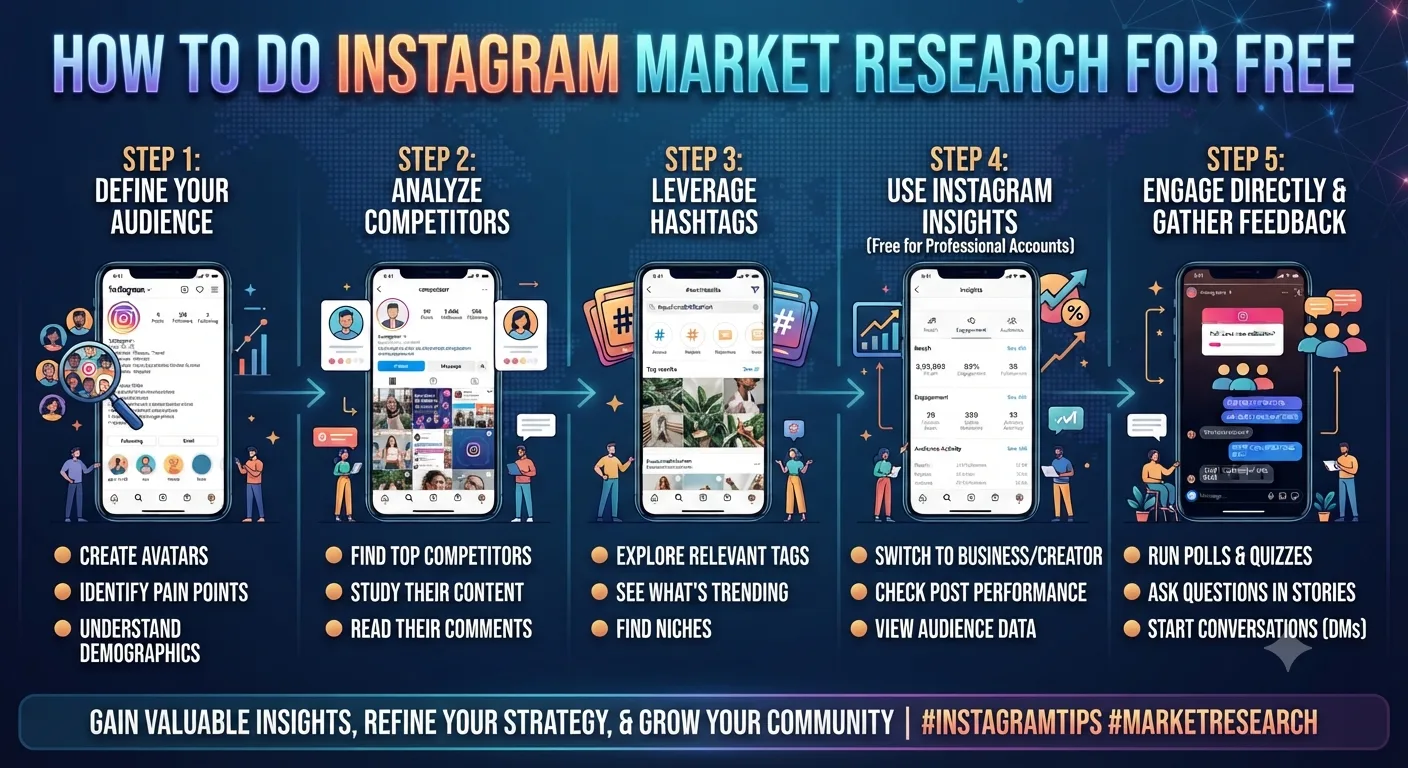
Start by identifying the hashtag ecosystem relevant to your research topic. This means finding not just the obvious top-level hashtags but the more specific sub-niche hashtags where the most engaged community activity concentrates, as covered in Day 9's hashtag strategy guide.
Browsing the Top Posts and Recent Posts within these hashtags provides several layers of market research intelligence simultaneously.
Content performance patterns reveal what specific angles, formats, and topics within the broader niche generate the strongest audience response. Top Posts within any hashtag have demonstrated above-average engagement from the community, which is a market research signal about what that community values most.
Language patterns across many posts in a hashtag reveal the specific vocabulary community members use to describe their experiences and needs. This vocabulary research is particularly valuable for creating content and copy that feels immediately native to the community rather than outsider-created.
Account patterns reveal who the influential voices in the community are, what their positioning is, and what gaps exist in the current landscape of voices serving this audience.
Research Method 3: Competitor Content Analysis Using InstaPV
Systematic competitor content analysis is one of the highest-value forms of Instagram market research because it reveals what is already working with the audience you are trying to reach, rather than requiring you to discover it from scratch.
Using InstaPV, identify the five to eight most relevant competitor or peer accounts in your space. For each account, review their follower growth trend and engagement rate to confirm they genuinely have an engaged audience rather than inflated numbers as covered in Day 18's fake follower guide.
For accounts confirmed to have genuine, engaged audiences, the market research process involves analyzing their content systematically across several dimensions.
Which content topics generate their highest engagement? Content that consistently outperforms the account's average engagement is telling you which topics the shared audience cares most about. This is direct evidence of market demand.
Which content formats generate their highest save rates? High save rates indicate content that the audience finds genuinely valuable as reference material, which reflects the most substantive forms of market need rather than purely entertainment preferences.
Which content topics generate the most substantive comment discussion? Active comment discussions reveal topics the audience has strong opinions about, which is often where the most engaged product and content opportunities exist.
What content gaps exist across the competitive set? Looking at what no competitor is covering well, or where all competitors are covering a topic superficially without genuine depth, reveals the clearest differentiation opportunities.
Research Method 4: Audience Listening Through Story Interactive Elements
For accounts that already have an Instagram following, Stories' interactive elements provide a direct, real-time market research capability that does not require any external tool or research infrastructure.
Poll stickers allow binary or multiple choice questions to be presented to the existing audience. For market research purposes, polls can test content preferences, product interest, feature prioritization, and problem prioritization with simple, low-friction participation.
Question stickers invite open-ended responses that reveal the specific questions, challenges, and interests of the existing audience in their own words. For niche accounts with engaged audiences, question sticker responses often surface the most specific and actionable market research insights available because they reflect genuine current concerns rather than responses to predetermined survey categories.
Quiz stickers can be used to assess the audience's knowledge level on topics relevant to the niche, which informs content complexity decisions and reveals educational gaps that represent content opportunities.
Slider stickers can gather quantitative interest signals across a spectrum for product or content ideas, showing how strong interest or agreement is rather than just whether it exists.
The advantage of Story-based market research is that participation requires minimal effort from the audience, making response rates significantly higher than traditional survey methods. The limitation is that only the existing follower base participates, rather than the broader potential market.
Research Method 5: User Generated Content Analysis
User generated content, posts that real customers create about products and experiences they have had, is some of the most valuable market research available on Instagram because it represents authentic, unprompted expression of real customer experience rather than responses to leading questions.
Searching for branded hashtags, product-specific hashtags, and category hashtags surfaces user generated content related to specific products, services, or experiences. Analyzing this content provides several layers of market intelligence.
Positive UGC reveals what customers value most about products and experiences in the category. The specific aspects they choose to photograph, the language they use in captions, and the contexts they show the product in all reveal what genuinely matters to real customers rather than what marketing materials claim should matter.
Critical UGC, including negative reviews, complaints, and expressions of disappointment in comment sections, reveals the specific failures and unmet needs in currently available solutions. These are often the most valuable market research signals because they point directly to the gaps that represent the strongest positioning opportunities.
The language used in UGC across many posts in a category reveals the vocabulary of real customer experience, which is the vocabulary that resonates most authentically in marketing copy and content creation.
Research Method 6: Influencer Audience Research
Public Instagram accounts with genuinely engaged audiences in your target niche represent natural samples of your potential customer base. The audience that follows and engages with a relevant influencer shares characteristics with the audience you are trying to reach, making their engagement patterns and behavior signals relevant market research data.
Using InstaPV to identify influencers with genuinely engaged audiences in your space, then systematically analyzing the comment sections of their high-performing content, provides the same type of audience behavior intelligence as direct comment mining but with the confidence that the audience is genuinely engaged rather than artificially inflated.
The specific market research value of influencer audience analysis comes from studying what specific types of content and topics within the niche generate the highest engagement from the influencer's audience. This tells you which sub-topics and angles resonate most with a sample of your potential audience, which directly informs content strategy and potentially product development priorities.
Research Method 7: Trend and Emerging Interest Detection
As covered in Day 15's trending topics guide, Instagram provides multiple signals for detecting what is gaining momentum within any specific niche before it reaches mainstream awareness.
For market research purposes, early trend detection is valuable because it reveals where audience interest is moving rather than only where it currently is. Business and content strategies built around emerging trends can establish authority in new areas before competition intensifies, while strategies built only around current trends are always competing on crowded ground.
The Explore page observation, hashtag Top Posts analysis, and fast-growing account research through InstaPV covered in Day 15 all provide the trend signals relevant to market research. The specific market research application is asking not just what is trending but what the trend reveals about shifts in audience needs, interests, or priorities that have longer-term strategic implications.
Organizing and Acting on Research Findings
Instagram market research produces value only when findings are organized and translated into specific decisions. A research session that surfaces interesting insights but produces no structural documentation or strategic action has limited practical value.
After any market research session, record findings in three categories.
Audience insights capture what you learned about who the target audience is, what specific problems and desires they express, and what language they use to describe their situation. These insights inform content tone, topic selection, and messaging strategy.
Content opportunities capture specific content ideas that the research reveals are likely to resonate with the audience, based on what generates strong engagement in comparable content and what questions and needs are not being adequately addressed by existing content.
Competitive gaps capture the specific areas where the competitive landscape shows weaknesses or absence that represent differentiation and positioning opportunities for your account or business.
Translating each finding category into specific planned content or strategy decisions within the same session preserves the value of the research by connecting it immediately to action rather than filing it away as interesting observations without implementation follow-through.
Frequently Asked Questions
Q: How often should I conduct Instagram market research?
A structured monthly research session, combined with lighter ongoing observation habits like regular Explore page browsing and comment section reading, maintains current market awareness without requiring unsustainable time investment. Markets move slowly enough that monthly structured research is generally sufficient for strategic planning purposes.
Q: Can I do meaningful market research on Instagram if I do not have an account?
Yes. Most of the research methods in this guide, comment section mining, hashtag community analysis, competitor content analysis through InstaPV, user generated content analysis, and trend detection, are accessible without an Instagram account. The Story interactive element research method is the only one that requires an existing follower base.
Q: How do I separate signal from noise when analyzing comment sections?
Focus on recurring patterns across multiple posts and multiple accounts rather than individual comments. A single comment expressing a specific need or frustration might be idiosyncratic. The same type of comment appearing across multiple posts on multiple accounts reflects a genuine pattern worth taking seriously.
Q: Is there any risk of confirmation bias in Instagram market research?
Yes. There is a natural tendency to notice and remember comments and signals that confirm existing beliefs while overlooking contradictory signals. The best protection is systematically recording all observations rather than selectively noting only those that fit pre-existing assumptions, and specifically looking for evidence that contradicts the hypotheses you are testing.
-
How to Spot Fake Instagram Followers Using Analytics
-
Instagram for Non-Profits: Grow Your Cause with Analytics
-
Best Instagram Analytics KPIs to Track Monthly
Conclusion
Instagram is one of the most accessible and richest sources of free market research available to any business, brand, or creator in 2026. The combination of comment section mining, hashtag community analysis, competitor content research through InstaPV, Story-based audience listening, user generated content analysis, influencer audience research, and trend detection provides a comprehensive market intelligence capability that would have cost significant budget through traditional research methods.
The organizations and creators that use Instagram as a research platform rather than only a content posting platform consistently develop better content strategies, more resonant messaging, and stronger product positioning than those who treat the platform purely as a distribution channel.
Start your Instagram market research with public account analytics on InstaPV →