Introduction
Fake Instagram followers are more pervasive than most people realize. A 2023 study estimated that somewhere between 10 and 15 percent of all Instagram accounts show signs of artificial follower inflation, and in the influencer marketing space specifically the problem is significant enough that brands have lost substantial amounts of marketing budget to partnerships with creators whose apparent audiences were substantially fake.
The challenge is that fake followers have become more sophisticated over time. Early fake follower services sold obviously fake accounts with no profile pictures, random usernames, and zero posts. These are still around but are now relatively easy to spot. More sophisticated services sell followers built on dormant real accounts, aged accounts with some content history, or networks of semi-active accounts that generate just enough activity to avoid the most basic detection.
The good news is that the fundamentals of fake follower detection remain effective regardless of how sophisticated the fake followers themselves become. The reason is simple: fake followers cannot generate genuine engagement. They cannot leave real comments about specific content. They cannot create the organic patterns of audience behavior that real followers produce. And the analytics patterns produced by real versus fake audiences are reliably distinguishable when you know what to look for.
This guide covers the complete analytics-based approach to fake follower detection for any public Instagram account.
Why Fake Followers Matter
Before getting into detection methods, it is worth being clear about why fake followers are a problem worth taking seriously.Instapv
For brands evaluating influencer partnerships, fake followers directly affect campaign ROI. Paying for access to an influencer's 500,000 followers when 200,000 of them are fake means paying for reach you will never achieve and conversion potential that does not exist.
For businesses assessing competitor Instagram presence, fake follower inflation can distort competitive benchmarking. A competitor that appears to have a much larger audience than you based on follower count may actually have a comparable or smaller genuine audience, which changes the competitive assessment significantly.
For account owners themselves, fake followers damage engagement rate, which as covered throughout this series is one of the primary factors in algorithmic distribution. A large proportion of fake followers suppresses the engagement rate that the algorithm uses to decide how widely to distribute content, creating a compounding disadvantage that grows over time.
Signal 1: Engagement Rate Relative to Follower Count
This is the most reliable and most important fake follower signal, and it is the one that should anchor any fake follower assessment.
As covered extensively throughout this series, engagement rate for genuine Instagram accounts falls within predictable ranges based on account size. The benchmarks from Day 8's engagement rate guide are worth repeating here specifically in the context of fake follower detection.
Accounts with fewer than 10,000 followers typically show engagement rates between 4 and 8 percent for genuinely organic audiences. Accounts between 10,000 and 100,000 followers typically show 2 to 5 percent. Accounts between 100,000 and 1 million followers typically show 1 to 2.5 percent.
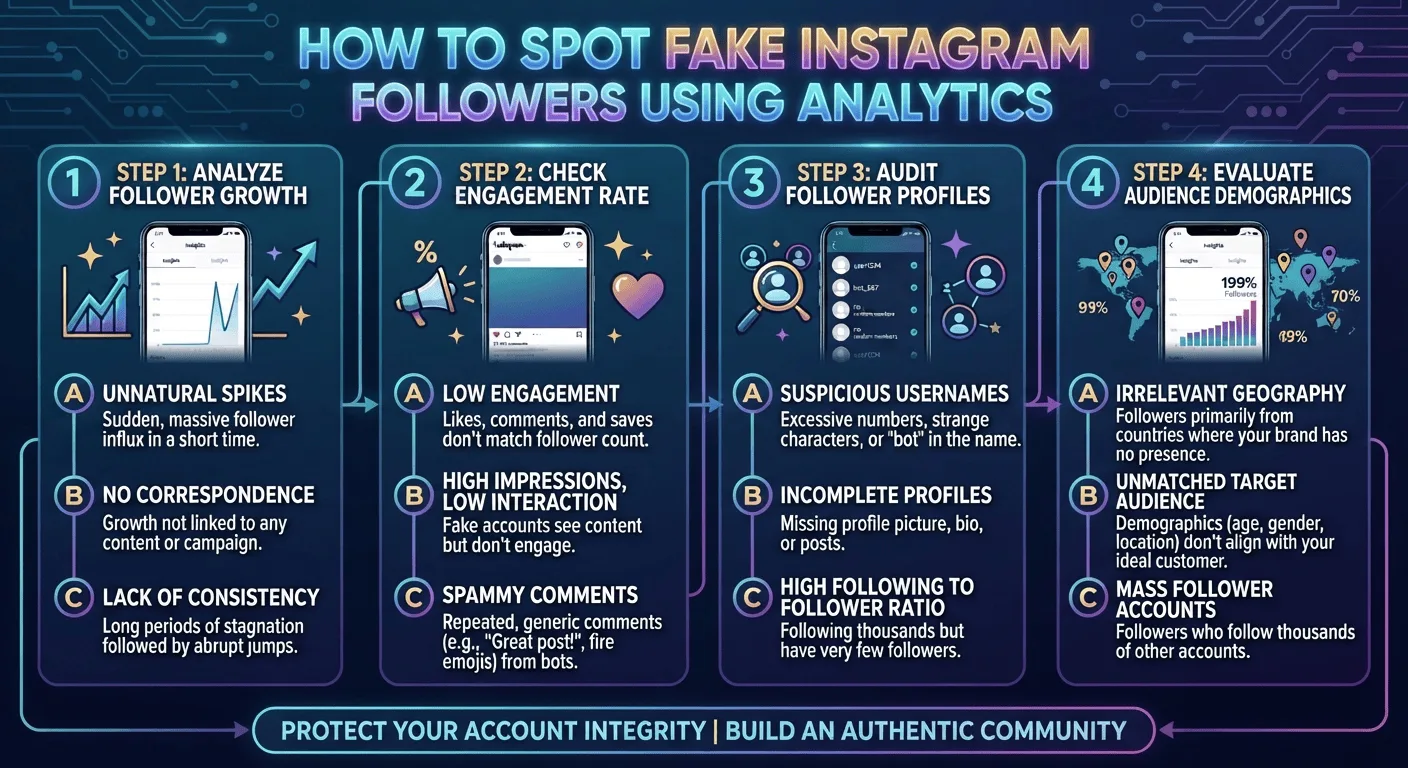
An account significantly below these benchmarks for its size is showing the primary quantitative signal of a fake follower problem. The math is straightforward: fake followers never engage, so every fake follower added to a denominator without contributing any engagement to the numerator pulls the engagement rate down.
An account with 200,000 followers and an engagement rate of 0.15 percent is generating roughly 300 engagements per post from an audience of 200,000 people. This level of engagement is statistically impossible for a genuine audience of this size regardless of content quality or niche. The only explanation that fits the data is a large proportion of fake or inactive followers.
Using InstaPV to check engagement rate trends for any public account makes this calculation immediate. The engagement rate is displayed directly in the analytics dashboard alongside follower growth data, allowing assessment without manual calculation.
Signal 2: Follower Growth Spike Patterns
The shape of a follower growth curve is one of the clearest visual indicators of fake follower purchases, and InstaPV's growth charts make these patterns immediately visible.
Genuine organic follower growth, as covered in Day 5's influencer tracking guide and Day 14's organic growth guide, produces a relatively smooth upward curve with occasional spikes that correspond to identifiable events: viral content, press coverage, collaborations with larger accounts, or significant campaigns.
Purchased follower growth produces a distinctly different pattern: near-vertical increases over very short periods, typically one to three days, that do not correspond to any identifiable content event. These spikes appear on the growth chart as sudden jumps that stand out sharply against the otherwise smooth or gradually-changing growth trend.
Additional patterns worth noting include sawtooth patterns where follower count increases sharply then decreases, indicating ongoing follower purchase activity followed by periodic removal of fake accounts by Instagram's detection systems. Multiple similar spikes at regular intervals, suggesting a subscription-based follower purchase service where new followers are delivered on a schedule, are also characteristic.
When reviewing any account's growth chart through InstaPV, look specifically for these patterns and attempt to explain any significant growth spike by reference to content published around that time. A spike that cannot be explained by any visible content or event is a strong signal of purchased followers.
Signal 3: Comment Quality and Authenticity
Engagement rate tells you how much interaction is happening. Comment quality tells you whether that interaction is genuine.
As established in Day 11's fake account detection guide and Day 12's caption guide, genuine comments share specific characteristics that distinguish them from fake or purchased engagement. They reference the actual content of the specific post rather than being generic enough to apply to any post. They are written in natural, varied language that reflects individual human expression. They often share personal context or ask specific follow-up questions. And they appear in a realistic temporal distribution, spread across different times, rather than clustering within minutes of posting.
Fake comments share the opposite characteristics. They are generic, often single words or short phrases like "great," "nice post," or "love this" without any content reference. They come in clusters of very similar responses posted within seconds of each other. Many come from accounts that themselves show fake account signals: no profile picture, random usernames, very few posts, very high following counts.
Spending five to ten minutes reading through the comment sections of recent posts on any account under evaluation provides a qualitative assessment that is genuinely informative even when quantitative metrics are inconclusive. An account with superficially reasonable engagement rate numbers but comment sections dominated by generic, non-specific responses has a qualitative engagement quality problem that the quantitative metrics are understating.
Signal 4: The Following-to-Follower Ratio
As covered in Day 11's fake account detection guide, the ratio between how many accounts someone follows and how many follow them in return carries meaningful information about how the following was built.
Genuine audiences built primarily through content merit show a natural follower-to-following ratio where the account is followed by significantly more accounts than it follows. A creator with 80,000 followers following 400 accounts has built their following through content. A creator with 80,000 followers following 75,000 accounts has built their following primarily through follow-back mechanics, which while not the same as buying followers, does indicate an audience of lower genuine interest than one built on content merit.
This ratio is one of the quickest screening signals for initial account assessment and can inform whether deeper investigation is warranted before investing time in more detailed analysis.
Signal 5: Audience Activity Patterns
For account owners reviewing their own analytics through Instagram Insights, audience activity patterns provide an additional signal layer for assessing follower quality.
A genuine audience from a specific geographic market shows activity patterns consistent with the time zones and behavior patterns of that market. Active hours concentrated during typical waking hours across the follower base's primary locations are expected and normal.
Unusual activity patterns, such as unexpectedly high activity during hours when the claimed audience demographic would typically be asleep, or activity distributions that do not match the geographic distribution shown in audience data, can indicate that the follower base includes a significant proportion of accounts from different geographic markets than the claimed audience, which is sometimes a signal of followers purchased from services that use account pools from specific regions.
This signal is primarily relevant for account owners assessing their own audiences rather than for external research, since activity pattern data is private to the account owner.
Signal 6: Like-to-Comment Ratio Anomalies
The natural ratio between likes and comments varies by content type and niche, but generally falls within a recognizable range for genuine audiences. Most posts receive more likes than comments since liking requires less effort.
Anomalous like-to-comment ratios can indicate specific types of purchased engagement. An account with very high like counts relative to comment counts may have purchased likes specifically without purchasing comment engagement, producing an unnaturally high like-to-comment ratio. Conversely, an account with high comment counts but very low like counts relative to follower size may have purchased comment engagement specifically, which is less common but does occur.
The key is that genuine audiences produce relatively consistent like-to-comment ratios across different posts of similar type. Significant anomalies from post to post, or ratios that deviate substantially from what other accounts of similar size and niche show, are worth noting as part of a broader assessment.
Combining Signals: A Scoring Framework
No single signal definitively proves an account has fake followers. The most reliable assessments combine multiple signals into an overall judgment.
A practical scoring framework assigns severity ratings across the six signals above and combines them to produce an overall assessment.
Engagement rate well below benchmark for account size: high severity signal. Unexplained follower growth spikes in the growth chart: high severity signal. Comment sections dominated by generic non-specific responses: medium-high severity signal. Very high following-to-follower ratio: medium severity signal. Anomalous audience activity patterns: medium severity signal for account owners. Unusual like-to-comment ratio anomalies: low-medium severity signal.
An account showing only one low-severity signal warrants monitoring but not immediate concern. An account showing two or more high-severity signals, particularly the combination of below-benchmark engagement rate and unexplained growth spikes, has almost certainly used artificial follower growth tactics at some meaningful scale.
Using InstaPV for Fake Follower Detection
InstaPV provides the two most important data points for fake follower detection directly in its analytics dashboard: the follower growth chart that makes spike patterns visually obvious, and the engagement rate trend that reveals whether interaction levels are consistent with a genuine audience of the account's size.
For any public account under evaluation, searching the username on InstaPV and reviewing these two elements in the analytics view takes less than five minutes and provides the core quantitative assessment foundation for any fake follower investigation.
The qualitative assessment of comment quality requires reviewing recent posts directly, which takes an additional five to ten minutes. The combination of InstaPV's quantitative analytics and manual comment quality review provides a thorough enough assessment for most practical evaluation purposes.
What to Do When You Find Fake Followers
The appropriate response to discovering fake followers depends on the context.
For influencer partnership evaluation, finding significant fake follower signals should at minimum prompt a direct conversation with the influencer requesting explanation of any growth anomalies and providing access to their Instagram Insights demographic data for verification. It should also prompt recalibration of the proposed partnership terms to reflect genuine audience size rather than total follower count if the partnership proceeds.
For competitive benchmarking research, discovering that a competitor has inflated their follower count through purchasing should adjust the competitive assessment by discounting their apparent audience size appropriately and focusing comparative analysis on engagement rate and genuine reach metrics that reflect real audience rather than inflated counts.
For account owners discovering fake followers in their own audience, removal is possible through third party follower audit tools that identify and allow bulk removal of suspect accounts. The short term effect of removing fake followers is a visible drop in follower count. The long term effect is an improved engagement rate, better algorithmic distribution, and a more accurately presented audience for any future partnership evaluations.
Frequently Asked Questions
Q: Can an account have fake followers without the account owner knowing?
Yes. Bot accounts and fake follower networks sometimes follow accounts automatically without any involvement from the account owner. This organic fake following is generally at a low level that does not significantly affect engagement metrics, but it does mean that some proportion of fake followers on any large account may not reflect deliberate inflation by the account owner.
Q: Is a low engagement rate always evidence of fake followers?
Not always. Very low posting frequency, a significant pivot in content direction that alienated the existing audience, or a period of algorithm changes affecting distribution can all produce temporarily suppressed engagement rates without fake followers being involved. Low engagement rate is a signal worth investigating rather than definitive proof, and the full set of signals should be reviewed before drawing conclusions.
Q: Can I determine the exact percentage of fake followers from public analytics?
No. Publicly available analytics do not allow calculating a precise fake follower percentage. The signals described in this guide allow identifying whether a significant fake follower problem likely exists and assessing its approximate scale, but precise percentage calculations require private analytics tools that analyze the individual follower accounts directly, which is not possible through public data alone.
Q: How long does it take Instagram to remove fake accounts after they are purchased?
Instagram's fake account removal is ongoing rather than periodic, but significant purges happen irregularly and can remove large numbers of fake accounts at once. The timing is unpredictable, which is one reason why the sawtooth growth pattern of purchase and subsequent removal is a common signal on accounts with ongoing fake follower activity.
-
Instagram Metrics That Actually Matter for Business Growth
-
How to Use InstaPV API for Developers and Businesses
-
Instagram for Non-Profits: Grow Your Cause with Analytics
Conclusion
Fake follower detection is a combination of quantitative analytics assessment and qualitative content review, both of which are accessible for any public Instagram account using InstaPV for the analytics layer and direct profile review for comment quality assessment.
The combination of below-benchmark engagement rate and unexplained follower growth spikes remains the most reliable indicator of significant fake follower inflation, supported by comment quality analysis and following ratio assessment as additional confirmatory signals. Applied systematically to any account under evaluation, this framework provides a reliable basis for fake follower assessment that protects against the most common and costly influencer marketing mistakes.
Check follower growth patterns and engagement rates for any public account on InstaPV →