Introduction
While mega-influencers and celebrities dominate headlines, the most cost-effective and frequently most impactful influencer partnerships happen at a smaller scale with micro-influencers whose smaller, highly engaged audiences often outperform massive followings on the metrics that actually matter for brands: trust, engagement, and conversion.
Micro-influencers typically defined as accounts with somewhere between 5,000 and 100,000 followers, though the exact range varies depending on who is defining the term occupy a sweet spot in influencer marketing. They are large enough to have meaningful reach and a degree of professional content quality, but small enough to maintain the personal connection with their audience that drives genuine trust and engagement.
The challenge for many brands is not understanding why micro-influencers are valuable, but actually finding the right ones accounts whose audience, content style, and values genuinely align with the brand, rather than accounts that simply meet a follower count threshold.
This guide covers exactly how to find, evaluate, and approach micro-influencers for your brand, with practical methods that work regardless of your industry or budget.
Why Micro-Influencers Outperform Larger Accounts for Many Brands
Before getting into discovery methods, it is worth understanding why micro-influencers have become such a significant focus of modern influencer marketing strategy.
Engagement Rate Advantage
As covered extensively throughout this series, engagement rate generally declines as account size increases. Micro-influencer accounts typically achieve engagement rates of 4 to 8 percent or higher, compared to engagement rates of 1 to 2 percent or lower for mega-influencer and celebrity accounts. This means a brand's sponsored content is statistically far more likely to generate genuine interaction likes, comments, saves, shares when placed with a micro-influencer than with a much larger account.
Audience Trust and Authenticity
Micro-influencers typically maintain closer, more personal relationships with their audiences. Followers often perceive micro-influencer recommendations as more genuine and less commercially motivated compared to recommendations from celebrities or mega-influencers who are widely understood to be paid for the vast majority of their content. This trust differential translates directly into stronger purchase intent and conversion from sponsored content.
Cost Efficiency
Micro-influencer partnerships typically cost a fraction of what mega-influencer or celebrity partnerships command, while frequently delivering comparable or superior engagement and conversion metrics relative to cost. This makes micro-influencer strategies particularly attractive for brands with limited marketing budgets or those wanting to test multiple partnerships rather than committing significant budget to a single large partnership.
Niche Audience Precision
Micro-influencers frequently serve highly specific niche audiences rather than broad general appeal, they have built dedicated followings around specific interests, locations, or communities. For brands targeting specific customer segments, this precision can deliver more relevant audience exposure than a larger, more general-interest account.
Scalability Through Multiple Partnerships
Because individual micro-influencer partnerships cost less, brands can often work with multiple micro-influencers simultaneously for the same budget that would secure a single larger partnership diversifying reach across multiple distinct audiences and content styles rather than concentrating risk and exposure in a single relationship.
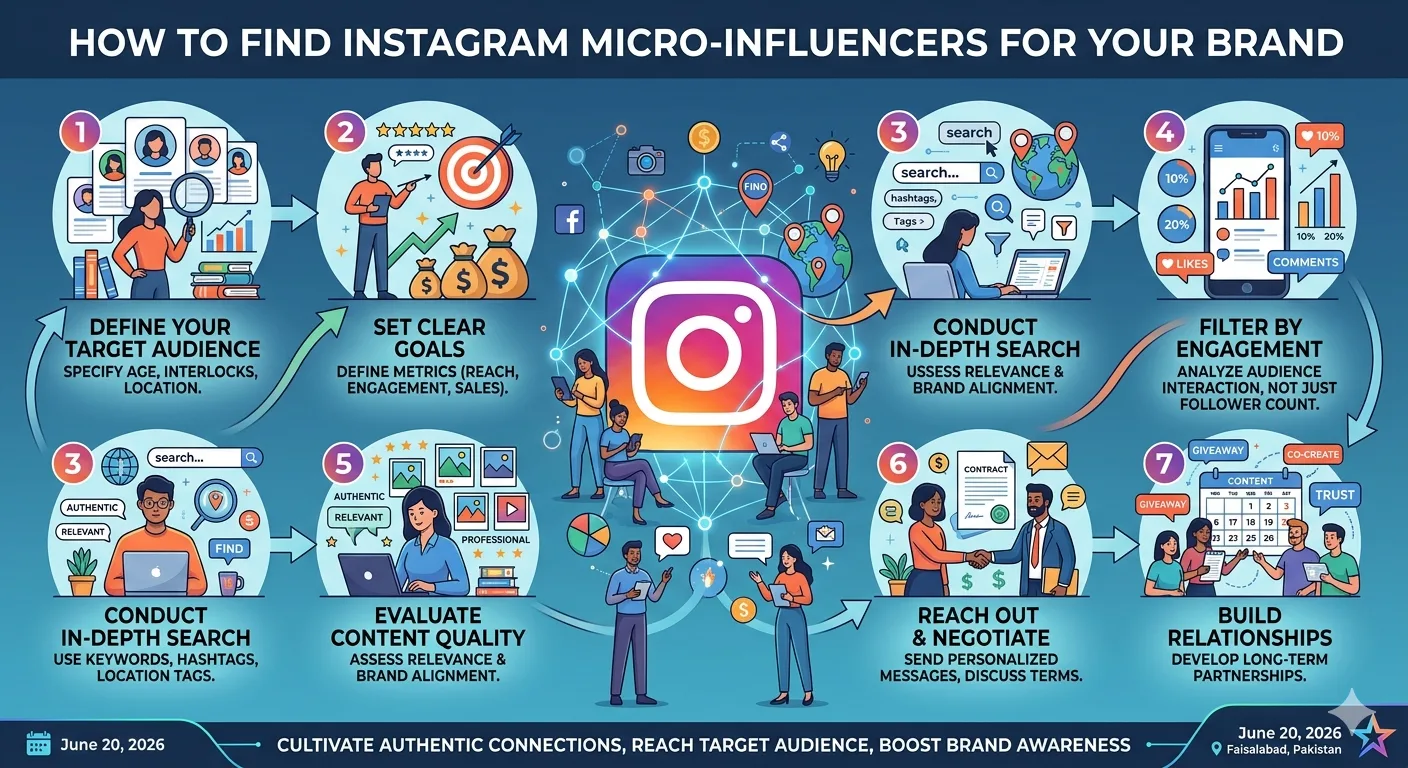
Method 1: Hashtag and Niche Search
The most direct method for finding micro-influencers is systematic search through hashtags and content relevant to your industry and target audience.
Building Your Hashtag Research List
Identify the specific hashtags your target audience and potential partners use both broad category hashtags and more specific niche hashtags. As discussed in earlier posts in this series, niche-specific hashtags with moderate post volumes (10,000 to 200,000 posts) tend to surface more relevant and discoverable accounts than massive, oversaturated hashtags.
Searching Top Posts vs Recent Posts
Within each hashtag, review both the Top Posts section (showing content that has generated strong engagement relative to the hashtag's typical performance) and the Recent Posts section (showing the latest content chronologically). Top Posts surfaces accounts that the algorithm has already identified as high-performing within that hashtag community. Recent Posts allows you to discover newer or smaller accounts that have not yet accumulated enough engagement history to consistently appear in Top Posts.
Documenting Candidates
As you discover accounts through hashtag search that fall within the micro-influencer follower range and appear to align with your brand, add them to a candidate tracking spreadsheet for further evaluation.
Method 2: Geographic and Local Search
For brands with a geographic component local businesses, regional service providers, brands launching location-specific campaigns Instagram's location tagging features provide a powerful discovery method specific to micro-influencer research.
Using Location Search
Instagram allows searching by specific location tags, surfacing content that has been geotagged at that location. For local businesses, searching relevant locations within your service area neighborhoods, landmarks, or business districts surfaces local accounts that frequently post about or visit relevant locations.
Identifying Local Micro-Influencers
Local micro-influencers are particularly valuable for location-specific campaigns because their audience is disproportionately likely to be geographically relevant to your business a significant advantage over influencers with geographically dispersed audiences, even larger ones, for businesses that depend on local customer acquisition.
Method 3: Competitor and Adjacent Brand Analysis
One of the most efficient discovery methods is examining which influencers your competitors and adjacent brands in your industry are already working with providing a pre-vetted starting pool of candidates with demonstrated relevance to your industry.
Researching Competitor Influencer Partnerships
Using InstaPV, review the content and tagged posts of direct competitors and adjacent brands in your industry. Look for sponsored content patterns, branded hashtag campaigns, and Collab posts that reveal which influencers these brands have worked with.
This research serves two purposes: it identifies micro-influencers who have already demonstrated willingness to work with brands in your space, and it gives you insight into how competitors are structuring their influencer partnerships, which can inform your own approach.
Evaluating Whether to Approach Competitor-Affiliated Influencers
An influencer who has worked with a direct competitor may not be the ideal candidate for your brand, depending on the specifics of exclusivity arrangements (if any) and how recently and prominently they featured the competing brand. However, influencers who have worked with brands in your broader category but not direct competitors are often excellent candidates, since they have demonstrated relevant audience fit without the conflict-of-interest considerations.
Method 4: Branded and Community Hashtag Monitoring
Many brands including your own, if you have an existing customer base on Instagram have organic mentions and tags from customers who may already be effectively functioning as micro-influencers without a formal partnership.
Monitoring Your Own Brand Mentions
Search for your branded hashtag (if you have one) and any general mentions or tags of your brand. Accounts that organically post positive content about your brand, particularly those with engaged micro-influencer-range followings, represent some of the most promising potential partners they have already demonstrated genuine affinity for your brand without any compensation, which is one of the strongest possible signals of authentic fit.
Identifying Brand Advocates for Formal Partnership
Customers and organic advocates who already create quality content about your brand are often more receptive to formal partnership discussions than cold outreach to influencers with no prior brand relationship, and the resulting content tends to feel more authentic since it builds on a genuine existing relationship with the brand.
Method 5: Influencer Discovery Platforms and Databases
Beyond manual search methods, dedicated influencer discovery platforms provide searchable databases of influencer accounts filterable by follower count, niche, location, engagement rate, and other criteria.
How These Platforms Work
Most influencer discovery platforms aggregate publicly available Instagram data and present it in a searchable, filterable database format, allowing brands to quickly narrow down candidates matching specific criteria rather than manually searching hashtags and competitor content.
Combining Platform Discovery With Manual Verification
While discovery platforms are efficient for generating initial candidate lists, the deeper evaluation process verifying engagement authenticity, reviewing content quality and consistency, and assessing brand alignment still requires the kind of manual research covered throughout this series using tools like InstaPV. Discovery platforms are best understood as a candidate generation tool to be followed by thorough individual evaluation, not a replacement for that evaluation.
Evaluating Micro-Influencer Candidates
Once you have built a candidate list through these discovery methods, the evaluation process follows the same framework covered in Day 7's influencer research walkthrough but with some considerations specific to the micro-influencer segment.
Engagement Rate Expectations
Apply the micro-tier engagement rate benchmarks discussed earlier in this series generally 4 to 8 percent for accounts in the 5,000 to 50,000 follower range. Candidates significantly below this benchmark for their size warrant the same scrutiny discussed in the red flags section of the influencer research walkthrough.
Content Consistency and Quality
Because micro-influencers often operate without professional production teams, content quality varies more widely within this segment than among larger, more established accounts. Look for consistency in posting frequency, visual style, and caption quality as indicators of a serious, professional approach even at a smaller scale.
Niche Alignment Precision
Micro-influencers' value often comes specifically from their niche precision. Evaluate not just whether a candidate's general category aligns with your brand, but whether their specific angle, sub-niche, and audience composition match your actual target customer profile precisely.
Authenticity Indicators
For micro-influencer evaluation specifically, pay particular attention to comment quality and the genuine, conversational nature of audience interaction this is often where micro-influencers' value is most apparent, since their smaller scale typically allows for more genuine, individual engagement with followers than larger accounts can maintain.
Reaching Out to Micro-Influencer Candidates
Once you have identified and evaluated strong candidates, the outreach approach for micro-influencers differs somewhat from approaching larger, more established influencers who may have professional management.
Personalize Every Outreach Message
Micro-influencers, unlike celebrities or mega-influencers, typically manage their own communications and can tell the difference between a personalized outreach and a generic template sent to dozens of accounts simultaneously. Reference specific content from their account, explain genuinely why you think they would be a good fit, and demonstrate that you have actually engaged with their content rather than just their follower count.
Be Clear About Compensation Expectations
Micro-influencer compensation varies widely some work for product exchange alone, particularly newer accounts, while more established micro-influencers typically expect monetary compensation appropriate to their engagement and audience size. Being upfront and transparent about what you are offering, while remaining open to negotiation, results in more productive initial conversations than vague outreach that leaves compensation unaddressed.
Propose Specific, Concrete Collaboration Ideas
Rather than a generic partnership inquiry, proposing a specific content idea or campaign concept tailored to the influencer's particular style and audience demonstrates genuine interest and makes it easier for them to envision and respond to the opportunity.
Building a Micro-Influencer Network Over Time
The most effective long-term micro-influencer strategies move beyond one-off partnerships toward building an ongoing network of relationships.
Start With Smaller Test Partnerships
Before committing to larger or longer-term arrangements, smaller initial partnerships a single sponsored post, a product exchange, a limited campaign allow you to evaluate actual performance and working relationship quality before scaling the partnership.
Track Performance Systematically
Using the tracking approaches covered in Day 5's influencer growth tracking post, monitor how each micro-influencer partnership performs over time, both during the active partnership and in terms of the influencer's broader account trajectory.
Maintain Relationships Beyond Single Campaigns
Micro-influencers who deliver strong results for an initial partnership are valuable ongoing relationships worth maintaining for future campaigns, seasonal content, or product launches building a network of trusted partners reduces the research and evaluation burden for future campaigns and often results in increasingly authentic content as the relationship and genuine brand familiarity develops over time.
Frequently Asked Questions
Q: What follower count range actually defines a micro-influencer?
Definitions vary, but the most commonly used range is approximately 5,000 to 100,000 followers, with some definitions narrowing this to 10,000 to 50,000 specifically. Accounts below 5,000 followers are often termed nano-influencers, while the upper boundary blends into the mid-tier influencer category.
Q: How many micro-influencers should a brand work with for a typical campaign?
This depends heavily on budget and campaign goals, but many brands find that working with five to fifteen micro-influencers for a coordinated campaign provides meaningful reach diversity while remaining manageable for coordination and quality control purposes.
Q: Do micro-influencers require formal contracts?
Yes, even for smaller partnerships, a clear written agreement covering compensation, deliverables, timeline, usage rights for the content, and disclosure requirements protects both parties and sets clear expectations, regardless of the partnership's scale.
- Q: How can I verify a micro-influencer's engagement is genuine rather than artificially inflated?
Apply the red flag assessment framework covered in Day 7's influencer research walkthrough checking for unexplained follower spikes, engagement rate consistency with account size benchmarks, and comment quality using InstaPV's analytics to review growth trends and engagement patterns over time rather than relying on a single snapshot.
Q: Should I prioritize follower count or engagement rate when comparing micro-influencer candidates?
For most campaign goals, engagement rate is the more reliable predictor of campaign performance within the micro-influencer category, since the follower count differences within this segment are generally less significant than the engagement quality differences. A candidate with 12,000 followers and 7 percent engagement is typically a stronger choice than one with 40,000 followers and 1.5 percent engagement.
-
How to Save Instagram Profiles to Track Progress Over Time
-
What Is an Instagram Engagement Rate and How to Calculate It
-
Instagram Stories Best Practices: 15 Tips for More Views
Conclusion
Micro-influencers represent one of the most cost-effective and consistently high-performing segments of influencer marketing, offering brands genuine engagement, audience trust, and niche precision that larger accounts often cannot match relative to cost.
Finding the right micro-influencer candidates requires moving beyond simple follower count searches toward systematic discovery through hashtag research, geographic and local search, competitor analysis, brand mention monitoring, and discovery platforms followed by thorough evaluation using the analytics and content review frameworks covered throughout this series.
With InstaPV providing free, anonymous access to the analytics data needed for thorough evaluation, building a strong micro-influencer strategy is accessible to brands of any size and budget.
Research and evaluate micro-influencer candidates on InstaPV →