Introduction
One of the most common conversations in social media management goes something like this: an account has been posting consistently for six months, follower count has grown modestly, engagement looks reasonable, and everyone involved has a general sense that things are going okay. But no one can answer the specific question: is the strategy actually working?
This ambiguity is usually not about a lack of data. Instagram generates enormous amounts of performance data. It is about the absence of defined success criteria. Without knowing what success specifically looks like for the account, there is no way to evaluate whether current performance represents genuine strategic success, adequate performance that falls short of potential, or the appearance of activity without meaningful underlying progress.
This guide covers how to define what success means for any specific Instagram account and strategic situation, how to translate that definition into trackable metrics with realistic targets, and how to build the ongoing evaluation process that answers the working question with evidence rather than intuition.Instapv
Why Most Instagram Strategies Lack Clear Success Criteria
The absence of clear success criteria in most Instagram strategies is not random. Several systematic factors produce this gap.
Instagram metrics are inherently multidimensional, with reach, engagement, follower growth, saves, shares, and business conversion metrics all telling different parts of the story. Without a framework for prioritizing which dimensions matter most for a specific account, all dimensions get tracked loosely without any being tracked rigorously enough to serve as meaningful success indicators.Read blog
The language around Instagram success is often borrowed from general marketing without being adapted to the specific characteristics of Instagram as a channel. Awareness, engagement, and conversion are real marketing objectives, but what awareness means for a local service business building a community Instagram presence is completely different from what it means for an e-commerce brand trying to drive online sales, and treating them the same produces metrics frameworks that serve neither well.
Realistic baseline expectations are genuinely difficult to set without either prior experience with the specific account or access to competitive benchmarking data. The absence of realistic expectations leads either to inflated targets that make any reasonable performance look like failure or to the absence of any specific targets that makes evaluation impossible.
Step 1: Define What Success Means for This Specific Account
Before any metric selection or target setting, answering the question of what success specifically means for this account in this context is the essential starting point.
The Business Objective Question
What does this Instagram account exist to accomplish for the business or person behind it? This question is more specific than it might appear.
For an e-commerce brand, success might mean driving sufficient website traffic that converts at adequate rates to produce positive ROI on the Instagram investment, as covered in Day 26's ROI measurement guide.
For a personal brand building toward coaching or consulting business, success might mean building sufficient audience trust and demonstrating sufficient expertise that a proportion of the audience becomes paying clients, as covered in Day 11's personal brand guide.
For a local service business, success might mean becoming sufficiently well-known within the local community that Instagram becomes a meaningful source of new client inquiries, as covered in Day 26's real estate guide in the context of client acquisition through Instagram.
For a content creator building toward brand partnerships, success might mean achieving the audience size, engagement rate, and niche authority that attracts partnership interest at target rate levels, as covered in Day 27's fitness influencer guide.
The specific business objective defines which metrics matter most because different objectives connect to different Instagram metrics through different causal chains.
The Stage of Growth Question
The appropriate definition of success also depends on where the account is in its development. As covered in Day 21's growth case study, accounts in different phases of the zero to 100,000 follower journey have different primary success metrics.
For accounts in the foundation phase under 1,000 followers, success means establishing the clarity, consistency, and early audience quality that creates the foundation for subsequent growth. The primary success metric is engagement rate quality from the early follower base rather than follower count growth rate.
For accounts in the early growth phase between 1,000 and 10,000 followers, success means developing the content-audience fit that triggers algorithmic amplification and beginning the collaborative and community engagement activities that accelerate organic growth. Primary metrics include engagement rate trend, non-follower Reel reach percentage, and the early indicators of genuine community formation.
For accounts in the growth acceleration phase between 10,000 and 50,000 followers, success means sustaining the content quality and strategic focus that maintains strong engagement as follower count grows and converts algorithmic reach into lasting audience relationships. Primary metrics include maintaining engagement rate at or above benchmark for account size and follower quality signals.
For accounts in the scale phase above 50,000 followers, success is increasingly defined by downstream business outcomes rather than pure Instagram metrics, since the audience is large enough that its connection to business results should be measurable.
Step 2: Select the Metrics That Measure Your Specific Success Definition
With the business objective and growth stage clearly defined, selecting the specific metrics that measure progress toward that objective is straightforward rather than overwhelming.
The Primary Metric
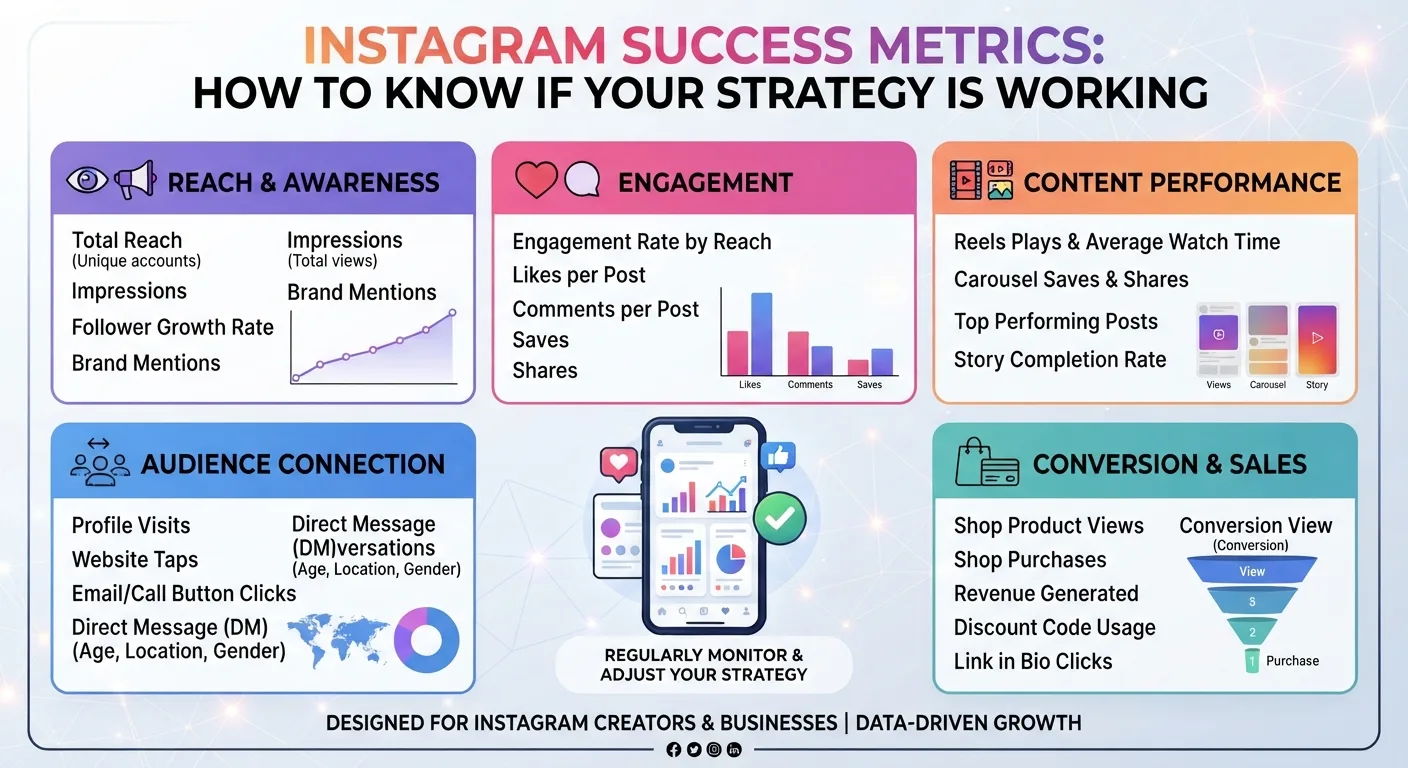
Every account strategy should have one primary metric that is the clearest indicator of whether the strategy is working. This is the metric that, if improving consistently over time, most directly indicates that the account is making progress toward its defined objective.
For an e-commerce brand, the primary metric is Instagram-attributed revenue or revenue from Instagram-sourced website conversions. For a personal brand building toward coaching, it might be the weekly volume of genuine inquiry messages or profile visits from relevant content. For a local service business, it might be the monthly count of client inquiries identifying Instagram as their discovery source.
The primary metric should ideally be a downstream business outcome rather than a platform metric, because platform metrics like engagement rate are intermediate indicators of strategy health while business outcome metrics directly measure whether the strategy is achieving its ultimate purpose.
Supporting Metrics
Three to five supporting metrics provide the leading indicators and diagnostic signals that explain movements in the primary metric and identify specific areas for improvement before problems show up in downstream business outcomes.
As covered in Day 19's KPI guide, the supporting metrics should collectively cover the major strategic functions: audience growth, content performance, audience quality, and business impact. Each supporting metric should have a clear logical connection to the primary metric, representing a step in the causal chain between Instagram activity and the primary business outcome.
For the e-commerce brand example, supporting metrics might include average engagement rate as an indicator of content quality and audience relationship, non-follower Reel reach percentage as an indicator of discovery effectiveness, website click-through rate from Instagram as the direct link between Instagram activity and website conversion opportunity, and site conversion rate from Instagram-sourced traffic as the efficiency measure for how well Instagram-sourced visitors match the buyer profile.
Diagnostic Metrics
Below the supporting metrics, additional diagnostic metrics are tracked for troubleshooting rather than for regular strategic evaluation. These are metrics that help identify the specific cause of a problem when supporting metrics show unexpected movements.
If engagement rate declines unexpectedly, diagnostic metrics including save rate by content type, posting time versus audience activity alignment, and comment quality assessment help identify whether the decline is from content quality deterioration, posting time drift from optimal windows, or audience composition change.
Step 3: Set Realistic Targets Based on Evidence
With metrics selected, setting specific numerical targets gives evaluation the precision that vague directional goals like grow follower count or improve engagement cannot provide.
Benchmarking Current Performance
Before setting targets, document current performance on every selected metric. This baseline is the reference point against which all subsequent targets are set and all future evaluation is conducted.
For metrics available through Instagram Insights, the baseline is the average across the most recent thirty days of consistent posting. For competitive benchmarks from InstaPV, document the current follower growth rate and engagement rate of the two to three most relevant comparison accounts. For business outcome metrics from Google Analytics, document the current monthly volume and conversion rate for Instagram-sourced traffic.
Using Competitive Context to Set Realistic Targets
As covered in Day 9's competitor analysis guide and throughout this series, using InstaPV to benchmark performance against comparable accounts provides the external reference needed to distinguish ambitious but realistic targets from targets that either undervalue genuine potential or demand impossible performance.
If comparable accounts in the niche are achieving engagement rates of 4 to 6 percent and the current account is at 2.1 percent, a target of 3.5 percent in three months is ambitious but realistic. A target of 8 percent in three months is not realistic based on what comparable accounts demonstrate is achievable. A target of 2.5 percent in three months is not ambitious enough to justify calling it a goal.
The Time Horizon Question
Targets need associated time horizons to be evaluable. As covered in Day 23's analytics-to-action guide, different types of metrics have different realistic improvement timelines.
Profile and content quality changes, like bio optimization or caption structure improvement, can show measurable effects within two to four weeks of implementation.
Engagement rate changes from content strategy adjustments typically show clear trends within six to twelve weeks of consistent implementation.
Follower growth rate changes from Reels investment or collaboration strategies typically show clear directional effects within four to eight weeks.
Downstream business metric improvements from Instagram strategy changes often take three to six months to show consistent patterns, because the lead time between Instagram discovery and business conversion can be substantial.
Step 4: Build the Evaluation Rhythm
With metrics and targets defined, the evaluation rhythm determines how frequently progress is assessed and what specific decisions each evaluation triggers.
The Monthly Review
As covered in Day 19's KPI tracking guide, monthly reviews assess progress on all selected metrics against baseline and targets. The specific questions the monthly review should answer are: is the primary metric improving at the expected rate, are the supporting metrics moving in directions consistent with eventual primary metric improvement, are there any supporting metrics showing unexpected movements that require diagnosis, and what specific strategy adjustments are warranted based on this month's data?
The output of each monthly review is a small set of specific strategy decisions for the following month, each traceable to specific data observations, as covered in Day 23's analytics-to-action guide.
The Quarterly Assessment
The quarterly assessment asks a more fundamental set of questions: is the overall trajectory of the account consistent with achieving the defined success criteria within a realistic time horizon, are the success criteria themselves still the right ones for the account's current situation and objectives, and are there any fundamental strategy elements that need to be reconsidered rather than incrementally adjusted?
This quarterly perspective prevents the situation where monthly adjustments are consistently navigating in the right direction on individual metrics but the overall account trajectory has drifted away from the fundamental objective without anyone noticing.
The Annual Strategy Review
Once per year, reassessing the fundamental definition of success for the account accounts for changes in business objectives, platform dynamics, competitive landscape, and account development that may have made the original success framework obsolete.
An account that defined success as building audience for coaching two years ago may now be large enough that the success definition should shift toward retention, client results demonstration, and premium tier audience development rather than pure growth. An account that defined success as Instagram-only ROI may now have enough audience to justify a success framework that includes cross-platform audience distribution and long-term brand equity rather than only direct Instagram conversion.
Common Evaluation Mistakes That Lead to Wrong Conclusions
Evaluating Too Early
As covered in Day 21's posting time analysis and multiple other posts throughout this series, Instagram strategy effects take time to manifest clearly. Evaluating engagement rate changes after two weeks of implementation, follower growth rate changes after one month of new content strategy, or business impact changes after three months of investment produces noisy, unreliable data that leads to abandoning effective strategies before they produce visible results.
Conflating Platform Metrics With Business Success
A beautiful engagement rate trend that does not translate into any measurable business outcome is Instagram success but not business success. Evaluating Instagram strategy purely through platform metrics without connecting to business outcomes produces optimization for platform performance rather than business performance, which are related but not the same thing.
Ignoring Competitive Context
As covered in Day 9's competitor analysis guide and throughout this series, evaluating performance without competitive context misses essential interpretation information. An engagement rate that is declining may still be above competitive benchmark and may reflect normal algorithmic dynamics rather than a specific strategy problem. An engagement rate that appears stable may be declining relative to competitors who are improving, indicating a competitive positioning problem that absolute metrics do not reveal.
Measuring Consistency Without Measuring Direction
Tracking metrics consistently without tracking their direction over time produces data that cannot answer the working question. It reveals where things are, not whether they are getting better or worse. Every metric should be tracked with a trend arrow indicating its direction over the relevant comparison period.
-
Privacy and Instagram: What Public Profiles Reveal About You
-
Instagram for Fitness Influencers: Awth, and
-
How to Find Niche Instagram Communities Using Search and Analytics
Q: What if my primary business metric is not directly attributable to Instagram?
For businesses with complex attribution environments or long conversion cycles, using the closest measurable proxy for the primary business outcome is more productive than abandoning business outcome measurement entirely. Tracking Instagram-attributed website traffic quality, lead inquiry volume from identified Instagram sources, or brand awareness survey results among Instagram followers all provide partial but meaningful evidence of business impact even when precise revenue attribution is difficult.
Q: How do I know when to change targets versus when to change strategy?
Change targets when the original targets were set without sufficient competitive benchmarking and prove to be unrealistically high or insufficiently ambitious based on subsequent competitive context research. Change strategy when performance is consistently below targets and the analytical diagnosis identifies specific strategy elements as the cause rather than external factors. The analytical framework in Day 23's analytics-to-action guide provides the hypothesis-test-adjust process that distinguishes strategy problems from target problems.
Q: Should success metrics differ for client accounts versus owned accounts?
Yes. For client accounts, success metrics should be defined collaboratively with the client based on their specific business objectives and agreed upon in writing before work begins, as covered in Day 20's client reporting guide. For owned accounts, success metrics should reflect the account owner's genuine priorities rather than industry convention.
Q: How does InstaPV support ongoing success evaluation?
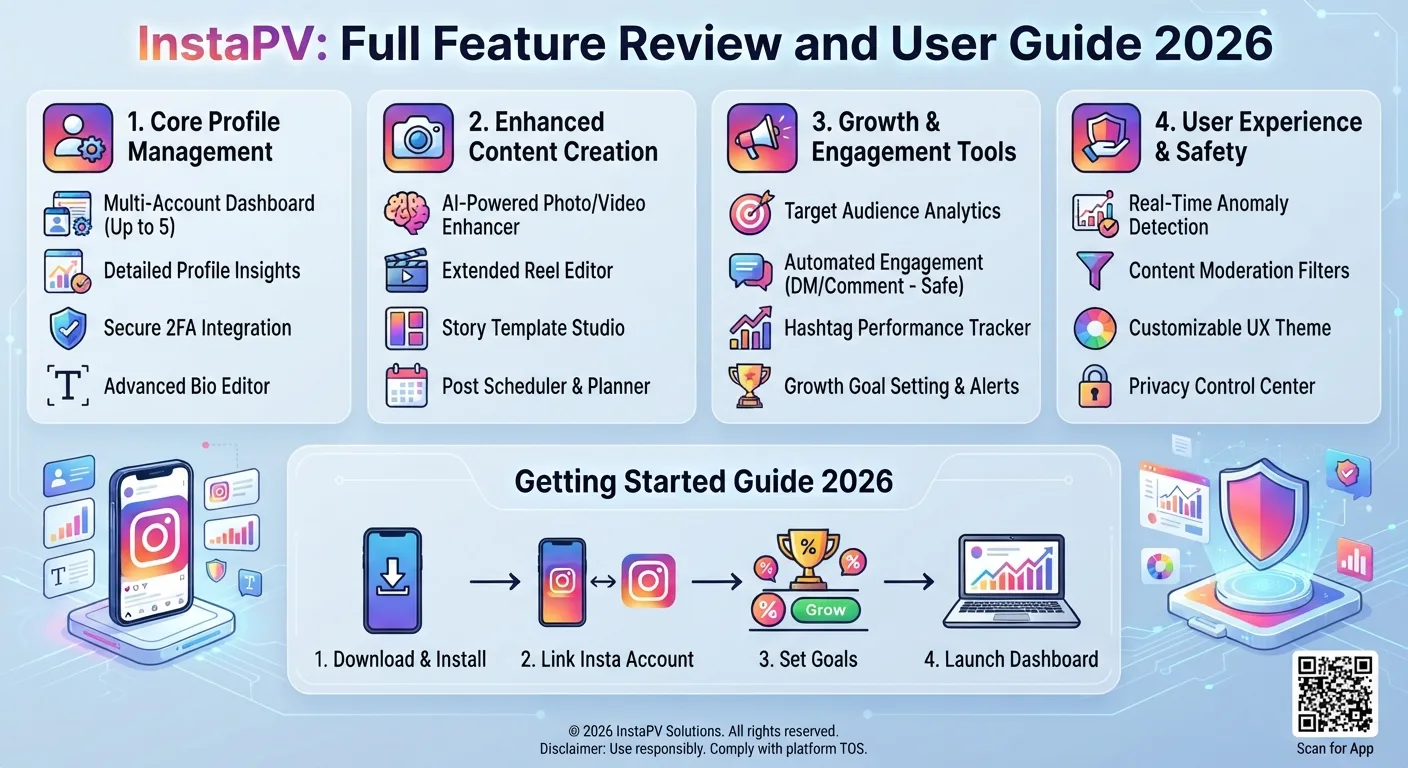
InstaPV's competitive benchmarking capability, providing follower growth and engagement rate data for comparable accounts in any public niche, is the primary support for the competitive context component of success evaluation. Monthly competitive benchmarking through InstaPV, as described in Day 19's KPI guide, ensures that absolute performance metrics are consistently interpreted within the relevant competitive context rather than evaluated in isolation.
Conclusion
Knowing whether your Instagram strategy is working requires a specific sequence: defining what success means for the specific account and objective, selecting the metrics that measure progress toward that definition, setting realistic evidence-based targets with clear time horizons, and building an evaluation rhythm that produces regular, actionable performance assessment.
The absence of any one of these components produces the ambiguous you know, things seem to be going okay assessment that characterizes most Instagram strategy evaluation and that fails to surface either genuine problems requiring strategic adjustment or genuine progress worth building on.
With all four components in place, the working question becomes answerable with evidence at every monthly review rather than remaining perpetually uncertain despite months of consistent effort.
Use InstaPV competitive benchmarking to contextualize your success metrics →