Introduction
Instagram now offers more content formats than at any point in its history. Stories, Reels, carousel posts, single image posts, and video posts all coexist on the same platform, each with different mechanics, different audience behaviors, and different relationships with the algorithm.
For anyone managing an Instagram presence, choosing the right format for each piece of content is one of the most consequential decisions in a content strategy. The same idea presented in the wrong format will consistently underperform compared to the same idea presented in the format best suited to how the audience engages with it.
This guide builds on the Stories versus posts comparison from Day 6 and the Reels strategy guide from Day 11 to bring all three major formats into a single comprehensive comparison. By the end you will have a clear framework for deciding which format to use for any specific piece of content.Instapv
Understanding What Each Format Is
Before comparing performance, it is worth being precise about what each format actually is and how it works.
Instagram Stories
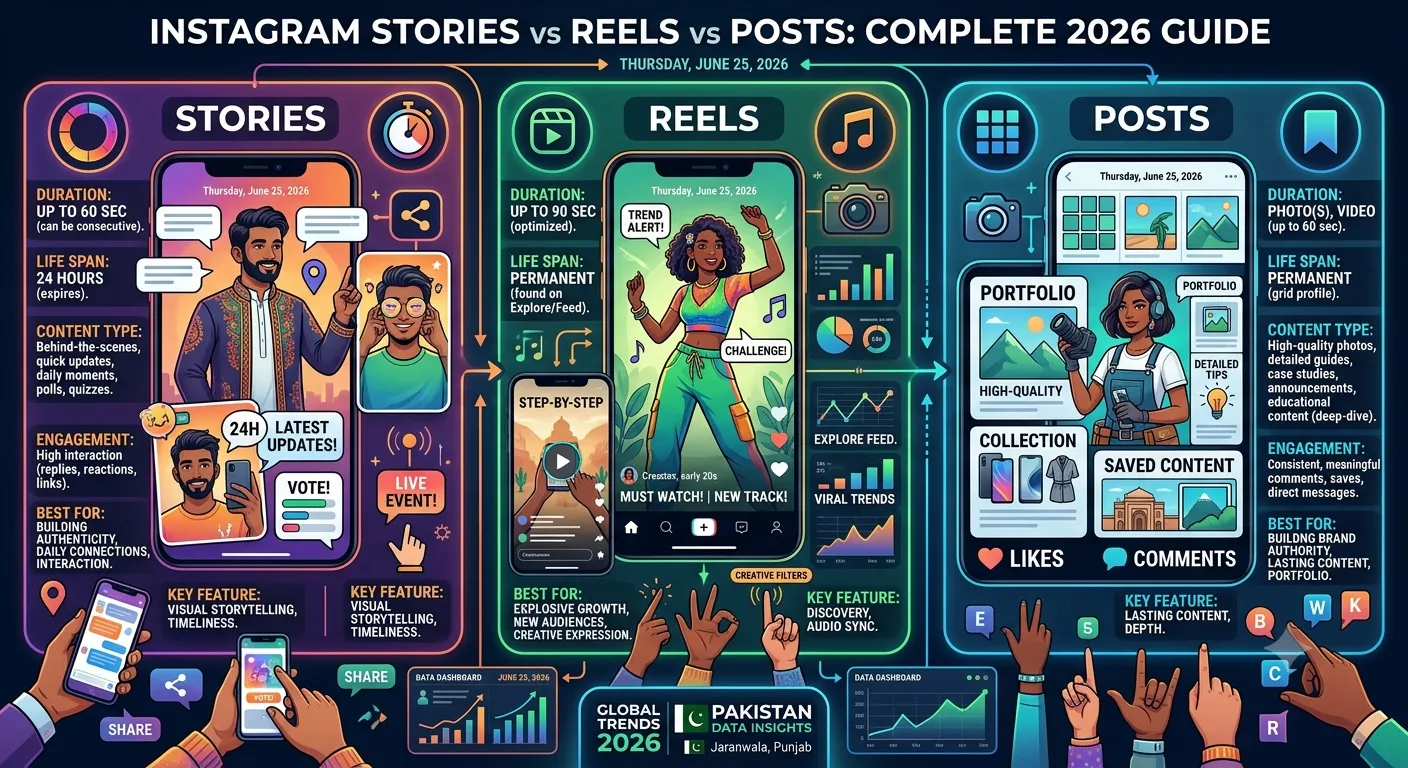
Stories are vertical full screen content that disappears after 24 hours unless saved to Highlights. They appear at the top of the app in the Stories bar for accounts a user follows. Stories can include photos, short videos, text overlays, interactive stickers, links, and a range of other elements. Each Story frame can be up to 60 seconds of video.
Stories are primarily a broadcast format for your existing followers rather than a discovery format for new audiences. As covered in Day 6's comparison post, they reach the people who already follow you rather than distributing content broadly to new viewers.
Instagram Reels
Reels are short to medium length vertical videos, currently up to 90 seconds for most accounts though Instagram has been testing longer formats, that appear in the Reels tab, the Explore page, and within the main feed. Reels are the platform's primary discovery format and can reach significant audiences beyond existing followers through algorithmic distribution.
As covered extensively in Day 11's Reels strategy guide, watch time and completion rate are the dominant algorithmic signals for Reels distribution.
Feed Posts
Feed posts include single images, carousel posts with multiple images or slides, and video posts that appear in the main scrollable feed. Feed posts are permanent, visible on your profile indefinitely, and accumulate engagement over time. They reach primarily existing followers through the main feed but can reach new audiences through the Explore page and hashtag pages.
Carousels specifically have the additional distribution mechanic mentioned in Day 7's trends post, where Instagram can re-serve the carousel starting from a different slide to followers who saw but did not engage with the initial delivery.
Reach: Which Format Reaches the Most People
Reach works differently for each format and the answer depends on whether you are measuring reach among existing followers or reach to new audiences.
Reaching New Audiences
Reels are the clear leader for reaching audiences beyond your existing followers. The Reels tab and the algorithmic distribution to non-followers through Explore and the main feed Reels section provide the most significant organic discovery surface available on Instagram in 2026.
Feed posts, particularly those that achieve Explore page placement, can also reach new audiences but typically at lower scale than well performing Reels. Carousels with high save rates receive additional distribution as discussed in the Day 7 trends post.
Stories reach almost exclusively existing followers and contribute virtually nothing to reaching new audiences. They are not distributed to non-followers through any surface.
Reaching Existing Followers
All three formats reach existing followers, but they do so through different mechanisms and with different levels of reliability.
Stories appear at the top of the app every time a follower opens Instagram, giving them the highest visibility per posting event for existing followers who open the app regularly. However, completion rates mean not every follower who sees your Story bubble in their bar actually watches the content.
Feed posts appear in followers' main feeds but the algorithm determines placement, meaning not every post reaches every follower. Strong early engagement improves main feed placement as covered in Day 7's algorithm post.
Reels appear in followers' main feeds alongside feed posts and are subject to the same algorithmic placement considerations.
Engagement: What Kind of Interaction Each Format Drives
Engagement works differently across formats both in type and in depth, as first discussed in Day 6's Stories versus posts comparison.
Stories Engagement
Story engagement is personal and direct. The primary engagement signals are views, completion rate, and replies, which are direct messages sent in response to a Story. Interactive elements like polls, quizzes, and question boxes generate responses that represent active audience participation rather than passive viewing.
Story engagement is private and ephemeral. It does not appear publicly on your profile and disappears with the Story. But the quality of story engagement, particularly replies and interactive element responses, represents some of the deepest audience relationship signals available on the platform.
Reels Engagement
Reel engagement is driven by watch time and completion, with likes, comments, shares, and saves adding to the signal. As covered in Day 11, shares and saves are particularly valuable for Reels because they signal genuine content value that drives algorithmic amplification.
Comments on Reels tend to be more active than comments on feed posts for many account types, partly because Reels often surface to non-followers who discover the content and comment as part of a first interaction with the account.
Feed Post Engagement
Feed post engagement is public, permanent, and cumulative. Likes and comments accumulate visibly on the post indefinitely and contribute to how new profile visitors perceive the account's health. Saves and shares are the highest value engagement signals as covered throughout this series.
Carousels specifically tend to generate higher save rates than single image posts because their multi-slide structure creates reference worthy content that people want to return to, as discussed in the Day 11 Reels guide's mention of the carousel resurgence.
Algorithm Treatment: How Each Format Is Distributed
The algorithm treats each format through different ranking systems as detailed in Day 7's full algorithm guide.
Stories Algorithm
Stories are ranked in each follower's Stories bar based on relationship strength, recent interaction history with that account's Stories, and completion rate patterns. The algorithm prioritizes showing Stories from accounts whose Stories the viewer has consistently watched and interacted with, and deprioritizes accounts whose Stories the viewer regularly skips.
Reels Algorithm
Reels are evaluated primarily on watch time, completion rate, and replay rate. Strong performance on these signals triggers distribution to non-followers through the Reels tab and Explore page. Originality and the absence of watermarks from other platforms affect recommender eligibility as covered in Day 11.
Feed Post Algorithm
Feed posts are ranked in followers' main feeds based on interest prediction, relationship strength, and recency as covered in Day 7. Posts that achieve strong early engagement receive elevated placement in followers' feeds and may be distributed to non-followers through the Explore page.
Content Lifespan: How Long Each Format Remains Active
This is one of the most practically significant differences between formats.
Stories disappear after 24 hours unless saved to Highlights. Their engagement window is limited to that period, though Highlights extend specific Stories indefinitely.
Reels are permanent on your profile and continue to accumulate views and engagement over extended time periods. A well performing Reel can continue being distributed by the algorithm days or weeks after posting. This long tail distribution makes Reels significantly more time efficient per piece of content than Stories.
Feed posts are permanent and accumulate engagement over time. While the majority of engagement typically happens within the first 24 to 48 hours, posts continue to be visible on the profile indefinitely and can be rediscovered through profile visits, hashtag pages, and Explore.
Production Requirements: What Each Format Demands
Understanding production requirements helps with realistic content planning.
Stories have the lowest production barrier of any format. They are designed for quick, authentic, low effort content that does not require the same production standards as permanent content. A Story can be a quick text post, a candid photo, or a brief impromptu video recorded on a phone without any additional setup.
Feed posts sit in the middle of the production spectrum. Single image posts require photography or graphic design effort. Carousel posts require multiple coordinated pieces of content. The permanence of feed posts creates a higher quality expectation than Stories since the content remains visible on the profile indefinitely.
Reels have the highest production requirements of the three formats. Strong hook execution, tight editing, audio consideration, and on screen text for silent viewers all require more deliberate production effort than Stories or simple feed posts. The competitive landscape for Reels attention has also raised the baseline quality expectation in most niches.
When to Use Each Format: A Decision Framework
Combining all the above, here is a practical decision framework for choosing between formats.
Use Stories When
You want to maintain daily connection with existing followers without the production demands of permanent content. You have time sensitive information that is relevant now but not worth permanent profile placement. You want to build direct conversation through replies and interactive elements. You want to drive traffic to a recent feed post or Reel by alerting your existing followers to it. You want to share authentic behind the scenes content that humanizes your brand without affecting your feed aesthetic.
Use Reels When
Reaching new audiences beyond your existing followers is a primary goal. You have content that works well in short to medium video format and that benefits from motion rather than static presentation. You want to maximize the potential reach ceiling of a specific piece of content. You have educational or entertainment content that can hold attention from opening to close and that benefits from long tail distribution over multiple days or weeks.
Use Feed Posts When
You are creating content that should remain permanently accessible on your profile. You have educational or reference worthy content that benefits from the carousel format's multi-slide structure and high save rate potential. You want to build your profile's permanent content library that new visitors encounter when they first discover your account. You have high quality photography or visual content that works better as a static image than as a video.
The Coordinated Approach: Using All Three Together
As introduced in Day 6's Stories versus posts comparison, the most effective Instagram strategies use all three formats in a coordinated way rather than choosing one exclusively.
A typical coordinated content arc might look like this. A Reel introduces a topic to new audiences with strong hook and efficient value delivery. A follow up feed post, often a carousel, goes deeper on the same topic for the followers the Reel attracted, providing reference worthy content they can save. Stories throughout the week maintain daily connection with existing followers, build anticipation for upcoming content, and drive traffic back to the Reel and the feed post for anyone who missed them.
This three format coordination creates a content flywheel where each format reinforces the others rather than operating in isolation.
Frequently Asked Questions
Q: Should I prioritize Reels over other formats if growth is my main goal?
Yes, with qualification. Reels are the primary growth format and should receive meaningful allocation in any growth focused content strategy. However, feed posts build the permanent content library that converts Reel viewers into followers once they visit your profile, and Stories maintain the relationship with existing followers that keeps them engaged over time. Growth through Reels without the supporting formats produces less durable results.
Q: Do carousels or single images perform better for feed posts?
Carousels consistently outperform single images for save rate and often for overall engagement rate, as discussed in Day 7's trends post covering the carousel resurgence. For content that benefits from multi-slide structure, carousels are the stronger choice. For content that works as a single powerful image, single posts remain effective.
Q: Does posting frequency need to be different across formats?
Yes. Stories benefit from higher frequency, ideally daily or near daily, since their 24 hour lifespan means gaps are more noticeable. Reels and feed posts benefit from consistency at a lower frequency, typically two to four of each per week, prioritizing quality over volume.
Q: Can the same content be repurposed across all three formats?
Yes with adaptation. A piece of content designed for one format rarely works perfectly in another without modification. A Reel script can become a carousel with each key point as a slide. A carousel can be summarized in a Story series. Adapting the core idea rather than directly copying the content between formats produces better results than treating repurposing as a simple copy-paste exercise.
-
10 Ways InstaPV Helps Social Media Managers Save Time
-
How to Write an Instagram Caption That Gets More Comments
-
Instagram Profile Audit: How to Review and Improve Any Account
Conclusion
Stories, Reels, and feed posts each serve distinct purposes within a complete Instagram strategy. Understanding what each format does well, what algorithm treatment it receives, what engagement it drives, and what production it requires allows you to assign content ideas to the format where they will perform best rather than defaulting to a single format out of habit or convenience.
The most effective accounts use all three formats deliberately and in coordination, creating a content system where each format strengthens the others rather than competing with them for the same time and audience attention.
Research how top accounts balance content formats in your niche on InstaPV →