Introduction
Most Instagram users think about privacy in binary terms: their account is either public or private, and if it is public, they have accepted that their content is visible. But the practical reality of what a public Instagram profile reveals about a person is significantly more complex and more revealing than this simple framing suggests.
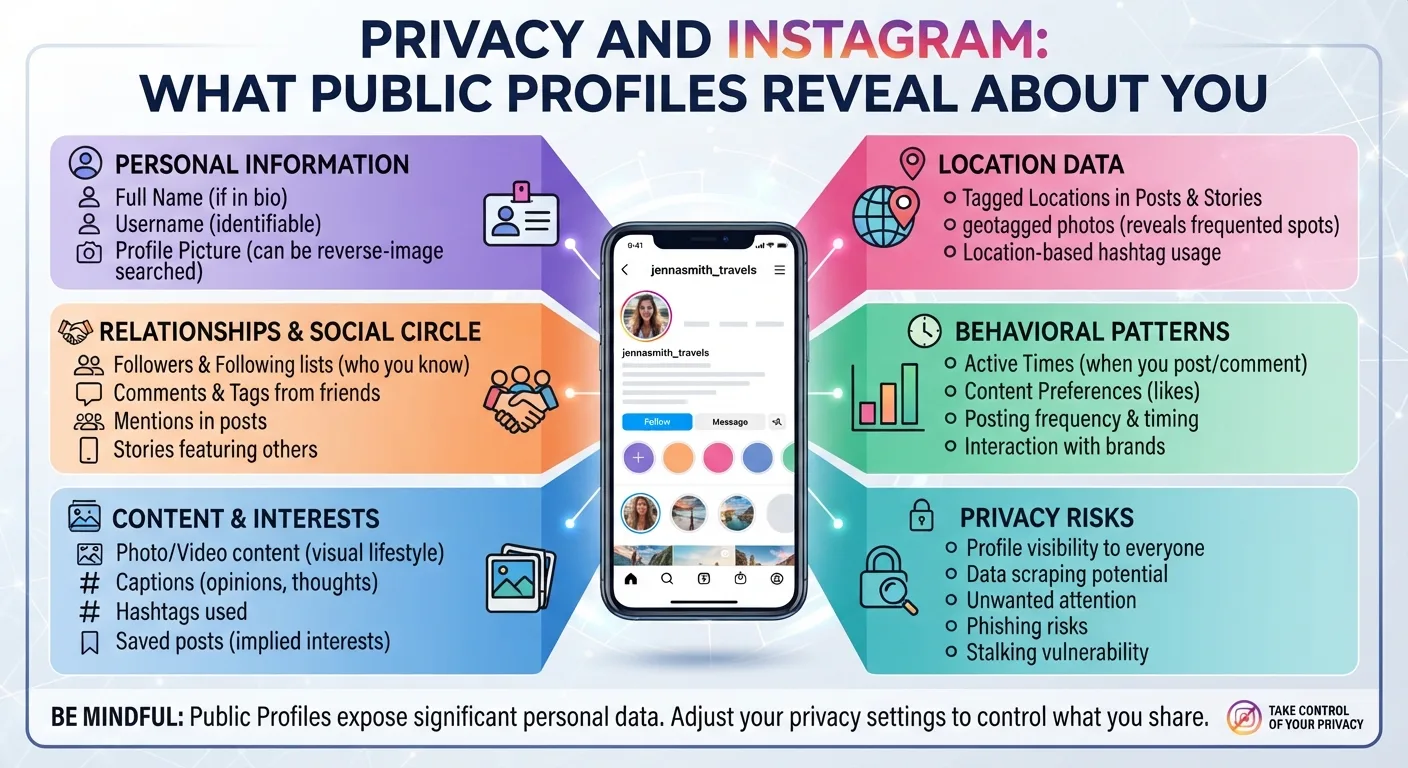
A public Instagram profile is not just a collection of photos and captions. It is a detailed data landscape that reveals, to anyone who takes the time to look, an extensive picture of where a person goes, who they spend time with, what they care about, how they spend their money, what their daily routines look like, where they live and work, what their relationships are, what their politics and values are, and much more. This information exists not in any single post but in the aggregate of everything a public account has published over time.
This guide covers exactly what public Instagram profiles reveal, how this information can be aggregated and used, what the practical privacy implications are for different types of users, and how to make more informed decisions about what you share publicly without necessarily making your account private.Instapv
The Aggregation Problem: Why Individual Posts Reveal More Than They Seem
The most important privacy concept for understanding Instagram public profiles is the aggregation problem. Any individual post on a public Instagram account may reveal relatively little sensitive information. A photo of a meal at a restaurant reveals almost nothing on its own. A photo from a hiking trail reveals very little on its own. A photo from a neighborhood park reveals very little on its own.
But when you aggregate dozens or hundreds of such posts from the same public account, patterns emerge that reveal specific, sensitive information that no individual post discloses.
A year of restaurant photos with location tags reveals not just that someone likes to eat out, but which specific restaurants they frequent, which neighborhoods they visit regularly, approximately what their income level might be based on the establishments they patronize, and who they typically dine with based on consistent companion appearances.
A year of hiking and outdoor activity posts reveals not just that someone is active outdoors, but which specific trails and areas they visit, the typical times and days of their outdoor activities, and potentially where they live based on which trailheads they consistently start from.
A year of park and neighborhood photos reveals not just that someone likes outdoor spaces, but which specific neighborhood they live in, the approximate block they frequent, and potentially their home address if the combination of regular location tags triangulates to a specific area.
None of this information is disclosed in any single post. All of it is disclosed by the aggregate of a public account's posting history to anyone willing to spend time reading through it.Read blog
What Location Data Reveals
Location data embedded in Instagram posts, whether through the explicit location tag feature or through visual context in images and captions, is one of the most revealing categories of information on public accounts.
Explicit Location Tags
When a user tags a specific location on an Instagram post, they are creating a public record linking their presence to a specific place at a specific time. A single location tag is minimally revealing. A pattern of location tags across months or years creates a detailed map of the person's movements, habits, and regular locations.
Explicit location tags can reveal home neighborhood or approximate home address through the clustering of tags around a specific area. They reveal workplace location through patterns of midday or morning tags at or near a specific office location. They reveal routine locations like gyms, coffee shops, and grocery stores through their recurrence. And they reveal travel patterns, social habits, and lifestyle through the broader distribution of non-routine location tags.
Visual Location Disclosure
Beyond explicit location tags, visual content itself reveals location information to viewers who are familiar with the area depicted or who are motivated to identify the location from visual cues.
Distinctive architectural features, recognizable landmarks visible in the background, street signs partially visible in images, neighborhood-specific visual characteristics, and the combination of multiple background elements can all allow someone motivated to do so to identify a specific location from an image even without any explicit tag.
For most viewers, this level of analysis is not applied. For someone with specific motivation to identify a public account holder's location, such as a stalker, a targeted scammer, or any other bad actor, this visual analysis is a realistic threat.
Real-Time Location Disclosure
Stories with location tags disclose real-time location in ways that are particularly sensitive from a safety perspective. A person who regularly posts Stories from their home neighborhood with location tags, or who posts Stories while traveling that reveal when their home is unoccupied, is creating real-time location disclosure that goes beyond the retrospective pattern analysis possible from feed posts.
What Relationship Data Reveals
Public Instagram accounts reveal relationship data through several mechanisms that individually seem innocuous but collectively create a detailed picture of the account holder's personal network.
Tagged People
When another account is tagged in a post, Instagram creates a visible link between the two accounts. A pattern of tags with the same accounts over time reveals close relationships. The nature of the content in which someone is tagged reveals the type of relationship, whether romantic, familial, professional, or social.
Consistent Appearance of Same People
Even without explicit tags, consistent appearance of the same face or faces in public posts reveals regular presence in the account holder's life. The relationship can often be inferred from the contexts in which the same person appears.
Follower and Following Lists
For public accounts, the follower and following lists can reveal relationship information through the specific accounts followed. A public account following a specific person's private account, for example, suggests a relationship that neither account has publicly disclosed. Mutual follows between accounts, particularly between a public figure and a private individual, can reveal relationships that both parties might prefer to keep private.
Comment Relationship Patterns
Patterns of consistent, familiar comment interactions between specific accounts reveal relationship closeness in ways that go beyond what either account may have explicitly disclosed. An account that consistently receives comments using familiar or intimate language from specific other accounts is publicly signaling the existence of those close relationships regardless of any explicit statement about them.
What Daily Routine Data Reveals
Public Instagram accounts, particularly those of active daily posters, often inadvertently reveal detailed daily routine information through the aggregate of their posting behavior.
Posting time patterns reveal when the account holder is typically awake and active. Consistent morning posts at specific times reveal wake-up routines. Consistent late-night posts reveal sleep patterns. The absence of posts during specific time windows can reveal work schedules.
Content patterns by time of day reveal routine structure. Consistent breakfast posts at specific times, gym posts before work, coffee shop posts during specific hours, and dinner posts in the evening collectively reveal a detailed picture of daily routine that could be used by someone seeking predictable access to the person.
For most people, this level of routine visibility is not a significant concern because they are not subjects of specific bad-actor interest. For public figures, people in protective custody or witness protection contexts, or people with specific safety concerns about known bad actors, routine disclosure through Instagram posting patterns can be a genuine safety issue.
What Financial Information Reveals
Public Instagram posts often inadvertently reveal significant information about a person's financial situation, both directly and indirectly.
The quality and frequency of restaurant dining posts, the brands and price points of clothing and accessories visible in posts, the type and location of accommodation in travel posts, and the neighborhood visible in home-adjacent posts all provide signals about income level and spending patterns.
Travel frequency and destination quality reveal disposable income. Vehicle visible in posts reveals approximate financial status. Home visible in posts, whether owned or rented and in what neighborhood, reveals financial position.
For most people, financial information visible in Instagram posts is not particularly sensitive in isolation. In combination with other visible information, particularly for people who might be targets of financial fraud, social engineering, or relationship fraud, this financial visibility creates vulnerability.
What Behavioral and Psychological Data Reveals
Perhaps the most underappreciated category of information public Instagram profiles reveal is behavioral and psychological data: information about personality, values, beliefs, political orientation, mental health, and personal struggles.
Caption content reveals political and social values through the perspectives expressed, the causes supported, and the events celebrated or criticized. The brands and accounts followed and engaged with reveal ideological orientation through pattern analysis. Reaction to events and public moments reveals values and personality characteristics.
Mental health visibility on public accounts is a specific area of concern. Public accounts that include discussions of mental health struggles, anxiety, depression, grief, or relationship difficulties provide information that could be used by bad actors to manipulate the account holder through social engineering, targeted scams, or romantic manipulation that exploits disclosed vulnerabilities.
The behavioral patterns visible through Instagram engagement history, including what the account likes, comments on, and shares, reveal psychological characteristics and interests that go beyond what the account holder explicitly states.
Practical Privacy Guidance for Public Account Holders
Understanding what public accounts reveal does not necessarily mean making accounts private. For many users, particularly creators, businesses, and public figures, the visibility is intentional and appropriate. The goal is informed decision-making rather than universal restriction.
Location Tag Hygiene
Avoiding location tags that identify home address or immediate home neighborhood significantly reduces the most sensitive category of location disclosure. Using neighborhood-level rather than specific address-level location tags for local content, avoiding tags that identify home when posting from home, and avoiding real-time location disclosure in Stories while home are all practical steps that reduce location vulnerability without significantly affecting content quality.
Timing Delay for Location-Sensitive Content
Posting travel content after returning from a trip rather than in real time eliminates the real-time home-vacant disclosure risk that live travel posting creates. Similarly, posting about distinctive home location contexts with a delay reduces the real-time location disclosure that enables physical vulnerability.
Relationship Disclosure Awareness
Being conscious of what relationship information is revealed through consistent tags, mentions, and visible companion appearances gives account holders agency over what their network visibility communicates. For people who want to keep specific relationships private, avoiding consistent public co-presence on Instagram is the most effective approach.
Routine Pattern Awareness
For people with specific safety concerns, varying posting times and being conscious of what routine patterns are revealed by consistent posting behavior reduces the predictability that could be exploited.
What Third Party Tools Can and Cannot Access
As covered throughout this series, tools like InstaPV access publicly available content from public accounts. Understanding exactly what this means for the privacy of public account holders is part of a complete privacy picture.
InstaPV and similar tools can access everything on a public account that is visible to any unauthenticated visitor: posts, Stories during their 24-hour window, Highlights, profile information, and engagement metrics. This is the same information available to any person who visits the profile without logging in, accessed without requiring authentication.
What these tools cannot access is anything that requires account authentication or involves non-public data: private account content, private direct messages, archived content, Instagram Insights analytics, or any other data that Instagram restricts to the account owner or authenticated followers.
The practical implication for public account holders is that the privacy concern is not specifically about tools like InstaPV but about what is publicly posted in the first place. The tool does not change what information is available. It changes the efficiency and scale at which that already-available information can be accessed and analyzed.
The Privacy-Visibility Trade-off
For most Instagram users, particularly those who use the platform for professional or creative purposes, making an account entirely private is not a realistic solution to the privacy considerations above. The visibility that enables discovery, community building, and professional opportunity is incompatible with restricting all content to an approved follower list.
The more realistic approach is thoughtful public posting that extracts the benefits of visibility while minimizing the most sensitive categories of disclosure. This means being deliberate about location specificity, conscious about relationship disclosure, careful about real-time location posting, and aware of what routine pattern information is accumulating in the aggregate posting history.
-
How to Create an Instagram Audit Report for Free
-
Instagram for Real Estate: Using Profile Analytics to Win Clients
-
How to Use Public Instagram Data for Academic Research
Frequently Asked Questions
Q: Should I make my Instagram account private because of these privacy concerns?
This depends entirely on your situation and goals. For most creators, businesses, and public figures, the benefits of public visibility outweigh the privacy considerations, particularly when those considerations are managed through the practical hygiene steps described above. For private individuals with no professional need for public visibility, private accounts provide meaningful additional protection against the aggregate disclosure described in this guide.
Q: Does deleting old posts improve my privacy on a public account?
Yes, to some extent. Removing old posts that contain specific location or relationship information reduces the aggregated data available about past patterns. However, content that has already been cached, screenshotted, or archived by third parties or by the Wayback Machine may remain accessible even after deletion from Instagram itself.
Q: Can people find my home address from my public Instagram?
This depends on what you post. The specific combination of frequent location tags in a specific area, visual content showing recognizable location features near home, and routine posting patterns can allow a motivated person to identify your home neighborhood or in some cases your specific address. This is not the typical use of Instagram but represents the vulnerability for people with specific safety concerns.
Q: Does using tools like InstaPV to view someone's public profile violate their privacy?
As covered in Day 9's anonymous viewing ethics guide and Day 13's journalism guide, viewing publicly available content from public accounts does not violate privacy in the legal sense since the account holder has chosen to make the content publicly accessible. The ethical considerations discussed in this guide relate more to what account holders choose to post publicly than to whether viewing that public content is appropriate.
Conclusion
A public Instagram account reveals significantly more than most account holders consciously intend to share through any individual post. The aggregation of location data, relationship signals, routine patterns, financial indicators, and behavioral information across the full posting history of a public account creates a detailed personal information landscape that is available to anyone who accesses the public account.
For most Instagram users, the practical implications of this do not require dramatic action. Thoughtful location tag hygiene, awareness of real-time location disclosure risks, and consciousness about what sensitive categories of information are accumulating in the aggregate posting history are the most practical responses for the vast majority of public account holders.
For people with specific safety concerns, the profile of what a public account reveals should inform a more careful and deliberate approach to what is posted publicly, potentially including switching specific categories of content to private accounts or omitting them from Instagram entirely.
Research what any public Instagram profile reveals using InstaPV →