Introduction
Instagram and e-commerce have a relationship that has deepened steadily since the platform introduced shopping features. For product based businesses, Instagram now functions as a complete discovery to purchase pipeline, capable of moving a potential customer from never having heard of a brand to completing a purchase without ever leaving the app.Instapv
But the brands using Instagram most effectively for e-commerce are not simply running product ads or posting catalog images. They are building genuine audiences, creating content that earns organic reach, using shopping features strategically rather than reflexively, and treating Instagram as a brand building channel as much as a direct sales channel.
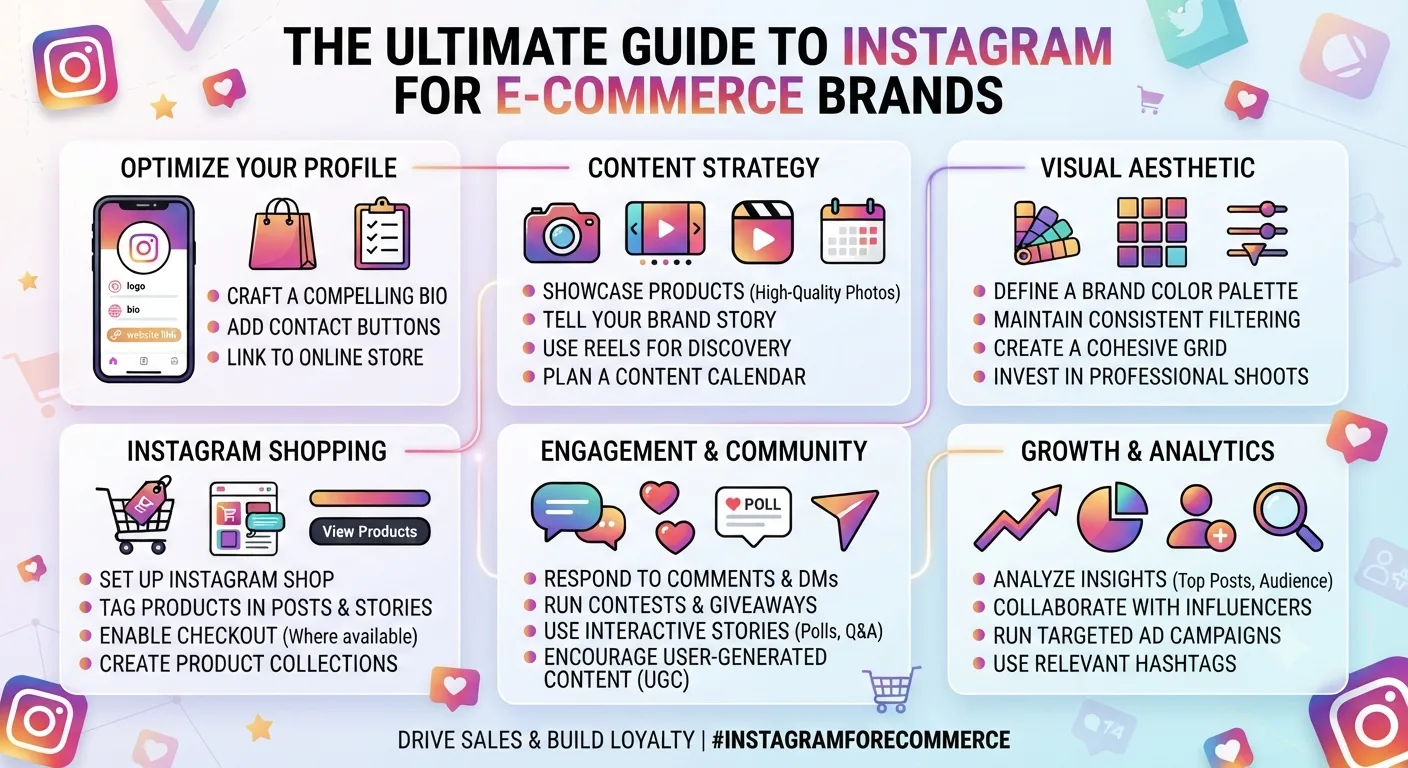
This guide covers the complete approach to Instagram for e-commerce brands in 2026, from setting up correctly through content strategy, shopping features, advertising, analytics, and competitive research.
Setting Up an E-Commerce Instagram Account Correctly
The foundation of an effective e-commerce Instagram presence is technical setup that enables all the shopping and analytics features the platform offers.
Business Account and Commerce Eligibility
An Instagram business account is the starting requirement for any e-commerce brand. As covered in Day 10's small business guide, business accounts provide access to Insights, contact buttons, and the ability to run paid promotions.
Beyond the basic business account, Instagram's Commerce eligibility requires compliance with its commerce policies and connection to a product catalog through either the Meta Commerce Manager or a connected e-commerce platform integration. Major e-commerce platforms including Shopify, WooCommerce, and BigCommerce offer direct Instagram integration that simplifies catalog connection and keeps product information synchronized between your store and Instagram.
Product Catalog Setup
The product catalog is the foundation of Instagram Shopping features. A complete, accurate catalog with high quality product images, clear product titles, accurate pricing, and complete product descriptions enables the full range of shopping features including product tagging in posts and Stories, the Shop tab on your profile, and collection organization.
Investing time in catalog quality pays returns across every shopping feature that draws from it. Poor catalog images or incomplete product information undermine the impression created by otherwise strong content.
Shop Tab Optimization
The Shop tab on your Instagram profile functions as a storefront within Instagram. Organizing products into logical collections, writing clear collection and product descriptions, and featuring your strongest selling products prominently in the shop gives profile visitors a direct path to purchase discovery beyond your content feed.
Content Strategy for E-Commerce Brands
The most effective e-commerce Instagram content is not primarily promotional. As noted in Day 10's analysis of Nike's Instagram strategy, the brands with the strongest Instagram presences in e-commerce rarely lead with direct product promotion. They build audiences through content that is genuinely interesting and valuable, then convert that audience through strategic product integration.
Content Pillars for E-Commerce
A well designed content pillar structure for an e-commerce brand typically balances four content types.
Product focused content shows products in context and in use rather than as catalog images. Lifestyle photography that shows real people using products in real environments, process content showing how products are made or sourced, and comparison content helping customers understand product differences all serve commercial purposes while remaining genuinely interesting.
Educational content relevant to the product category builds audience and trust simultaneously. A skincare brand that educates its audience about ingredients, skin types, and skincare routines is building the knowledge base that makes its products more desirable while providing genuine value independent of any specific purchase intent.
Community and user generated content featuring real customers using products provides social proof that brand created content cannot replicate. Reposting customer content, with permission, shows potential buyers how real people experience the products rather than only how the brand presents them.
Brand story and values content builds the emotional connection that differentiates brands operating in competitive product categories. Content showing sourcing practices, manufacturing processes, team members, and brand values creates brand identity that goes beyond product specifications.
Product Photography and Visual Standards
As a visual platform, Instagram requires product photography that meets a consistently high visual standard. This does not necessarily mean expensive professional photography for every post. It means understanding the visual standard that your specific niche and audience expects and meeting it consistently.
Lifestyle product photography, showing products being used in natural settings relevant to the target customer's life, consistently outperforms pure product shots for engagement on Instagram because it helps potential customers visualize the product in their own context rather than as an object in isolation.
Visual consistency across the feed, as covered in Day 7's analysis of major brand accounts, creates the accumulated brand recognition that compounds over time and makes each new post feel familiar before it is even viewed in detail.
Using Instagram Shopping Features Strategically
Instagram's shopping features provide a direct path from content to purchase that reduces the friction of the traditional click-through-to-website journey. Using them strategically rather than reflexively maximizes their value.
Product Tagging in Feed Posts
Product tagging allows viewers to tap a tagged product in a post to see its name, price, and a link to purchase without leaving the app. The tag appears as a small icon on the post image that expands when tapped.
The most effective product tagging is selective rather than exhaustive. Tagging every product in every post makes content feel like a catalog. Tagging specifically in posts where the product is the natural focus, or where the lifestyle context makes the product most appealing, keeps tagging feeling like a useful navigation tool rather than a sales pressure tactic.
Product Tagging in Stories
Stories product tagging allows viewers to tap through to a product directly from Story content. For time sensitive promotions, new product announcements, or product demonstrations in video Story format, the direct Story tag provides the most frictionless path to purchase available within the app.
Stories product tags work particularly well when paired with a genuine product demonstration or use context rather than a simple product announcement. A Story showing how to use a product in a specific situation, with a direct tap to purchase the product shown, combines content value with commercial functionality in a way that feels useful rather than purely promotional.
Collections and the Instagram Shop
Organizing the Shop tab into logical collections, by product type, by use case, by season, or by any categorization that makes browsing intuitive for your specific customer, turns the Shop tab into a genuine discovery destination rather than just a product list.
Featuring limited time collections, seasonal edits, or curated gift guides within the Shop tab creates reasons for existing followers to visit the Shop tab repeatedly rather than only discovering it once.
Instagram Reels for E-Commerce
As covered in Day 11's Reels strategy guide, Reels are the primary organic discovery format on Instagram. For e-commerce brands, Reels provide the most significant opportunity to reach potential customers who have never heard of the brand.
The most effective e-commerce Reels are not product advertisements. They are genuine content pieces, demonstrations, tutorials, before and after reveals, or product in use scenarios, that happen to feature the brand's products naturally rather than treating the Reel as a 30 second commercial.
A kitchen equipment brand that creates a Reel showing an impressive cooking technique using their pan is creating content that is genuinely interesting to cooking enthusiasts while also putting the product in front of potential buyers in the most persuasive possible context: seeing it produce a result they want to achieve themselves.
Instagram Stories for E-Commerce
Stories serve a different purpose for e-commerce brands than Reels. Where Reels drive discovery, Stories maintain relationship with existing followers and drive conversion from an already interested audience.
For e-commerce specifically, Stories are effective for flash sales and limited time promotions where the ephemeral 24 hour format matches the time sensitivity of the offer. Behind the scenes content showing product creation, packing orders, or team activity builds the brand relationship that makes followers feel invested in the brand's success. New product teasers and reveal sequences build anticipation that drives stronger engagement on formal launch posts.
User Generated Content Strategy
User generated content, posts and Stories from real customers featuring brand products, is one of the most valuable content assets available to e-commerce brands on Instagram. It provides authentic social proof, reduces content production burden, and creates community around the brand that purely brand created content cannot build.
Encouraging UGC requires making it easy and rewarding for customers to post. A branded hashtag makes UGC discoverable and gives customers a community to participate in. Featuring customer content on the brand's own profile provides social recognition that motivates future participation. Running occasional campaigns specifically requesting customer content with a clear participation mechanic creates coordinated UGC surges that can generate significant community momentum.
Influencer and Creator Partnerships for E-Commerce
As covered in Day 8's micro-influencer guide, influencer partnerships for e-commerce brands work best when they are based on genuine audience alignment rather than follower count alone. A creator whose audience genuinely uses and cares about the type of products your brand sells will produce better commercial results than a larger creator whose audience has no particular affinity for your product category.
For e-commerce specifically, the most valuable influencer content formats are product in use demonstrations that show real world results, honest reviews that address common customer questions and objections, and educational content that positions the product within a broader context the audience cares about.
Using InstaPV to research potential partners before reaching out, reviewing their follower growth trends, engagement rates, and content quality as covered in Day 7's influencer research walkthrough, ensures partnership decisions are based on current performance data rather than outdated impressions.
Instagram Advertising for E-Commerce
Organic Instagram strategy provides the foundation, but paid advertising can significantly accelerate results for e-commerce brands willing to invest in it.
The most effective Instagram advertising for e-commerce integrates with organic strategy rather than operating independently. Ads that promote organic content already performing well extend the reach of proven content rather than gambling ad budget on untested creative. Retargeting ads reaching people who have already engaged with organic content or visited the website convert at substantially higher rates than cold audience advertising because they are reaching people with demonstrated interest rather than unfiltered new audiences.
Dynamic product ads that automatically show relevant products to people who have previously viewed those products on the brand's website represent the most sophisticated and typically highest converting use of Instagram advertising for e-commerce, though they require proper pixel setup and catalog integration to function.
Analytics for E-Commerce Instagram
Beyond the general analytics framework covered in Day 2's analytics guide and Day 10's content planning post, e-commerce brands should track specific metrics that connect Instagram activity to actual business outcomes.
Website traffic from Instagram, tracked through link clicks from the bio link and from shopping features, provides the most direct connection between Instagram activity and e-commerce metrics. Combining Instagram traffic data with website conversion rate for that traffic segment reveals the actual revenue contribution of Instagram activity.
Shopping feature tap through rates, the percentage of post or Story viewers who tap through shopping tags to product pages, measure the commercial effectiveness of specific content in driving purchase intent.
Comparing the conversion rate of Instagram sourced website visitors against other traffic sources reveals Instagram's relative commercial effectiveness versus other acquisition channels and informs investment allocation decisions.
Competitive Research for E-Commerce Brands
Understanding what competing e-commerce brands are doing on Instagram provides context for benchmarking and strategic differentiation that internal analytics alone cannot provide.
Using InstaPV to research competitor accounts provides follower growth trends, engagement rate data, and content strategy visibility for any public competitor profile. As covered in Day 4's competitor research guide, anonymous research through InstaPV means competitors are not alerted to your research interest.
For e-commerce specifically, competitive research through Instagram should include reviewing competitor Highlight structures for product and category organization, studying which content formats and topics generate their strongest engagement, and tracking their shopping feature adoption and integration approach.
-
Instagram Highlight Covers: How to View and Download Them
-
How to Grow Instagram Followers Organically: 2026 Guide
-
Instagram Week 2 Recap: Trends, Updates, and What to Watch
Frequently Asked Questions
Q: How important is the Instagram Shop tab compared to driving traffic to a standalone website?
Both matter and serve slightly different customer journey stages. The Shop tab reduces friction for customers who discover products through Instagram and want to purchase without leaving the app, which benefits conversion from Instagram's own audience. Driving traffic to your own website maintains the customer relationship within your own controlled environment where you have more data, more customization, and more cross sell and upsell capability. Most e-commerce brands benefit from investing in both rather than choosing between them.
Q: Should an e-commerce brand post every product in its catalog on Instagram?
No. Instagram content should be curated around products and stories that make compelling visual and narrative content rather than treating Instagram as a complete catalog display. Feature products that photograph well, that have interesting stories behind them, or that are currently strategic priorities rather than attempting comprehensive catalog coverage.
Q: How do I measure Instagram's actual contribution to sales?
Tracking UTM parameters on the Instagram bio link, using Instagram's native shopping analytics for shopping feature conversions, and comparing website traffic source data before and after Instagram campaigns gives the most complete picture of Instagram's actual sales contribution. Perfect attribution is difficult given the multi-touch nature of most purchase journeys, but these methods provide a reasonable approximation.
Q: Is Instagram or TikTok better for e-commerce?
Both platforms have meaningful e-commerce capability and reach. Instagram's longer history, more developed shopping infrastructure, and stronger presence among older demographic segments make it particularly strong for certain product categories. TikTok's algorithm and content culture make it particularly strong for others. Most e-commerce brands at significant scale maintain presence on both rather than choosing exclusively.
Conclusion
Instagram in 2026 is a complete e-commerce ecosystem capable of driving every stage of the customer journey from initial brand discovery through purchase and post-purchase community building. The brands using it most effectively treat it as a brand building and community development channel first, with commercial features layered in strategically rather than leading with promotion.
The combination of strong organic content strategy, strategic shopping feature integration, influencer partnerships based on genuine audience alignment, and analytics that connect Instagram activity to actual business outcomes gives e-commerce brands a coherent framework for extracting maximum value from the platform.
Research competitor e-commerce brand strategies on Instagram using InstaPV →