Introduction
Competitor research is one of the most valuable activities any business can do on Instagram and one of the most awkward to do through the platform itself.
The moment you follow a competitor's account, visit their profile repeatedly, or watch their stories while logged into your business account, you create signals. A competitor who notices your brand account engaging with their content may become more cautious about what they post, may start monitoring your account in return, or in smaller, more competitive niches may simply notice and feel uncomfortable about being watched.
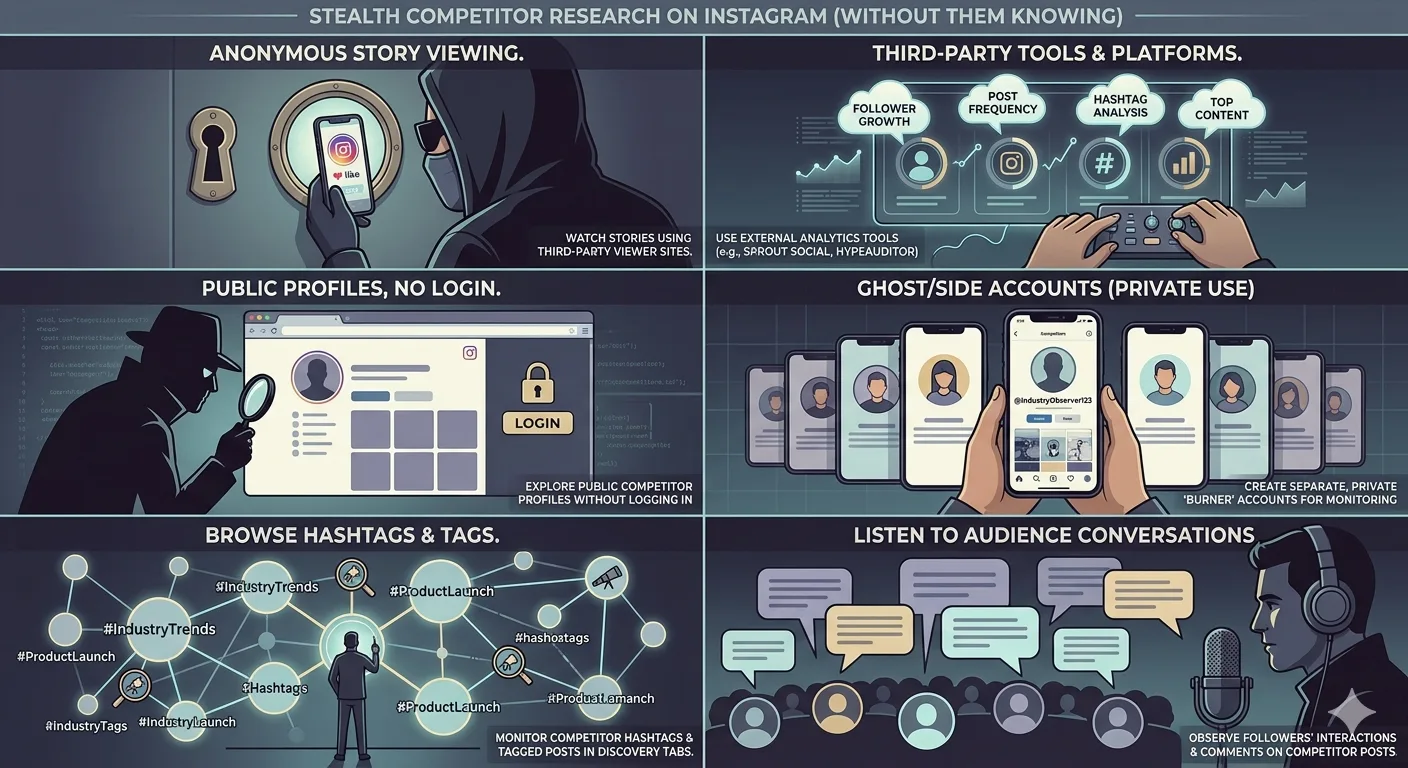
This guide covers how to conduct thorough, professional competitor research on Instagram without any of these signals being generated what to look for, how to organize your research, and how to use anonymous viewing tools like InstaPV to do all of it without your competitors ever knowing you were there.
Why Anonymous Competitor Research Matters
Before getting into the how, it is worth being clear about why anonymity matters in this context because some people assume competitor research is something to be embarrassed about or hide. It is not. It is standard business practice across every industry. The anonymity matters for practical reasons, not ethical ones.
Avoiding Tipping Off Your Strategy
If a competitor notices consistent engagement from your account, they may infer that you are paying close attention to their moves and adjust their behavior accordingly. A competitor planning a product launch who notices your account suddenly watching their stories every day might accelerate their timeline, change their messaging, or become more guarded about previewing content publicly.
Avoiding Reciprocal Monitoring
In many industries, competitive monitoring is mutual once it becomes visible. If your account starts showing up in a competitor's story viewers list regularly, they may start monitoring your account just as closely which is not inherently bad, but it does mean your own content and strategy become subject to the same scrutiny you are applying to them.
Maintaining Professional Distance in Small Niches
In smaller or tightly-knit industries, business relationships often exist alongside competitive ones. The same brands that compete for customers might also collaborate on industry events, refer customers to each other for non-overlapping services, or simply maintain cordial professional relationships. Visibly monitoring a competitor's every story can create unnecessary friction in these relationships, even when the underlying research activity is completely normal and expected.
What to Research: A Complete Competitor Analysis Framework
Effective competitor research goes well beyond occasionally checking what a competitor posted recently. Here is a comprehensive framework covering everything worth examining.
Content Strategy and Themes
Review a competitor's last 30 to 50 posts and categorize them by theme product showcases, educational content, behind-the-scenes, promotional content, user-generated content, company culture, customer testimonials. Calculate the approximate ratio of each category. This reveals their overall content philosophy and what they prioritize communicating to their audience.
Posting Frequency and Consistency
Note how often the competitor posts to their feed, how often they post stories, and whether their posting schedule is consistent or irregular. A competitor who posts daily versus one who posts twice a week is operating under very different resource allocations and content strategies and their results will reflect that.
Visual Branding and Production Quality
Examine the visual consistency of their feed color palettes, photography style, graphic design elements, use of templates for recurring content types. Production quality and consistency often reflect the resources a competitor is investing in their Instagram presence, and significant changes in production quality over time can signal changes in budget, team, or strategic priority.
Engagement Patterns
Using InstaPV's analytics, review the competitor's engagement rate trends over time. Is engagement growing, stable, or declining? Are there specific posts that significantly outperformed their typical engagement and if so, what made those posts different?
Follower Growth Trajectory
Track the competitor's follower growth over time through InstaPV. Steady growth, accelerating growth, plateaus, or declines all tell a story about how effectively their current strategy is working and whether they have recently made significant strategic shifts.
Promotional Strategy
Note how the competitor handles promotions, sales, and product launches. What is their typical lead time before an announcement? Do they use countdown content, teaser campaigns, or direct announcements? How do they structure calls to action? This is particularly valuable intelligence before your own promotional periods.
Customer Interaction Style
Review how the competitor responds to comments and engages with their audience. Are they highly responsive, formal, casual, humorous? Customer interaction style is part of brand positioning and reveals how the competitor wants to be perceived by their audience.
Highlight Structure
As covered in an earlier post in this series, a competitor's Highlight structure reveals what they consider important enough to make permanently accessible products, testimonials, FAQs, behind-the-scenes content. Reviewing Highlight categories and content gives you insight into their priorities that goes beyond what appears in their regular feed.
Influencer and Collaboration Patterns
Note any influencer partnerships, Collab posts, or cross-promotions visible in the competitor's content. This reveals their partnership strategy, the types of accounts they work with, and potentially the budget tier they are operating in based on the size and positioning of the accounts they collaborate with.
Hashtag and Caption Strategy
Review the hashtags and caption structures the competitor uses. Are they using niche-specific hashtags or broad ones? Are captions short and punchy or long-form and educational? Do they consistently use calls to action, and what form do those take?
-
10 Instagram Growth Hacks That Actually Work in 2026
-
Instagram Profile Viewer: How It Works and Is It Safe?
-
How Brands Use Instagram Analytics to Grow Their Business
Step-by-Step: Conducting Anonymous Research Using InstaPV
Here is how to put this framework into practice using InstaPV, from start to finish.
Step 1: Create a Competitor Tracking List
Identify the three to five most relevant direct competitors for your research. For most businesses, this is a manageable number that allows for thorough analysis without becoming overwhelming. Write down their Instagram usernames.
Step 2: Search Each Competitor on InstaPV
Go to instapv.xyz and search each competitor's username. No login is required, and your visit generates no record visible to the competitor.
Step 3: Review Their Profile and Recent Posts
Examine the profile information and scroll through recent posts, applying the content strategy framework above. Take notes on content themes, visual style, and posting patterns.
Step 4: Watch Their Active Stories
If the competitor has active stories, view them through InstaPV's story viewer. This gives you visibility into their real-time activity promotions, announcements, behind-the-scenes content without appearing in their viewer list.
Step 5: Browse Their Highlights
Review the competitor's Highlight collections for permanent, curated content that reveals their priorities and key messaging.
Step 6: Check the Analytics Dashboard
Open InstaPV's analytics view for the competitor's profile to review follower growth trends and engagement rate data over time. This gives you the performance context behind the content you have been reviewing.
Step 7: Document Your Findings
Record your observations in a structured format a spreadsheet or document organized by the framework categories above. Date your entries so you can track changes over time during future research sessions.
Step 8: Schedule Regular Follow-Ups
Competitor research is most valuable as an ongoing practice rather than a one-time exercise. Set a recurring schedule weekly for fast-moving competitors, monthly for more stable ones to repeat this process and track how competitor strategies evolve over time.
Building a Competitor Research Spreadsheet
A simple but effective way to organize ongoing competitor research is a shared spreadsheet with the following structure:
Columns: Competitor name, date reviewed, follower count, follower growth since last review, engagement rate, recent content themes, notable posts or campaigns, Highlight changes, notes.
Rows: One row per competitor per review date, allowing you to track changes over time in a single view.
This structure makes it easy to spot patterns across multiple review periods for example, noticing that a competitor's engagement rate consistently spikes around certain content themes, or that their follower growth accelerated following a specific campaign you documented in an earlier review.
Turning Research Into Action
Research that does not inform decisions is just data collection. Here is how to translate competitor research into practical strategic actions.
Identify Gaps in Your Own Content
If your research reveals that competitors are consistently succeeding with a content theme or format you have not explored educational content, behind-the-scenes footage, customer testimonials consider whether incorporating similar content (in your own voice and style, not as a copy) could fill a gap in your own strategy.
Anticipate Competitive Moves
Tracking a competitor's content patterns and Highlight changes over time can help you anticipate upcoming announcements or campaigns. A competitor who has historically posted teaser content one to two weeks before major announcements gives you a pattern you can watch for in the future.
Benchmark Realistic Goals
Use competitor engagement rates and growth trajectories as realistic benchmarks for your own account, adjusted for relative account size and time in the market. This grounds your own goal-setting in what is actually achievable in your specific market rather than generic industry-wide benchmarks that may not reflect your niche's realities.
Identify Differentiation Opportunities
Sometimes the most valuable insight from competitor research is not what competitors are doing well, but what they are consistently not doing. A niche or content angle that no significant competitor is addressing represents a potential differentiation opportunity for your own brand.
Ethical Boundaries to Maintain
Anonymous competitor research is standard, legitimate business practice but it operates within ethical boundaries worth being explicit about.
Research informs strategy; it does not justify copying. Studying what competitors do successfully should inform your own original strategy, not result in directly replicating their specific content, campaigns, or creative assets. Beyond the ethical concerns, directly copied content typically underperforms because audiences can often sense when content lacks originality, and your own brand voice and positioning differ from your competitor's even when the underlying topic is similar.
Public content only. Everything covered in this guide applies exclusively to publicly available content on public Instagram accounts the same content any member of the public could see. This is fundamentally different from any attempt to access private information.
Research, not harassment. The anonymity discussed in this guide serves a practical business purpose avoiding tipping off your strategy and maintaining professional distance. It should never be used as a tool for harassment, stalking, or any activity intended to harm rather than inform.
Frequently Asked Questions
Q: How many competitors should I track regularly?
For most businesses, three to five direct competitors provides a manageable but meaningful sample. Tracking too many competitors dilutes the depth of analysis you can give to each, while tracking too few may not provide enough comparative context.
Q: How often should I conduct competitor research?
This depends on how fast-moving your industry is. For industries with frequent product launches, promotions, or trend cycles, weekly or biweekly reviews capture meaningful changes. For more stable industries, monthly reviews are typically sufficient.
Q: Can competitors find out I am using InstaPV to research them?
No. InstaPV accesses publicly available content without generating any signal visible to the account owner. There is no notification, no record, and no way for a competitor to know their public Instagram content has been reviewed through InstaPV.
Q: Is it normal for businesses to research each other this way?
Yes competitive analysis is a standard part of business strategy across virtually every industry, and social media competitive research is simply the modern equivalent of monitoring competitors' advertising, pricing, or store displays, which businesses have always done.
Q: What should I do if I notice a competitor appears to be researching my account?
This is also completely normal and not something to be concerned about. If anything, it may simply reflect that your account is doing something worth paying attention to. Continue focusing on your own strategy rather than reacting to competitive monitoring in either direction.
Conclusion
Thorough competitor research is one of the highest-value activities a business can invest time in on Instagram but doing it through your own logged-in account creates unnecessary friction, signals your interest to competitors, and can invite reciprocal scrutiny.
Using InstaPV for anonymous research removes all of these concerns. You can systematically review competitor content strategy, posting patterns, engagement trends, follower growth, and Highlight structure building a complete picture of how your competitive landscape operates without ever appearing on a single competitor's radar.
Combined with the comprehensive framework in this guide and a consistent review schedule, anonymous competitor research becomes a genuine strategic advantage rather than an occasional, ad-hoc activity.