Introduction
Return on investment is the question that ultimately determines whether Instagram deserves continued investment of time, money, and strategic attention from any business. Every hour spent creating content, every dollar spent on photography or production, and every resource allocated to Instagram strategy needs to be justified by outcomes that matter to the business. Without measurement, these investments are made on faith rather than evidence.
The challenge for most small businesses, solopreneurs, and early-stage brands is that comprehensive Instagram ROI measurement has traditionally required either expensive analytics platforms or sophisticated technical infrastructure that is not accessible without significant investment. The assumption that proper ROI measurement requires paid tools has led many businesses to skip measurement entirely, which is a worse outcome than imperfect measurement with free tools.
The reality is that meaningful Instagram ROI measurement is achievable using entirely free tools: Instagram's native Insights, Google Analytics or any comparable free website analytics platform, and research capabilities like InstaPV. This guide covers the complete methodology for measuring Instagram ROI with zero paid tool spend.
What Instagram ROI Actually Means
Before getting into measurement methods, establishing a clear definition of ROI for your specific situation prevents the common mistake of measuring the wrong things.
In its most basic form, ROI is the relationship between what you put in and what you get out. For Instagram specifically, the inputs are the costs of maintaining the Instagram presence, and the outputs are the business value that presence generates.
The Inputs: What Goes Into Instagram
Time is the primary input for most Instagram accounts. Content creation time, community engagement time, analytics review time, and strategic planning time all have a cost even when they are not paid directly. Estimating the hourly cost of these time investments at your effective hourly rate provides the most accurate input figure.
For accounts using paid production resources, professional photography costs, video production costs, or agency fees represent direct financial inputs that are easy to quantify.
For accounts running paid promotions, advertising spend is a direct input cost that should be factored into ROI calculations when evaluating promoted content specifically.Read blog
The Outputs: What Instagram Generates
Business outputs from Instagram vary depending on the business model and how Instagram is being used within the broader business strategy.
For e-commerce businesses, the most direct output metric is revenue attributable to Instagram-sourced traffic. For service businesses, output metrics include leads, inquiries, and consultation bookings that originated from Instagram. For content businesses, audience growth and engagement that translates into sponsorship or subscription revenue represents the output. For brand awareness plays, outputs might include share of voice metrics, press mentions driven by Instagram presence, or consumer survey data about brand recognition.
The key insight is that the right output metric depends on how Instagram fits into the business model rather than any universal Instagram-specific metric. Engagement rate is not an output for ROI purposes. It is an intermediate metric that should correlate with actual business outputs but is not itself the business value being measured.
Setting Up Free Measurement Infrastructure
Before measuring anything, setting up the infrastructure that enables measurement takes initial effort but creates the foundation for ongoing ROI tracking without any paid tools.
Google Analytics for Website Traffic Attribution
Google Analytics, which is free, provides the website-side measurement needed to understand what Instagram-sourced visitors actually do when they reach your website. Setting it up for Instagram measurement specifically requires several configuration steps.
Creating a dedicated Instagram goal in Google Analytics defines what counts as a conversion for Instagram traffic specifically. For an e-commerce business, this is a purchase completion. For a service business, it might be a contact form submission, a booking confirmation, or a newsletter signup. For any business with a clear conversion event, creating a Google Analytics goal that tracks this event is the foundation of downstream business measurement.
Enabling social media traffic reporting in Google Analytics and confirming that Instagram traffic is being correctly attributed ensures that the data being analyzed actually reflects Instagram-sourced visits rather than being misattributed to direct traffic or other sources.
UTM Parameter Setup for Instagram Links
As covered in Day 18's business metrics guide, UTM parameters are the free technical mechanism that enables precise attribution of website traffic and conversions to specific Instagram activities.
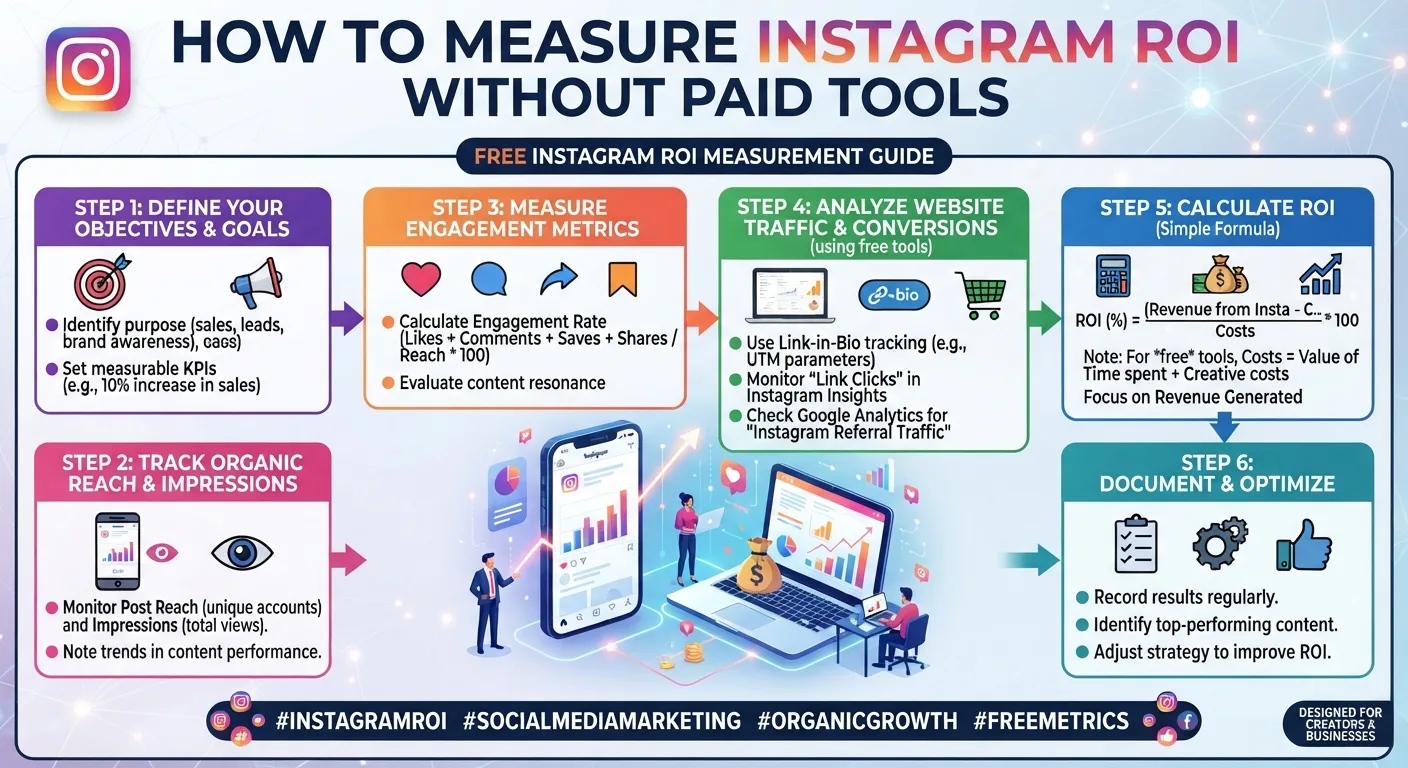
UTM parameters are tags added to the end of URLs that tell Google Analytics exactly where the traffic came from. For Instagram measurement, a basic UTM setup uses utm_source equals instagram, utm_medium to specify the content type such as story, bio, or post, and utm_campaign to specify any relevant campaign name.
For example, a URL in the Instagram bio might be structured as: websiteurl.com/?utm_source=instagram&utm_medium=bio&utm_campaign=general
A Story link sticker for a specific product might be: websiteurl.com/product/?utm_source=instagram&utm_medium=story&utm_campaign=product-launch
These UTM parameters require no technical expertise beyond adding the tags to URLs before placing them in Instagram content. Google's free URL builder tool generates properly formatted UTM URLs without requiring any code knowledge.
Spreadsheet Tracking System
As covered in Day 19's KPI tracking guide, a simple spreadsheet tracking system maintains the ongoing data that enables monthly ROI calculations without any paid tool. Create a spreadsheet with the following structure:
One tab tracking Instagram inputs: hours spent on content creation, hours on community management, hours on strategy, and any direct financial costs, recorded weekly or monthly.
One tab tracking Instagram outputs: website sessions from Instagram, conversion events from Instagram traffic, revenue or lead value from Instagram-sourced conversions, recorded monthly from Google Analytics.
One tab for ROI calculations: monthly input cost total, monthly output value total, and calculated ROI percentage.
This spreadsheet costs nothing to create and maintain and produces the data needed for ongoing ROI tracking with thirty to sixty minutes of monthly data entry.
Calculating the Inputs: What Your Instagram Investment Costs
Time Valuation
For most small business Instagram accounts, time is the dominant cost. Calculating the cost of time spent requires two inputs: how many hours per week are spent on Instagram activities, and what that time is worth.
Track time spent on Instagram activities for two to four weeks to get a realistic baseline rather than estimating from first principles. Many business owners significantly underestimate how much time they spend on Instagram when they include not just content creation but research, editing, caption writing, community engagement, analytics review, and strategic planning.
Value this time at your effective hourly rate, whether that is your freelance rate, your salary expressed as an hourly figure, or an opportunity cost estimate based on what else you could be doing with the same hours.
Multiply the weekly hour estimate by the hourly value and by four to get a monthly time cost.
Production Cost Valuation
Any direct financial costs for photography, video production, graphic design, or content tools specifically used for Instagram should be tracked as direct costs and added to the monthly input total.
For costs that are shared across multiple uses, such as design software that is also used for other business purposes, attribute a reasonable proportion of the cost to Instagram based on the percentage of use dedicated to Instagram content.
Advertising Spend
If any Instagram paid promotions are running, the advertising spend should be included in the input cost calculation. For accounts running both organic and paid content, calculating ROI separately for organic versus paid activity, and then combining for an overall figure, provides more useful insight than blending the two.
Calculating the Outputs: What Instagram Is Generating
Revenue Attribution for E-Commerce
Google Analytics with proper UTM parameter setup provides direct revenue attribution for e-commerce businesses. The e-commerce reporting section of Google Analytics shows sessions, transactions, and revenue attributed to Instagram as a traffic source.
Compare the revenue figure from Instagram-attributed transactions against the input cost calculated above to produce the basic ROI figure.
For businesses with longer purchase cycles where Instagram discovery may precede conversion by days or weeks, multi-touch attribution rather than last-touch attribution produces more accurate revenue attribution. Google Analytics supports multi-touch attribution models that give credit to multiple touchpoints in the conversion path rather than only the last source before purchase.
Lead Valuation for Service Businesses
For service businesses where the Instagram output is leads and inquiries rather than direct revenue, assigning a monetary value to leads allows the same ROI calculation methodology.
If you know your average lead-to-client conversion rate and average client value, the expected value of a lead is average client value multiplied by conversion rate. Multiplying the number of Instagram-attributed leads by this expected lead value gives a monthly output value figure comparable to revenue attribution for e-commerce.
Instagram-attributed leads are those where the lead source is tracked to Instagram, whether through UTM-tagged contact form pages, direct messages from Instagram followers, or leads who identify Instagram as their discovery source when asked.
Brand Value Output Consideration
For accounts where Instagram's primary function is brand awareness rather than direct conversion, quantifying the output is harder but not impossible. Follower growth has quantifiable value if each new follower represents a potential future customer with a known expected lifetime value. Brand awareness surveys comparing brand recognition among Instagram followers versus non-followers can quantify the awareness value of the Instagram presence.
These softer value calculations are necessarily approximate but provide better evidence for continued Instagram investment than no measurement at all.
The Monthly ROI Calculation
With input and output figures established, the ROI calculation is straightforward.
ROI percentage equals the output value minus the input cost, divided by the input cost, multiplied by 100.
Example: If Instagram costs a business 1,200 dollars per month in time and production costs and generates 3,800 dollars in attributed revenue, the ROI calculation is:
3,800 minus 1,200 equals 2,600 dollar return. 2,600 divided by 1,200 equals 2.17. Multiplied by 100 equals 217 percent ROI.
This positive ROI means that for every dollar invested in Instagram, the business is generating 3.17 dollars back. A positive ROI above 100 percent indicates that Instagram is generating more than double its cost, which is a strong justification for continued investment.
A negative ROI or a very low positive ROI indicates that the current investment level is not being justified by the current returns, which is a signal to either improve the strategy to increase returns, reduce the input cost by improving efficiency, or reconsider the investment level.
Improving ROI Through Evidence-Based Optimization
Measuring ROI is not just a reporting exercise. It provides the directional signal for optimization decisions that improve returns over time.
Identifying Highest-Return Content Activities
By tracking which specific content types and campaigns generate the strongest conversion outcomes, time investment can be shifted toward the activities with the highest return rather than distributed evenly across all activities based on habit or intuition.
A business that discovers its educational carousel content generates five times more website visits per hour invested than its product showcase content has a clear direction: invest more time in educational carousels and less in product showcases. This reallocation of the same total time investment can dramatically improve ROI without increasing the total input cost.
Reducing Input Cost Through Batch Efficiency
As covered in Day 13's content calendar guide, batch content creation produces the same output with significantly less total time than creating content individually for each post. Improving production efficiency through batching reduces the time input cost while maintaining the same output quality, directly improving the ROI calculation without requiring any increase in returns.
Competitive Context for ROI Interpretation
Using InstaPV to understand the engagement levels and growth trajectories of comparable accounts helps contextualize whether your ROI figures reflect genuine opportunity for improvement or reasonable performance given the competitive environment.
As covered in Day 9's competitor analysis guide, understanding that comparable accounts in your niche are achieving similar or better results with similar input investment suggests that the channel has more potential to unlock through strategy optimization. Understanding that your ROI is already strong relative to what comparable accounts appear to achieve suggests maintaining rather than dramatically changing the current approach.
Common ROI Measurement Mistakes to Avoid
Measuring Engagement Rate as ROI
Engagement rate is an important intermediate metric but it is not ROI. An account with high engagement rate that generates no business outcomes has positive engagement rate metrics and zero business ROI. These are different things, and conflating them produces misleading conclusions about Instagram's business value.
Using Platform-Reported Metrics Without Business Context
Instagram Insights provides reach, impressions, and engagement data. These metrics have no inherent dollar value unless connected to business outcomes through the attribution infrastructure described in this guide. Reporting these metrics without connecting them to business outcomes does not constitute ROI measurement.
Ignoring Time Cost in Favor of Only Financial Costs
Many small business owners calculate ROI only against direct financial costs and exclude the value of their own time, which produces dramatically overstated ROI figures that do not reflect the true opportunity cost of Instagram investment. Including time cost at a realistic hourly value is essential for an accurate ROI calculation.
Measuring ROI Too Early in the Account's Development
As covered in Day 21's growth case study, Instagram returns compound over time as audience builds and algorithmic distribution improves. Measuring ROI in the first three months of an account and finding it negative does not mean Instagram has negative ROI over a longer time horizon. Setting appropriate time horizons for ROI evaluation, typically at least six to twelve months for a developing account, prevents premature abandonment of strategies that would produce positive returns with continued consistent execution.
-
What Is Instagram Story Completion Rate and Why It Matters
-
How to Use Public Instagram Data for Academic Research
-
Instagram for Real Estate: Using Profile Analytics to Win Clients
Frequently Asked Questions
Q: How precise does the ROI calculation need to be to be useful?
Directional accuracy is sufficient for most strategic purposes. A rough calculation that is clearly negative suggests reconsideration or optimization. A clearly positive calculation suggests continued investment. The goal is not accounting precision but strategic clarity, and a simple monthly tracking system provides adequate precision for that purpose.
Q: What if I cannot attribute revenue directly to Instagram because my business has a long sales cycle?
Proxy metrics provide the best available ROI approximation for long sales cycles. Tracking Instagram-attributed leads and valuing them at the expected lead value based on historical conversion rates and average deal size provides a reasonable proxy for direct revenue attribution. Supplementing with qualitative tracking, asking new clients how they first heard about the business, adds further evidence about Instagram's contribution to the pipeline.
Q: How do I measure the ROI of brand awareness from Instagram if I cannot track direct conversions?
Brand awareness value is inherently difficult to quantify but not impossible to approximate. Follower growth has a calculable expected value if you know the expected lifetime value of a customer who discovers the business through Instagram and converts at historical rates. Brand recall surveys comparing Instagram followers against non-followers can quantify awareness value more directly but require access to survey tools.
Q: Should I include the ROI calculation in client reports for social media management clients?
Where the attribution infrastructure is in place to support accurate ROI calculation, including ROI data in client reports is powerful evidence of the value being delivered. Where attribution is imperfect or where the account is in early development where ROI may still be negative despite positive trajectory, framing returns in terms of intermediate metrics with clear connection to eventual business outcomes maintains client confidence while being honest about the current state of measurement.
Conclusion
Measuring Instagram ROI without paid tools is genuinely achievable through the combination of Google Analytics, UTM parameter setup, Instagram's native Insights, and a simple tracking spreadsheet. The methodology is not technically complex. It requires consistent data entry, honest time cost valuation, and the discipline to connect platform metrics to actual business outcomes rather than reporting engagement metrics as a proxy for ROI.
The business that measures Instagram ROI rigorously has a significant strategic advantage over the business that invests in Instagram based on intuition and optimism: it makes investment decisions based on evidence, optimizes toward what is actually working, and can justify continued investment to stakeholders with data rather than hope.
Research competitive benchmarks to contextualize your Instagram ROI on InstaPV →