Introduction
Instagram's collaboration features have evolved significantly over the past few years, moving from a simple co-authoring function to a more comprehensive set of tools that enable different types of creator partnerships, brand collaborations, and community building at scale.
For creators and brands trying to grow beyond the organic limitations of their own follower base, understanding exactly how each collaboration feature works, what it can and cannot achieve, and how to measure whether collaboration efforts are producing the outcomes they are designed for is increasingly important strategic knowledge.
This guide covers every collaboration feature currently available on Instagram, explains the specific mechanism through which each one drives reach and engagement, and provides the tracking framework that reveals whether collaboration activity is producing genuine strategic value.Instapv
The Core Collaboration Feature: Instagram Collabs
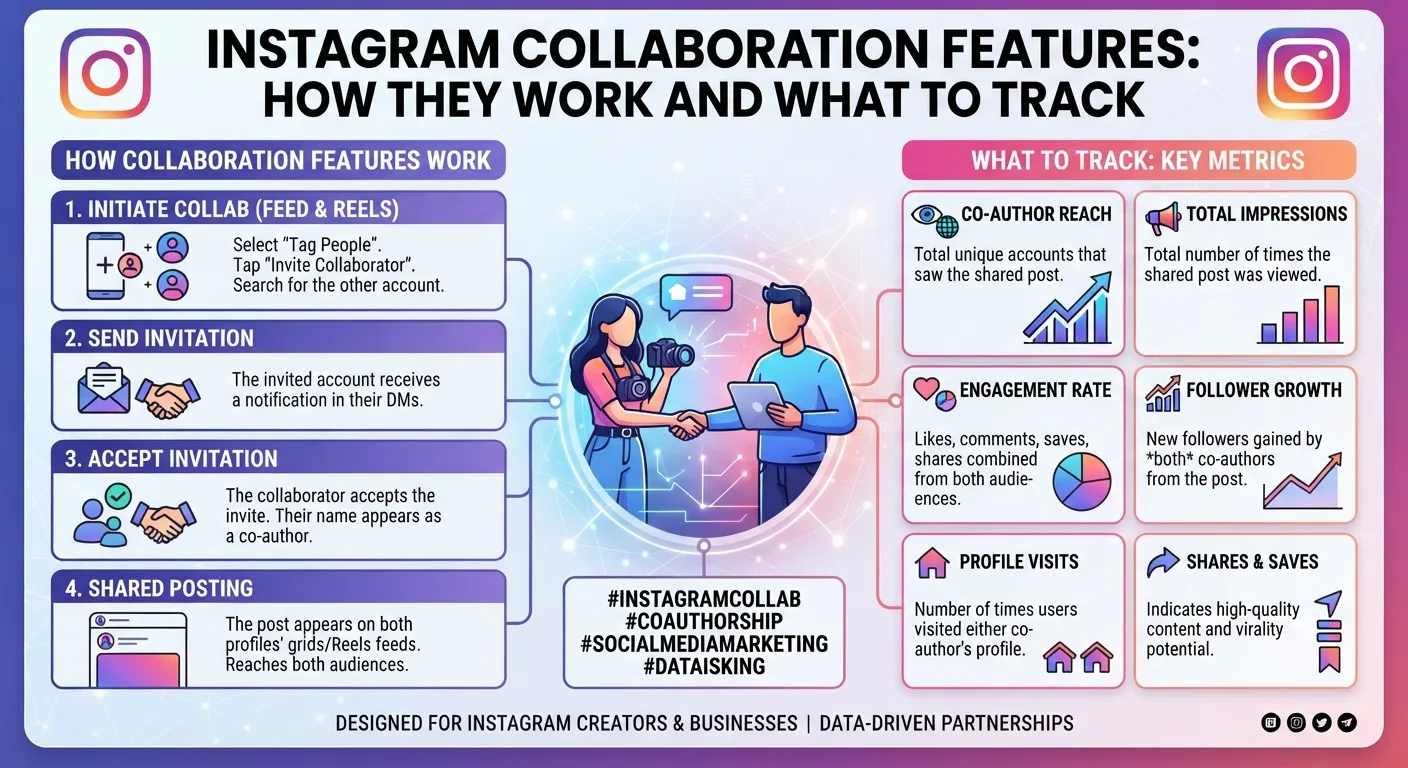
The most impactful collaboration feature Instagram offers is the Collab function, which allows two accounts to co-author a single feed post or Reel that appears simultaneously on both profiles and is distributed to both accounts' audiences.
How Collabs Work Technically
When an account creates a post or Reel and invites a collaborator using the Collab feature in the tagging interface, the invited account receives a notification to accept the collaboration. Upon acceptance, the content appears on both the original creator's profile and the collaborator's profile simultaneously.
The shared post appears in the feed of both accounts' followers, is distributed through both accounts' algorithmic channels, and shows the combined engagement from both audiences in a single engagement count rather than separately on each profile. Comments, likes, saves, and shares accumulate in one shared pool visible on both profiles.
This combined distribution is what makes the Collab feature significantly more powerful than a simple mention or tag. The content is genuinely co-distributed rather than simply appearing on one profile with a reference to another.
What Collabs Cannot Do
Several important limitations of the Collab feature are worth understanding explicitly before building collaborative strategy around it.
Collabs only work between two accounts, not three or more simultaneously. For multi-creator campaigns, separate bilateral Collabs or traditional tagging must be used.
The invited collaborator cannot edit the content after accepting the Collab. The original creator retains creative control over the post itself.
Collab invitations expire if not accepted within a specific time window, so timing coordination between collaborators is important for campaigns with specific publishing deadlines.Read blog
Tracking Collab Performance
Because Collab posts appear on both profiles and accumulate combined engagement, tracking their performance requires a slightly different approach than standard single-account post analytics.
What to Track for Collabs
Follower growth in the days immediately following a Collab post is the most direct measure of the new audience exposure the collaboration generated. As covered in Day 5's influencer tracking guide, comparing follower growth rate in the two weeks before and after a Collab provides a controlled comparison that reveals the collaboration's net contribution to audience building.
Profile visits from the Collab post, visible through Instagram Insights for account owners, shows how many people the content reached who were then interested enough to visit the account profile. Combined with the profile visit to follower conversion rate covered in Day 18's business metrics guide, this gives a complete picture of how many people the Collab exposed the account to and what proportion converted to followers.
Engagement rate on the Collab post relative to the account's average, accounting for the fact that the Collab was shown to a combined audience, reveals how well the content resonated with the combined audiences of both collaborating accounts.
Reach by source for the Collab post, particularly the proportion coming from non-followers, shows how effectively the Collab's dual-distribution mechanism reached audiences beyond both accounts' existing followers.
Instagram Live as a Collaboration Tool
Instagram Live provides a different type of collaboration mechanism than the Collab feed post feature. Live videos allow two accounts to go live together in a split-screen format that is visible to both accounts' followers simultaneously.
How Live Collaboration Works
An account going live can invite another account to join the live video through the guest feature. When the guest joins, their video appears alongside the host's in a split-screen view. Both accounts' followers receive notifications about the live session, creating dual-audience exposure similar to the Collab post mechanism but in a real-time format.
Strengths of Live Collaboration
Live collaboration creates engagement that pre-recorded content cannot replicate. The real-time nature of the interaction, the ability for followers from both accounts to ask questions and receive immediate responses, and the authentic, unscripted quality of live conversation generate a type of audience relationship depth that polished produced content does not produce.
For knowledge-sharing collaborations, Q&A sessions, or any content that benefits from genuine back-and-forth between two knowledgeable people, live collaboration often outperforms pre-recorded Collab posts for community building and relationship depth even when it reaches fewer total people.
What to Track for Live Collaborations
Peak concurrent viewers across the session, total viewers who joined at any point, and the number of questions asked and answered during the session provide the in-session performance data. The follower growth effect in the days following the live, and the saves of the live replay if the video is saved to the profile, provide the longer-term outcome data.
Story Collaboration and Resharing
Stories offer a more informal and higher-frequency collaboration mechanism than feed posts or live video. Several specific Story collaboration patterns are worth understanding.
Mention Resharing
When an account mentions another account in a Story by tagging them using the at symbol, the mentioned account receives a notification and the option to reshare that Story to their own Story within 24 hours. This resharing mechanism creates a chain of Story exposure across multiple audiences without requiring formal coordination.
For brands and businesses, being mentioned in Stories by genuine advocates and customers is a form of user-generated Story collaboration that provides authentic social proof as covered in Day 14's e-commerce guide and Day 23's food blogger guide.
Coordinated Story Takeovers
Story takeovers, where one account temporarily allows another creator to post Stories to their account, provide a specific type of audience introduction that the Collab feed post mechanism does not. The takeover creator speaks directly to the host account's audience, and the host account's followers experience content from a new voice within the familiar context of the account they already follow.
Tracking takeover effectiveness requires comparing Story view rates during the takeover period with the account's typical Story view rates, monitoring follower activity for any unusual growth or engagement following the takeover, and where possible tracking whether the guest account received new followers attributable to the takeover exposure.
Branded Content and Partnership Disclosure
Instagram's branded content tools, which include the paid partnership disclosure label that appears on sponsored content, are technically distinct from the collaboration features but operate alongside them for commercial partnership scenarios.
How Branded Content Labels Work
When a creator discloses that content is a paid partnership using Instagram's branded content tool, a Paid Partnership label appears beneath the creator's name on the post. This disclosure satisfies regulatory requirements in most markets for commercial partnerships and provides the brand partner with analytics visibility into the post's performance.
For brands evaluating influencer partnerships, the analytics access that the branded content disclosure unlocks, showing the brand how the specific post performed on the creator's account, is a valuable transparency benefit beyond the regulatory compliance function.
What Brands Can See Through Partnership Analytics
When a creator properly discloses a paid partnership and grants the brand analytics access, the brand can see reach, impressions, and engagement data for that specific post on the creator's account. This is private data that would not otherwise be visible to the brand and that cannot be accessed through any third-party tool including InstaPV.
For brands managing influencer campaigns, this analytics access is an important reason to use Instagram's official branded content disclosure mechanism rather than informal partnership arrangements that do not include analytics sharing.
Affiliate Collaboration Through Instagram
Instagram's affiliate program allows creators to earn commission on products purchased through their Instagram content, with a specific product tagging mechanism that tracks conversions.
How Instagram Affiliates Work
Eligible creators can tag products from participating brands in their content and earn commission when followers purchase those products through the Instagram interface. The tagged products show affiliate attribution that allows both the creator and the brand to track sales generated through specific content.
For brands managing affiliate programs through Instagram, this built-in tracking provides cleaner attribution than external affiliate links and creates stronger incentive alignment with creators who benefit directly from their content's commercial performance.
What to Track for Affiliate Collaborations
Click-through rate from affiliate product tags, conversion rate from clicks to purchases, and average order value from affiliate-sourced purchases provide the commercial performance data for affiliate collaborations. Comparing these figures across different creators, content types, and product categories reveals which affiliate partnership configurations generate the strongest commercial outcomes.
Collaboration Strategy: Building a Portfolio Approach
For accounts where collaboration is a significant growth strategy rather than an occasional tactic, building a portfolio approach that includes different types of collaborations serving different strategic functions produces more consistent results than relying on any single collaboration type.
Discovery Collaborations
These are Collab posts and live collaborations with accounts whose audiences significantly overlap with the target audience but minimally overlap with the existing follower base. The primary purpose is audience discovery and follower acquisition. As covered in Day 14's organic growth guide and Day 8's micro-influencer guide, the best discovery collaboration partners are accounts in adjacent but non-competing niches with genuinely engaged audiences.
Credibility Collaborations
These are collaborations with accounts that are more established, authoritative, or widely recognized in the niche. The primary purpose is credibility transfer and trust building rather than pure follower acquisition. Being associated with a recognized authority in the niche signals quality to new audiences in ways that are difficult to achieve through self-promotion alone.
Community Collaborations
These are collaborations with peer accounts of similar size and positioning that serve community building and mutual support rather than primarily growth or credibility goals. Active participation in a collaborative community of similar creators produces long-term relationship capital that generates ongoing collaboration opportunities, referrals, and peer support that individual follower count metrics do not capture.
Commercial Collaborations
These are brand partnerships, sponsored content relationships, and affiliate arrangements that serve revenue generation alongside any exposure benefits. As covered throughout this series, commercial collaborations work best when they are clearly aligned with the account's content positioning and audience interests rather than purely commercially motivated.
Common Collaboration Mistakes to Avoid
Collaborating Without Audience Alignment
The most common collaboration mistake is partnering with accounts based on follower count or relationship rather than audience alignment. A collaboration between two accounts whose audiences have no genuine overlap produces minimal mutual growth benefit because neither account's followers are particularly likely to be interested in the other account's content.
As covered in Day 15's audience analysis guide, verifying that a potential collaboration partner's audience genuinely overlaps with your target audience before committing to the collaboration prevents wasted collaboration opportunities.
Treating Every Collaboration as Equivalent
Different collaboration types serve different strategic functions, as covered in the portfolio approach above. Evaluating every collaboration against the same metrics regardless of its intended purpose produces misleading assessments. A credibility collaboration that does not produce significant follower growth may still have been highly successful if it produced the credibility transfer that was its actual purpose.
Neglecting Post-Collaboration Follow Up
The audience introduction that a successful collaboration creates is only the beginning of the relationship-building opportunity. Following up with content that serves the new audience introduced through the collaboration, and actively engaging with the new community members who arrive through collaboration exposure, converts the initial introduction into the lasting relationship that drives genuine long-term growth.
-
How to Turn Instagram Analytics into Actionable Strategies
-
10 Common Instagram Mistakes That Hurt Your Engagement
-
Instagram for Food Bloggers: Tips, Analytics, and Growth Strategies
Frequently Asked Questions
Q: Can I use a Collab post to feature content from an account that does not respond to my collaboration invitation?
No. The Collab feature requires explicit acceptance from the invited account. If an invited collaborator does not respond or declines, the content publishes on only the original creator's account without the co-author attribution.
Q: How do I find the right collaboration partners for my account?
As covered in Day 8's micro-influencer guide, Day 14's organic growth guide, and Day 19's niche research guide, identifying potential collaboration partners starts with finding accounts in adjacent niches whose audiences overlap meaningfully with your target audience. InstaPV's analytics can help assess whether potential partners have the genuine engagement that makes collaboration valuable.
Q: Does Instagram's algorithm treat Collab posts differently from regular posts?
Instagram has not officially specified whether Collab posts receive different algorithmic treatment than standard posts from a single account. The practical effect of the dual-distribution mechanism, where the post is shown to both accounts' audiences and accumulates engagement from both, typically results in stronger overall engagement signals that benefit distribution regardless of whether any specific algorithmic preference for Collab content exists.
Q: How many collaborations per month is reasonable to maintain quality?
This varies by account size, content production capacity, and collaboration type. Most accounts can sustain one to two meaningful collaborations per month without the collaboration activity consuming so much time that it compromises the regular content schedule. More frequent collaboration activity may be appropriate for accounts in growth-focused phases where collaboration is the primary growth mechanism.
Conclusion
Instagram's collaboration features, from Collab posts and live partnerships to Story resharing, branded content tools, and affiliate programs, provide a diverse toolkit for reaching new audiences, building credibility, and generating commercial outcomes that solo content creation cannot achieve.
The strategic value of collaboration comes from choosing the right collaboration type for the specific goal, ensuring genuine audience alignment with collaboration partners, tracking the metrics that reflect the specific purpose of each collaboration, and building a portfolio approach that uses different collaboration mechanisms for different strategic functions.
Consistent, well-measured collaboration activity compounds over time into a network of mutual relationships and cross-audience introductions that is one of the most sustainable organic growth mechanisms available on Instagram in 2026.
Research potential collaboration partners and their audience engagement on InstaPV →