Introduction
Every Instagram creator and brand manager faces the same recurring question when planning content: should this idea be a Story or a post?
On the surface, the question seems simple. In practice, it involves a set of trade-offs that depend on what you are trying to accomplish, who your audience is, what type of content you are creating, and how you define engagement in the first place.
Stories and feed posts are not interchangeable formats with the same strengths and weaknesses. They serve different purposes, reach different segments of your audience in different ways, generate different types of engagement, and interact with Instagram's algorithm through entirely different mechanisms. Understanding these differences not just at a surface level but in terms of the specific outcomes each format drives is one of the most practically useful things any Instagram creator or marketer can internalize.
This guide provides a thorough, honest comparison of Instagram Stories and feed posts across every dimension that matters for engagement, reach, and overall content strategy. Rather than declaring a definitive winner, it gives you the framework to make the right choice for each specific piece of content you create.
Defining Engagement Differently for Each Format
Before comparing engagement between Stories and feed posts, it is important to acknowledge that engagement means something different for each format and using the same definition for both leads to misleading conclusions. instapv
Feed Post Engagement
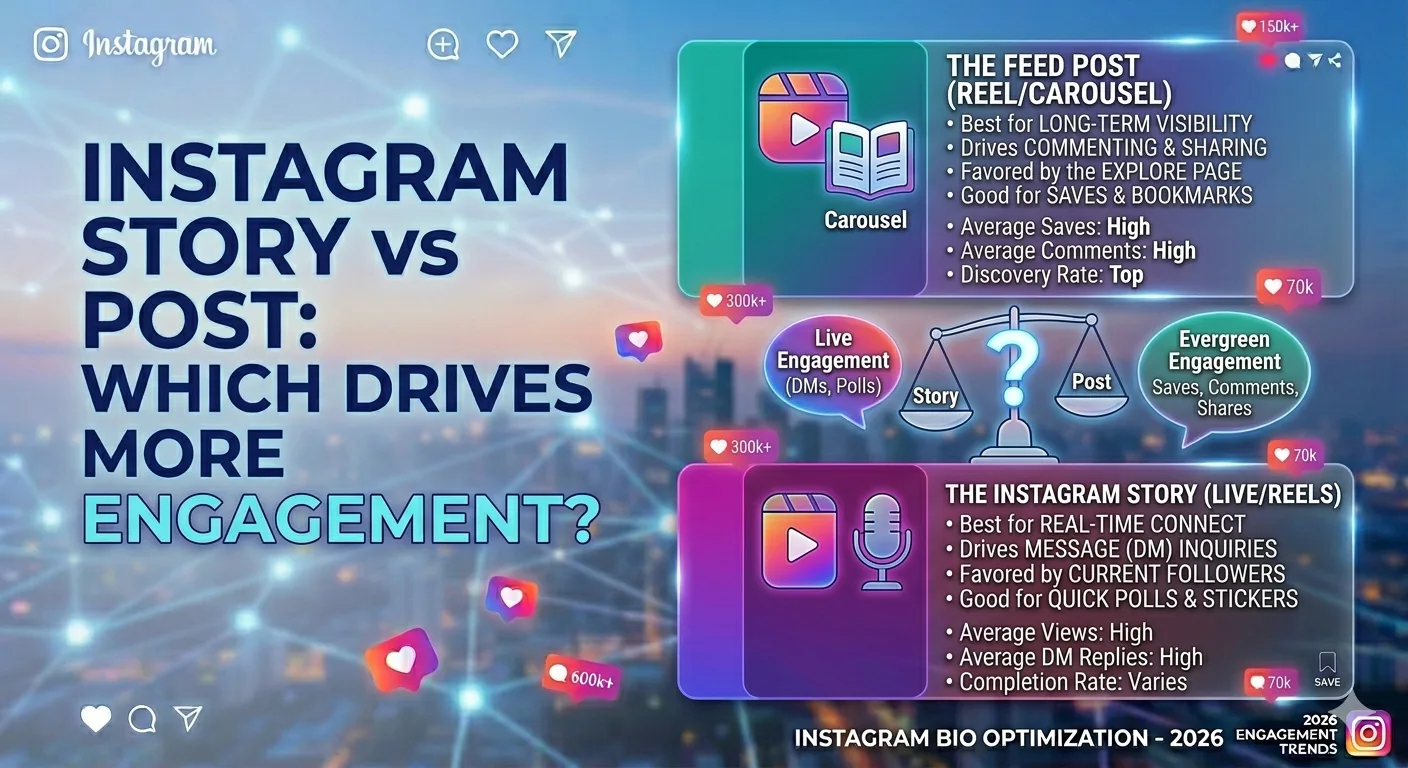
For feed posts, engagement is primarily measured through likes, comments, saves, and shares. These interactions are visible, persistent, and cumulative a post continues accumulating engagement long after it is published, and that engagement history remains visible on the post indefinitely.
Feed post engagement is also publicly visible. Anyone visiting your profile can see the engagement on your posts, making it a component of how new visitors perceive your account's health and resonance.
Story Engagement
Story engagement operates completely differently. The primary engagement signals for Stories are views, completion rate, replies (direct messages sent in response to a story), and interactive element responses poll taps, quiz answers, question responses, slider reactions, and link taps.
Crucially, story engagement is ephemeral it disappears with the story after 24 hours (or when removed from Highlights) and is largely private, visible only to the account owner. This means story engagement does not contribute to the publicly visible engagement metrics on your profile, but it does contribute to audience relationship building and algorithmic signals in ways feed posts do not.
Reach: Who Sees Each Format
One of the most significant practical differences between Stories and feed posts is in who sees them and how content is distributed to those viewers.
Feed Post Reach
Feed posts are distributed through several distinct channels simultaneously. They appear in followers' main feeds, can be surfaced on the Explore page to non-followers, can be discovered through hashtag pages, and can accumulate reach over extended time periods a strong post can continue gaining reach for days or even weeks after publication.
The multi-channel distribution potential of feed posts, particularly through the Explore page, makes them the primary vehicle for reaching new audiences who do not currently follow your account. Reels specifically are given significant priority for non-follower distribution, making them the highest-reach format on the platform for accounts trying to grow beyond their existing audience.
Story Reach
Stories, by contrast, reach almost exclusively your existing followers. They appear at the top of the app in the Stories bar for accounts followers have chosen to follow, and are not distributed to non-follower audiences through any equivalent of the Explore page for feed content.
This fundamental difference means Stories are primarily a tool for engaging your existing audience rather than expanding your reach to new ones. For audience growth, feed posts and Reels significantly outperform Stories. For deepening relationships with your existing audience, Stories excel.
Engagement Quality: Depth vs Breadth
Beyond raw numbers, the quality and nature of engagement differs significantly between the two formats.
Feed Post Engagement: Broad but Often Shallow
Feed posts can accumulate large numbers of likes and views particularly for accounts with significant reach or viral potential but much of this engagement is passive. A like requires a fraction of a second of attention. A comment takes more effort but still represents a brief interaction. The engagement is broad in terms of volume potential but often shallow in terms of genuine audience relationship.
The exceptions are saves and shares, which as discussed throughout this series represent deeper engagement signals a save reflects genuine intent to revisit the content, and a share reflects a decision to recommend the content to someone else. These deeper forms of feed post engagement are the ones most worth optimizing for.
Story Engagement: Narrow but Deep
Story engagement works at the opposite end of the spectrum. The absolute numbers are typically much smaller a story might get replies from 20 or 30 followers, while a feed post from the same account gets thousands of likes. But those 20 or 30 replies represent something qualitatively different: a direct, private conversation initiated by the viewer.
Story replies are essentially direct messages one of the most personal forms of communication available on the platform. When someone replies to your story, they are starting a private conversation with you. This creates relationship depth that like counts cannot replicate, and over time, the followers who regularly reply to your stories are often your most loyal and valuable audience members.
Interactive story elements polls, questions, quizzes, and sliders create a middle ground between passive viewing and active conversation. They invite participation with minimal friction, generating response rates significantly higher than what most feed posts achieve in terms of the percentage of viewers who actively engage.
Algorithm Interaction: How Each Format Signals to Instagram
Stories and feed posts interact with Instagram's algorithm in fundamentally different ways, which has significant implications for how each format affects your overall account performance.
How Feed Posts Signal to the Algorithm
For feed posts, Instagram's algorithm primarily evaluates engagement signals particularly the speed and depth of engagement in the hours immediately after posting, and the ongoing accumulation of saves and shares over time. A post that generates strong, diverse engagement (likes, comments, saves, and shares) in the first hour signals quality content and triggers broader distribution.
Feed posts are essentially competing for placement in two distribution systems simultaneously: followers' main feeds and the broader discovery surfaces (Explore, Reels tab, hashtag pages). Success in the algorithmic competition for discovery surfaces can dramatically amplify reach beyond what follower count alone would predict.
How Stories Signal to the Algorithm
Stories interact with the algorithm differently. Instagram tracks story engagement signals particularly completion rate (did viewers watch all the way through?) and interactive element responses and uses these signals to prioritize which accounts' stories appear at the front of the Stories bar for each user.
Accounts whose stories consistently generate high completion rates and interactive engagement tend to have their new stories shown prominently to followers, while accounts with lower completion rates may find their stories appearing later in the queue or not being watched at all, since most users do not scroll all the way to the end of their Stories bar.
Stories also serve as warm-up content that can prime the algorithm for subsequent feed post performance. An account that publishes active, engaging stories before releasing a feed post may benefit from elevated distribution for that post, as discussed in Day 4's growth hacks post.
-
Complete Guide to Instagram Bio Optimization for More Followers
-
How to View Instagram Without an Account: Step-by-Step Guide
-
Top 5 Instagram Niches with the Highest Engagement in 2026
Content Lifespan: Permanent vs Ephemeral
One of the most obvious practical differences between feed posts and Stories is their lifespan and this affects both how they should be used and what types of content are best suited to each.
Feed Posts: Permanent Content
Feed posts remain on your profile indefinitely or until manually deleted and continue to accumulate engagement over time. This permanence makes them appropriate for content you want to represent your brand over the long term: high-quality photography, educational content that remains relevant, product showcases, and brand-defining content that new profile visitors will encounter when they discover your account.
The permanent nature of feed posts also means they contribute to your profile's overall aesthetic and first impression something that Stories, which disappear after 24 hours, do not affect.
Stories: Ephemeral Content
Stories disappear after 24 hours unless saved to Highlights. This temporary nature changes both what content is appropriate for Stories and how audiences relate to it. The impermanence creates a sense of immediacy and authenticity viewers know they need to check now if they want to see it.
This ephemeral quality makes Stories ideal for time-sensitive content (limited-time offers, event coverage, real-time updates), behind-the-scenes content that adds personality without needing permanent profile placement, and experimental or less polished content that would feel out of place as a permanent feed post.
What Each Format Is Best For
Based on all of the above differences, here is a practical guide to which format serves which content goals most effectively.
When to Choose a Feed Post
Use a feed post when your primary goal is reaching new audiences beyond your existing followers particularly Reels for maximum discovery potential. Use feed posts for content you want to represent your brand permanently, for educational content with high save potential, for product launches and announcements that should be findable on your profile over time, and for any content where visible, cumulative engagement counts serve a purpose (such as demonstrating social proof to new profile visitors).
When to Choose a Story
Use Stories for building and maintaining relationships with your existing audience rather than reaching new ones. Stories are ideal for behind-the-scenes content, real-time updates, time-sensitive announcements, interactive engagement through polls and questions, personal sharing that does not need permanent profile placement, and content designed to generate direct conversations through replies.
Stories are also valuable as a distribution mechanism for drawing attention to recent feed posts many accounts use Stories specifically to alert their existing followers that a new post is live, driving initial engagement on feed posts during the critical first-hour window.
The Case for Using Both Together
The most effective Instagram content strategies do not choose between Stories and feed posts they use both deliberately, with each format serving its specific purpose within a coordinated approach.
The Story-to-Post Pathway
One of the most effective coordination patterns is using Stories to build context and anticipation before a feed post, then using Stories again after the post to drive traffic to it and maintain the conversation.
Before the feed post: Stories tease the upcoming content, build curiosity, or provide behind-the-scenes context about what is coming.
The feed post goes live: a polished, permanent piece of content designed for reach and discovery.
After the feed post: Stories share additional context, respond to comments, or re-share the post to ensure existing followers who have not seen it yet are aware of it.
This coordinated approach uses both formats in their respective strengths Stories for existing audience relationship and engagement, feed posts for new audience discovery while each reinforces the other.
The Post-to-Story Engagement Loop
A complementary pattern uses feed posts for initial content and then Stories to continue the conversation. After a feed post generates comments, use Stories to respond to the most interesting comments, share the question a commenter asked and provide a more detailed answer, or run a follow-up poll to get audience input on the topic raised in the post.
This creates an ongoing engagement loop where feed posts spark conversations that Stories then deepen — turning a single piece of content into a multi-day engagement arc.
Measuring the Right Things for Each Format
One of the most common mistakes brands and creators make is applying feed post metrics to Stories (or vice versa) and reaching misleading conclusions.
What to Measure for Feed Posts
Reach, engagement rate (likes plus comments plus saves plus shares divided by followers), save rate specifically as a signal of content utility, and share rate as a signal of word-of-mouth potential. For accounts focused on growth, the ratio of reach to follower count reveals how effectively feed posts are reaching beyond the existing audience.
What to Measure for Stories
Completion rate (what percentage of viewers who started your story watched it all the way through), reply rate (replies divided by views, as a measure of how many viewers were moved to start a conversation), interactive element response rate (for polls, quizzes, and questions), and exit rate at each frame (to identify where in a story sequence viewers are dropping off).
Frequently Asked Questions
Q: Do Stories or feed posts contribute more to follower growth?
Feed posts particularly Reels contribute significantly more to follower growth because they have the potential to reach non-follower audiences through the Explore page, hashtag pages, and algorithmic distribution to new users. Stories reach almost exclusively existing followers and do not contribute meaningfully to audience expansion.
Q: Which format should I prioritize if I have limited time and can only produce one type of content regularly?
If audience growth is your primary goal, prioritize feed posts particularly Reels. If relationship depth with your existing audience is the priority, Stories offer more direct impact. For most accounts, a combination of both is ideal, but if forced to choose one, the answer depends on which goal matters more at your current stage of growth.
Q: Do stories affect feed post reach, or are they completely separate?
There is evidence that story engagement activity keeping your account active and engaged in the Stories bar contributes positively to how the algorithm perceives your account's overall activity level, which may benefit feed post distribution. This is why some creators use Stories specifically as "warm-up" activity before posting to the feed.
Q: Can I repurpose the same content as both a Story and a feed post?
Yes, though the results vary. Content repurposed from feed to Stories often performs well Stories allow linking back to the feed post and giving existing followers additional context. Content repurposed from Stories to feed posts requires more attention to production quality and permanence appropriateness, since Stories are typically less polished than feed posts by design.
Q: How does the Stories completion rate affect my overall account performance?
Completion rate is one of the primary signals Instagram uses to prioritize story placement in the Stories bar. Accounts with consistently high completion rates tend to have their stories shown more prominently to followers, which means more followers actually see each story. Improving completion rate through tighter editing, stronger openings, and consistent value delivery across story frames directly affects how visible your Stories content is to your existing audience.
Conclusion
Stories and feed posts are not competing formats where one is clearly better than the other they are complementary tools with distinct strengths that serve different purposes within a complete Instagram content strategy.
Feed posts drive discovery and reach, building an audience through algorithmic distribution and leaving a permanent record that new profile visitors encounter. Stories deepen relationships with your existing audience through interactive, ephemeral, personal content that drives direct conversations and ongoing engagement.
The most successful Instagram accounts understand these differences and use both formats deliberately choosing feed posts when the goal is reaching new people and building a permanent content record, and choosing Stories when the goal is maintaining the relationships that make that audience genuinely valuable over time.
Analyze how top accounts balance Stories and feed posts on InstaPV →