Introduction
Academic researchers across disciplines have increasingly recognized Instagram as a source of data that enables investigations into social phenomena, cultural dynamics, consumer behavior, communication patterns, and human psychology at a scale and with a naturalism that controlled laboratory studies and surveys cannot replicate.
Instagram contains billions of publicly visible posts, comments, profiles, and engagement interactions. This public data represents naturally occurring human behavior rather than behavior elicited by research instruments, which gives it a kind of ecological validity that experimental data often lacks. People post on Instagram because they want to communicate, express identity, connect with communities, and participate in culture, not because a researcher asked them to. Studying this behavior can reveal things about human communication, social dynamics, and cultural patterns that are difficult or impossible to discover through other research methods.
At the same time, academic use of Instagram data raises specific methodological, ethical, and practical challenges that require careful consideration. This guide covers the research possibilities, the methodological approaches, the ethical frameworks that apply, and the practical tools including InstaPV that support efficient and appropriate academic Instagram research.
Research Areas Where Instagram Data Is Genuinely Valuable
Understanding which academic disciplines and research questions Instagram data is most naturally suited to answer helps researchers identify where Instagram can contribute meaningfully to their work rather than forcing it into every research context.
Communication and Media Studies
Instagram is a significant locus of contemporary public communication, making it a natural subject for communication and media researchers. Research questions about how public figures construct personas, how organizations communicate with publics, how narratives spread through visual social media, how communities form around shared visual aesthetics, and how platform affordances shape communication behavior are all naturally suited to Instagram data.
The visual nature of Instagram data adds a dimension that text-based platforms like Twitter do not provide, enabling research into visual communication, image culture, and the relationship between visual representation and social meaning that communication researchers have studied through other media for decades.
Social Psychology and Sociology
Social comparison processes, self-presentation and identity construction, group dynamics and community formation, social influence and conformity, and the relationship between online presentation and offline behavior are all research areas where Instagram provides relevant naturalistic data.
The public nature of Instagram profiles means that individual-level self-presentation data is available at scale without the reactivity that occurs when research participants know they are being observed. The community dynamics of hashtag communities, follower networks, and engagement patterns provide group-level data for sociological analysis.Read blog
Marketing and Consumer Research
Consumer behavior researchers have found Instagram particularly valuable for studying how brands communicate with consumers, how consumers respond to different types of commercial content, how influencer marketing effects operate, how visual branding strategies are executed and received, and how consumer communities form around product categories and lifestyle identities.
As covered throughout this series in the context of competitive research and market research, the publicly visible engagement patterns on brand accounts and influencer accounts provide data about consumer response that would otherwise require expensive survey or panel research to approximate.
Public Health Research
Instagram has become a significant channel for health communication, both from official health authorities and from lay influencers. Researchers studying how health information spreads, how health behaviors are promoted or discouraged through social media, how eating disorders, fitness obsessions, or other health-relevant behaviors are represented and potentially reinforced, and how public health campaigns translate into social media contexts have used Instagram data productively.
The ethical considerations around health-related Instagram research are particularly significant and are addressed in more detail in the ethics section below.
Cultural Studies and Anthropology
Instagram data enables cultural research into how specific communities visually represent themselves, how cultural values are communicated through image and caption choices, how cultural practices spread and evolve through social media, and how place-based identities are constructed and circulated through location-tagged content.
The geographic tagging capability of Instagram, as covered in Day 16's location search guide, provides a spatial dimension to cultural data that enables place-specific cultural research alongside community-based and topic-based analysis.
Methodological Approaches to Instagram Research
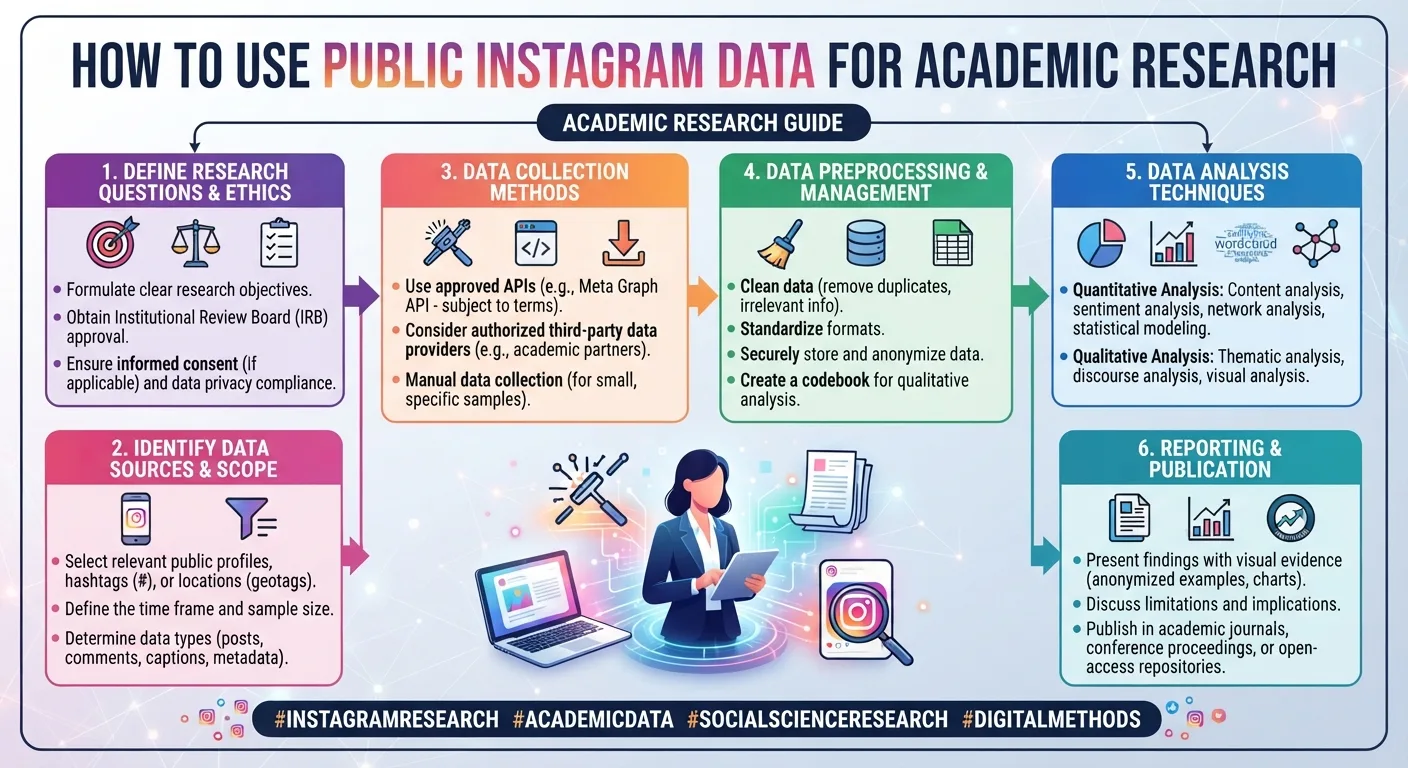
Instagram data can be analyzed using several distinct methodological approaches, each appropriate for different research questions and disciplinary contexts.
Content Analysis
Content analysis involves systematically coding and categorizing Instagram content, whether posts, captions, comments, or visual elements, according to a defined coding scheme and analyzing the distribution and relationships among coded categories.
For Instagram research, content analysis might involve coding images for compositional features, emotional valence, or subject matter, coding captions for rhetorical strategies, linguistic features, or topical content, or coding comment sections for sentiment, engagement patterns, or community dynamics.
Systematic sampling procedures are important for content analysis to ensure the sample is representative of the broader population of content being studied. Random sampling, stratified sampling by account size or time period, or purposive sampling based on theoretically relevant criteria are all appropriate depending on the research question.
Discourse Analysis
Discourse analysis examines how language in Instagram captions and comments constructs meaning, represents social realities, and positions speakers within social relationships. This approach is particularly suited to research questions about identity construction, ideological representation, community norms, and the relationship between language and social power.
Discourse analysis typically works with smaller, purposively selected samples where depth of analysis per text outweighs breadth of coverage, which makes it compatible with manual data collection through direct profile review rather than requiring large-scale automated data collection.
Network Analysis
Instagram's follower relationships, comment interactions, and hashtag co-occurrence patterns can be analyzed as networks to study information diffusion, community structure, influence patterns, and social clustering.
Network analysis of Instagram data typically requires more sophisticated data collection infrastructure than visual or text content analysis and often involves the Instagram API or specialized data collection tools.
Visual Analysis
Research questions specifically about the visual content of Instagram posts, rather than the textual or social dimensions, require analytical approaches suited to image and video data. Visual coding schemes, computational image analysis methods, and visual semiotics approaches have all been applied to Instagram image data in academic research.
The visual analysis dimension is one of Instagram's distinctive research contributions since most other widely used social media datasets are primarily text-based.
Practical Tools for Instagram Academic Research
InstaPV for Data Collection
InstaPV supports several data collection tasks relevant to academic Instagram research.
For qualitative and small-scale quantitative studies requiring manual data collection, InstaPV provides efficient access to public profile information, post content, comment sections, Stories, and Highlights from any public account without requiring Instagram authentication. This is particularly relevant for researchers who do not have Instagram accounts or who want to ensure their data collection does not create the reactivity that could occur if accounts being studied detected a research account visiting them repeatedly.
The analytics data available through InstaPV, specifically follower growth trends and engagement rate data, provides a publicly available measure of account performance that can be used as a variable in research designs examining what characteristics of accounts or content are associated with different engagement outcomes.
For archiving public Story content before it expires, InstaPV's download functionality serves the documentation needs of research that requires preserving a complete data record including time-sensitive content.
Instagram's Data Export Features
For researchers studying their own accounts or accounts to which they have authenticated access, Instagram's data download feature described in Day 24's archive guide provides a comprehensive export of all account data in a portable format that can be imported into research analysis tools.
Manual Data Collection Protocols
For many academic research purposes, systematic manual data collection using defined protocols is both methodologically appropriate and practically sufficient. A researcher documenting content from a purposively selected sample of public accounts, using InstaPV to access the relevant content efficiently, and recording data in a structured spreadsheet or qualitative data management system can conduct rigorous research without requiring any specialized technical infrastructure.
Ethical Framework for Academic Instagram Research
Academic research involving human subjects is subject to ethical oversight through institutional review boards, research ethics committees, and the professional ethics guidelines of relevant disciplines. Instagram research raises specific ethical questions that have been the subject of ongoing discussion in research ethics communities.
The Public Data vs Human Subjects Distinction
The most fundamental ethical question in Instagram research is whether studying publicly available Instagram data constitutes human subjects research requiring IRB review and informed consent, or whether it falls outside this framework as analysis of public records.
The emerging consensus in research ethics communities distinguishes between observational research using publicly available data from public accounts, which many frameworks consider outside the human subjects research definition, and research involving direct interaction with Instagram users, soliciting information from them, or experimental manipulation of their experience, which triggers standard human subjects requirements.
However, this consensus is not universal, and institutional policies vary. Researchers should always consult their institution's specific IRB guidance on social media research before proceeding.
Contextual Integrity Considerations
Even when content is technically publicly available, its original posting context matters ethically. A person who posted about a personal experience to a public Instagram account may have intended their audience to be their followers in that specific Instagram context, not researchers who will analyze and potentially publish about their post.
The principle of contextual integrity, developed by philosopher Helen Nissenbaum, holds that appropriate information flow depends on norms established in the original context of sharing. Research that moves information outside its original contextual norms, even when the information is technically public, raises ethical questions worth considering even when IRB review may not formally require it.
For research involving health-related content, private disclosures shared publicly, or content from vulnerable populations, contextual integrity considerations are particularly important.
Anonymization in Publication
Even when research uses publicly available Instagram data, standard academic practice recommends anonymizing specific individuals in publications when the research is not specifically about those individuals in their public role. This means paraphrasing rather than directly quoting unique content that could be attributed to a specific person, not naming specific accounts unless the research is explicitly about those accounts as subjects of study, and considering whether combining multiple pieces of information about a specific account could enable identification even when individual pieces are not obviously identifying.
Research on Vulnerable Populations
Research involving content from accounts belonging to minors, accounts focused on mental health conditions, eating disorders, self-harm, or other sensitive health topics, or accounts from other potentially vulnerable populations requires heightened ethical attention.
For research in these areas, the distinction between studying the phenomenon and studying specific individuals is particularly important. Research that analyzes aggregate patterns in how specific topics are represented on Instagram raises fewer ethical concerns than research that focuses on individual accounts belonging to potentially vulnerable people.
Citation and Data Documentation for Instagram Research
Academic publication involving Instagram data requires appropriate citation and documentation practices that allow readers to understand what data was collected, when, and how.
Citing Instagram Content
As covered in Day 21's research tools guide, Instagram content citation should include the account username, the date the content was accessed, the date the content was originally posted, and a URL or other identifying information for the original post. Standard academic citation style guides including APA, MLA, and Chicago have formats for social media content citation that provide the appropriate template.
Data Availability Statements
Many academic journals now require data availability statements explaining whether research data can be shared and how. For Instagram research using publicly available content, the public accessibility of the original data simplifies this requirement, though researchers should note any content that has been removed between data collection and publication.
Documenting Data Collection Procedures
Transparent documentation of data collection procedures, including how content was identified and selected, what time period the data covers, and what platform tools or third-party tools were used in collection, provides the methodological transparency that allows readers to evaluate the research and that enables replication.
-
How InstaPV Helps Recruiters Research Candidate Instagram Profiles
-
Instagram for Photographers: Using Analytics to Grow Your Portfolio
-
What Is Instagram Story Completion Rate and Why It Matters
Frequently Asked Questions
Q: Do I need IRB approval to conduct Instagram research?
This depends on your institution's policies, your jurisdiction, the specific nature of your research, and whether your research constitutes human subjects research under applicable definitions. Consulting your institution's IRB office before beginning Instagram research is strongly recommended rather than making this determination independently.
Q: Can I quote specific Instagram posts in academic publications?
Academic publications sometimes directly quote Instagram content for research purposes. Standard guidance recommends seeking permission from account owners when possible, anonymizing quotes that could identify individuals who are not themselves the subject of the research, and applying fair use judgment to the amount and purpose of quoted content. When in doubt, paraphrasing with appropriate attribution is a more conservative approach.
Q: Is Instagram data appropriate for quantitative research requiring statistical analysis?
Yes, with appropriate sampling procedures. Systematically collected, randomly or purposively sampled Instagram data can be coded and analyzed statistically using standard methods. The key methodological requirements are that sampling procedures are defined and documented, that coding schemes are reliable through inter-rater reliability testing, and that the limitations of social media data for generalizing to broader populations are acknowledged.
Q: How do I handle Instagram content that has been deleted between collection and publication?
Documenting the date of data collection and noting in the publication that some content may no longer be publicly available is standard practice. For research where the continued availability of specific content is important, archiving content at the time of collection using download tools provides a research record that does not depend on the continued availability of the original content.
Conclusion
Instagram represents a genuinely valuable data source for academic research across multiple disciplines, providing naturalistic data about communication, social behavior, cultural dynamics, consumer behavior, and public health communication at a scale and with an ecological validity that other data sources often cannot match.
The ethical framework for Instagram academic research requires careful attention to the public data versus human subjects distinction, contextual integrity considerations, anonymization in publication, and heightened care for research involving vulnerable populations. These ethical considerations are not obstacles to research but important dimensions of responsible scholarship that ensure Instagram research is conducted in ways that respect the people whose public data it analyzes.
Practical tools including InstaPV support efficient and appropriate data collection for academic purposes by providing anonymous access to publicly available content across any public Instagram accounts relevant to the research questions being investigated.
Access public Instagram data efficiently for research on InstaPV →