Introduction
Fashion and Instagram have had a relationship since the platform's earliest days. The visual format, the discovery-first algorithm, and the aspirational community that developed around style content made Instagram the natural home for fashion content long before the platform developed explicit commerce features.
In 2025, fashion is one of the most competitive content categories on the platform. Every niche from luxury couture to sustainable streetwear to vintage thrifting has established accounts with large, engaged audiences, sophisticated content strategies, and well-developed brand partnerships. Breaking through in this environment requires more than beautiful photography. It requires understanding what the data shows about what actually drives engagement and growth in fashion specifically, and building a strategy that reflects that understanding rather than simply producing more of the same content that already saturates the space.
This guide covers the specific analytics patterns, content strategies, and growth approaches that are currently working for fashion brands on Instagram, grounded in what the data shows about the format rather than generic Instagram advice that may not translate to fashion's specific visual and commercial dynamics.
Understanding the Fashion Instagram Landscape
Before getting into strategy, understanding the specific characteristics of the fashion category on Instagram clarifies what you are competing with and what success looks like.
The Visual Standard Is Extremely High
Fashion is perhaps the category where Instagram's visual quality expectations are highest. The platform's most followed fashion accounts consistently produce photography and video content at a quality level that reflects genuine professional investment. This does not necessarily mean expensive studio production for every post, as the authenticity trend covered in Day 7's weekly roundup has demonstrated. But it does mean that the baseline visual competence expected by fashion audiences is higher than in most other Instagram categories.
Understanding where your brand's content production capability sits relative to the visual standard in your specific fashion niche, whether luxury, streetwear, sustainable, vintage, or otherwise, is an important starting point. Each sub-niche has its own visual conventions and expectations that define what high quality means within that specific context.
Engagement Rates Vary Significantly by Sub-Niche
As covered in Day 6's niche engagement post, different niches show different typical engagement rate ranges. Within fashion, sub-niches vary substantially in their typical engagement rates. Sustainable fashion and vintage thrifting communities tend to show higher engagement rates than luxury fashion, partly reflecting the passionate, values-driven nature of these communities. Streetwear and sneaker culture shows strong engagement driven by drop culture and community identity. Luxury fashion tends to show lower engagement rates but higher conversion value per engaged follower.
Understanding the typical engagement range for your specific fashion sub-niche, through competitor research using InstaPV, provides the most relevant benchmark for assessing your own account's performance rather than applying generic fashion category benchmarks that average across very different sub-niches.
Discovery and Commerce Intersect More Naturally in Fashion
Fashion content on Instagram has a natural product discovery dimension that many other content categories lack. When someone sees an outfit they love on Instagram, the immediate question is often where to get it, which creates a natural conversion opportunity. Instagram's shopping features, covered in Day 14's e-commerce guide, are particularly well-suited to fashion because the visual format of the content is simultaneously the product demonstration and the discovery mechanism.
Fashion brands that build their Instagram strategy around this natural discovery to consideration to purchase path typically outperform those that treat Instagram as a pure awareness channel separate from commerce.
Content Strategy for Fashion Brands
The Content Pillars That Work in Fashion
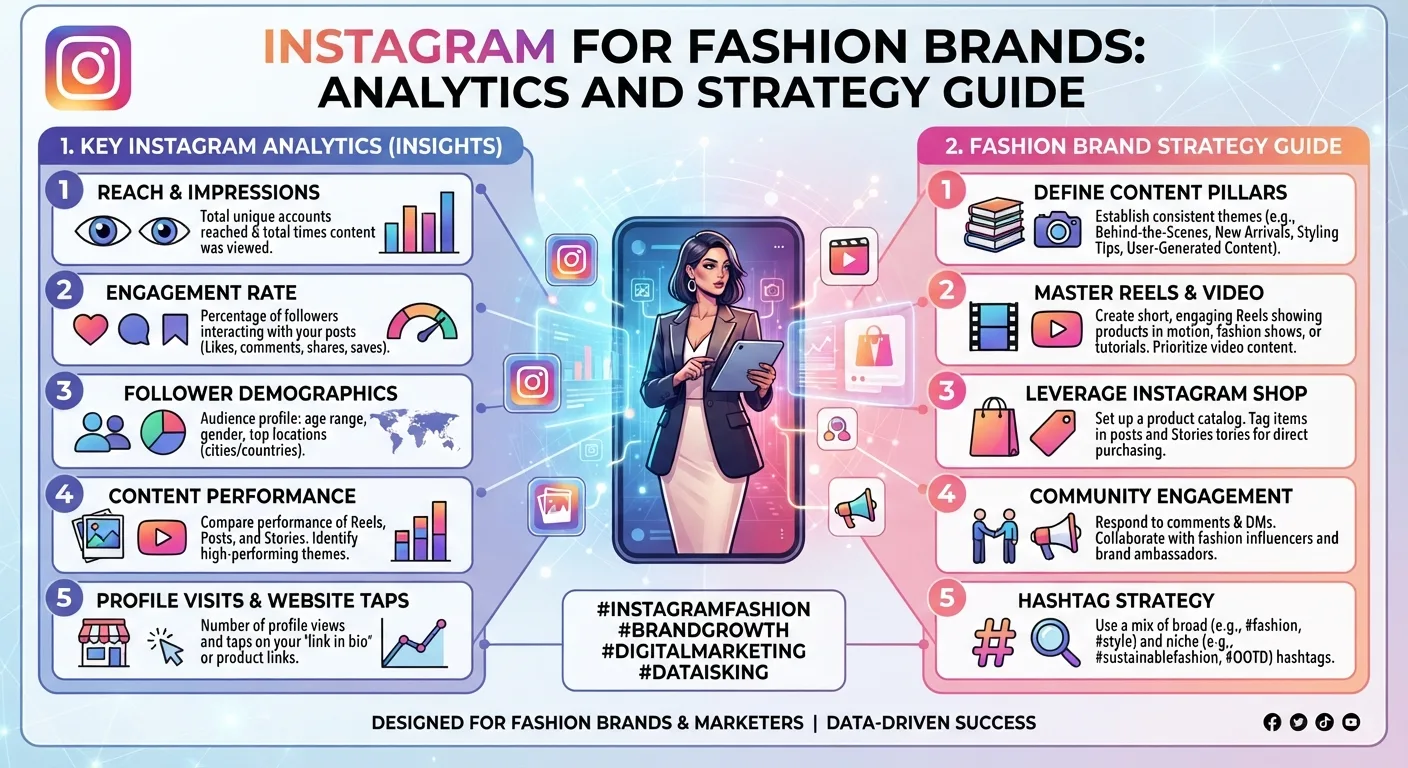
As covered in Day 10's small business guide and Day 11's personal brand guide, content pillars provide the thematic structure that gives an account consistent direction. For fashion brands specifically, the pillars that consistently generate strong engagement and saves tend to cluster around several distinct content types.
Outfit inspiration content showing complete looks styled in real contexts consistently generates strong engagement because it answers the practical question that most fashion followers are implicitly asking: how would I actually wear this? Styling an item or a collection in multiple ways, showing how the same piece works across different occasions or aesthetics, generates particularly strong save rates because it is inherently reference-worthy content that followers want to return to.
Behind the scenes content showing design processes, production insights, and the people who create the brand builds the emotional connection and brand story that differentiates fashion brands in a saturated market. As covered in Day 10's analysis of major Instagram accounts, the brands generating the strongest community loyalty are those whose audiences feel they know the story behind the brand rather than just the products.
Community and user-generated content featuring real customers wearing the brand provides the authentic social proof that brand-produced imagery cannot replicate. As covered in Day 14's e-commerce guide in the UGC section, Glossier's approach of making customer content central to the brand's Instagram presence is one of the most instructive models in fashion specifically.
Educational content about style, fit, fabric, care, and fashion knowledge positions the brand as an authority that adds value beyond the transactional product relationship. Fashion educators on Instagram, accounts that genuinely teach about style rather than simply showing it, consistently generate higher engagement rates and stronger community loyalty than purely aspirational accounts.
Trend commentary and cultural positioning content that places the brand in conversation with broader fashion trends and cultural moments creates relevance beyond the brand's own products.
The Visual Consistency Imperative
As covered in Day 10's analysis of the most followed accounts and Day 11's personal brand guide, visual consistency is one of the most distinguishing characteristics of successful fashion Instagram accounts. In fashion specifically, where visual presentation is inseparable from product value, the visual identity of an Instagram profile directly reflects on how the brand's products are perceived.
Developing and maintaining a consistent visual approach, including color palette, photography style, model and styling direction, editing approach, and grid layout, creates the cumulative brand recognition that makes each new post feel immediately recognizable. This recognition compounds over time into a form of brand equity that influences how followers perceive the quality and positioning of the brand's products.
Reels for Fashion: What Works
As covered in Day 11's Reels strategy guide, Reels are the primary discovery format on Instagram. In fashion specifically, several Reel formats consistently generate strong non-follower reach and follower conversion.
Outfit transformation Reels, where a neutral or base outfit is progressively styled into a complete look, tap into the transformation psychology discussed in Day 16's content types post and generate strong completion rates because the reveal at the end creates natural forward momentum that keeps viewers watching.
Get-ready-with-me style Reels showing real people getting dressed and styled for specific occasions combine the behind-the-scenes authenticity covered in multiple posts throughout this series with the practical styling inspiration that fashion audiences seek. This format consistently outperforms pure product showcase Reels for engagement and follower conversion because it feels more human and more practically useful.
Haul and try-on Reels that show real reactions to fit, quality, and styling versatility provide the authentic product evaluation that audiences are increasingly seeking as a counterpart to polished campaign photography. The unfiltered nature of authentic try-on content, when it is genuinely informative rather than staged, generates strong save rates and comment activity from audiences seeking genuine product assessment.
Styling challenge Reels that show multiple ways to style a single item or how to create multiple outfits from a minimal wardrobe tap into the practical value that generates saves, as covered in the save rate discussion throughout this series.
Analytics for Fashion Brands
The Metrics That Matter Most in Fashion
Beyond the general business metrics covered in Day 18's metrics guide, fashion brands should track several category-specific performance indicators.
Save rate on styling and outfit content is one of the most predictive metrics for fashion specifically. As covered throughout this series, saves reflect genuine reference value, and in fashion this typically means the viewer intends to reference the outfit or styling approach when they are shopping or getting dressed. High save rates on specific products or styling approaches are a direct signal of purchase consideration that no other engagement signal captures as clearly.
Product tag tap-through rate measures how effectively Instagram Shopping tags on product posts are driving consideration. As covered in Day 14's e-commerce guide, the click from a product tag to a product page represents genuine purchase intent that general engagement does not distinguish. Tracking this for different product categories, price points, and content contexts reveals which product types generate the strongest consideration from Instagram's audience.
Story link taps for specific product or collection links, as covered in Day 19's Story links guide, provide another direct measure of Instagram-driven purchase consideration that can be tracked separately from general website traffic.
Competitive Analytics in Fashion
Fashion is a category where competitive research is particularly valuable because trends, visual standards, and audience expectations evolve quickly and what works shifts with the seasonal and trend cycles of the industry.
Using InstaPV to track three to five competitor accounts, as covered in Day 9's competitor analysis guide, should be a regular practice for fashion brands. In addition to the standard growth and engagement metrics covered in Day 9, fashion brand competitive research should specifically note what product categories competitors are featuring most prominently, what visual styles are generating their strongest engagement, and whether there are content gaps in the competitive set that represent differentiation opportunities.
Instagram Shopping for Fashion
Fashion is one of the product categories most naturally suited to Instagram's shopping features, as covered in Day 14's e-commerce guide. The browsing behavior that Instagram facilitates, discovering visually compelling content and wanting to know where to get it, maps directly onto the purchase path for fashion.
Product Tagging Best Practices for Fashion
As covered in Day 14, product tagging works best when it feels like useful navigation rather than a sales push. In fashion specifically, this means tagging products in context rather than creating purely commercial product showcase content.
Tagging all items in a complete outfit photo allows viewers to shop any element they are interested in without the post feeling like a catalog. This contextual tagging within genuine styling content converts better than posts created specifically to showcase products, because the fashion inspiration context makes the product more desirable than a catalog-style presentation.
Collections and Seasonal Organization
Fashion's natural organizational structure around seasons, collections, and occasions maps well onto Instagram's Shop collections feature. Creating collections organized around how customers actually think about fashion, by occasion, season, aesthetic, or body type rather than just product category, creates a more useful shopping experience that extends time spent in the Instagram Shop.
Influencer Strategy for Fashion Brands
As covered in Day 8's micro-influencer guide and Day 15's influencer audience analysis guide, influencer partnerships in fashion have specific considerations beyond general influencer marketing principles.
Aesthetic Alignment Above Follower Count
In fashion more than almost any other category, the visual and aesthetic alignment between the brand and the influencer matters more than follower count. An influencer whose visual aesthetic, styling sensibility, and audience taste profile closely match the brand's positioning will consistently outperform a larger influencer with a misaligned aesthetic, because the partnership will feel authentic to both the influencer's audience and the brand's identity.
Using InstaPV to review potential influencer partners' visual content thoroughly, including Stories and Highlights that provide a more complete picture of their aesthetic than the curated feed alone, is essential for fashion brand influencer evaluation.
Micro-Influencers and Niche Community Positioning
As covered in Day 8, micro-influencers in fashion often provide the strongest ROI for brands targeting specific style communities. A micro-influencer with 8,000 followers deeply embedded in the sustainable fashion community will deliver more commercially meaningful audience exposure for a sustainable fashion brand than a generic lifestyle influencer with 500,000 followers whose audience has no particular connection to sustainable fashion values.
Seasonal Content Planning for Fashion
Fashion's cyclical seasonal structure requires content planning approaches that account for the industry's specific timing dynamics rather than generic monthly planning.
Leading the Season
Effective fashion Instagram content typically begins showcasing new seasonal content four to six weeks before the relevant season begins, building anticipation and establishing the brand's seasonal aesthetic before customers begin actively shopping for that season. This lead time also positions the brand's content to appear in the Explore pages of seasonally motivated shoppers before the visual landscape is saturated with similar seasonal content from competitors.
Transition Content
The transition between seasons, when audiences are ready to evolve their wardrobes but the new season has not fully arrived, is an underserved content opportunity that many fashion brands miss. Content that helps audiences transition between seasons, whether through layering styling, transitional wardrobe pieces, or styling approaches that extend the wearability of current wardrobe items into the next season, generates strong engagement because it addresses a specific, timely practical need.
-
How to Download Instagram Profile Pictures in Full Resolution
-
What Is Instagram Reach and How to Increase It
-
How to Track Instagram Hashtag Performance Without Third-Party Apps
Frequently Asked Questions
Q: How important is photography quality versus content authenticity in fashion Instagram today?
Both matter but they serve different functions. High-quality photography builds brand perception and visual identity. Authentic content builds community and trust. The most effective fashion accounts balance both rather than sacrificing either. The appropriate balance varies by brand positioning: a luxury brand requires higher production values to maintain brand equity, while a sustainable or vintage brand may actually benefit from a more raw, authentic visual approach that signals its values.
Q: How do I research what content is currently driving the strongest engagement in my specific fashion niche?
Using InstaPV to review the recent content and engagement trends of three to five high-performing accounts in your specific fashion sub-niche provides the most directly applicable intelligence. The accounts with the strongest engagement rate trends in your specific niche are almost certainly doing something with their content that is resonating particularly well with the shared audience right now.
Q: Should fashion brands focus on Reels or feed posts for primary content investment?
As covered in Day 12's format comparison guide, these formats serve different purposes. Reels drive discovery of new audiences and should receive meaningful investment for any fashion brand prioritizing growth. Feed posts, particularly high-quality photography and carousels, build the permanent visual identity and reference content that converts discovered audiences into followers and customers. Both deserve investment rather than either being deprioritized.
Q: How do I handle seasonal inventory that goes out of stock for product tagging?
Update or remove product tags when items go out of stock to avoid frustrating potential customers who discover styling content and want to purchase featured items. Styling content that features sold-out items can be repurposed to highlight similar available alternatives, or can be archived and reshared when items return. Instagram's Shopping management interface allows updating product tag links without deleting and reposting content.
Conclusion
Fashion on Instagram in 2026 is both more competitive and more opportunity-rich than at any previous point. More competitive because the visual quality and strategic sophistication of fashion content has increased substantially. More opportunity-rich because Instagram's commerce infrastructure, the expanded influencer marketing ecosystem, and the growing sophistication of niche community engagement all provide more leverage points for brands willing to invest in understanding what actually works rather than simply producing more content.
The brands succeeding in this environment are those that combine strong visual identity with genuine community engagement, that use analytics to understand what is working rather than guessing, that leverage influencer partnerships based on aesthetic alignment rather than follower counts, and that integrate Instagram's commerce features into content that feels genuinely stylistic rather than purely transactional.
Research competitor fashion brands and influencer accounts in your niche on InstaPV →