Introduction
Reach is one of the most commonly discussed Instagram metrics and one of the most commonly misunderstood. Many people use reach and impressions interchangeably, or confuse reach with follower count, or treat any increase in reach as a sign of success without understanding what is actually driving the change or whether it reflects meaningful progress toward their goals.
Getting reach right, understanding exactly what it measures, what affects it, and what genuinely moves it upward, is foundational to interpreting your Instagram performance accurately and making strategy decisions that actually improve distribution rather than chasing surface metrics that look good without translating into business outcomes.
This guide covers everything worth understanding about Instagram reach: the precise definition, the different types of reach and what each tells you, what the algorithm does and does not control about reach, and the specific, evidence-based strategies for increasing reach in ways that actually matter.Instapv
What Reach Actually Measures
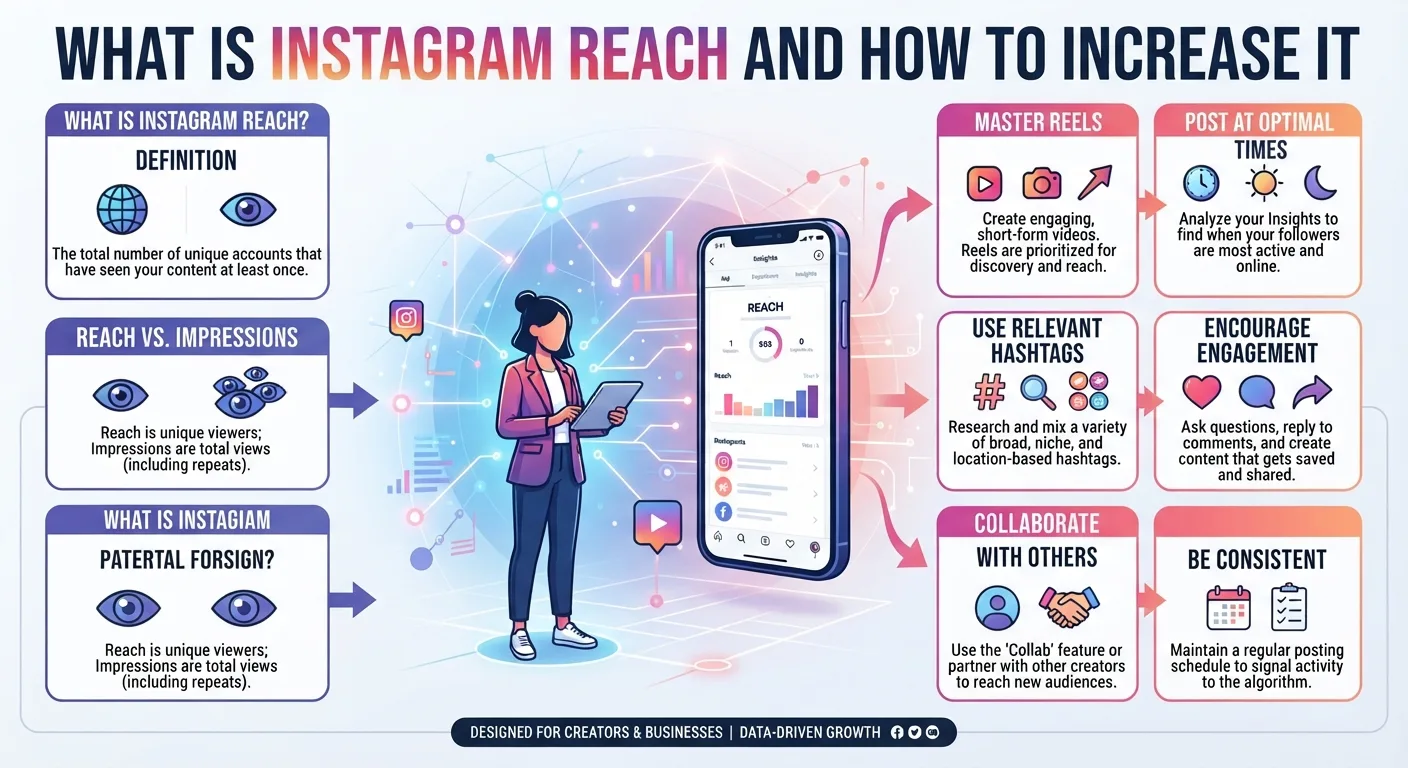
As covered in Day 5's reach versus impressions guide, reach measures the number of unique accounts that have seen a specific piece of content or your account's content overall during a measurement period. Each account is counted once regardless of how many times they viewed the content.
If 3,000 different people each saw your post once, your reach is 3,000. If those same 3,000 people each saw it twice, your reach is still 3,000 while your impressions would be 6,000. Reach counts unique viewers while impressions count total views including repeats.
This distinction matters because reach is the metric that most directly reflects how many distinct individuals your content is putting your brand in front of, which is the underlying measure for most distribution and awareness goals. Impressions can be elevated by repeat views from the same small group of highly engaged followers without reflecting any expansion in actual audience exposure.Read blog
The Different Types of Reach and What Each Reveals
Instagram Insights breaks down reach by source, showing where different viewers discovered the content. Understanding what each source type reveals is as important as knowing the total reach figure.
Follower Reach
Follower reach is the portion of your total reach that comes from existing followers seeing the content in their main feed. This is the most predictable component of reach since it reflects distribution to people who have already chosen to follow the account.
The proportion of your total followers who see any given post is typically much lower than most account owners expect. As covered in Day 7's algorithm guide, Instagram does not show every post to every follower. The algorithm distributes content to followers based on predicted interest and relationship strength, which means a post may reach only 10 to 30 percent of the follower base for typical accounts, with strong content reaching higher percentages and weaker content reaching lower ones.
Non-Follower Reach
Non-follower reach is the portion of total reach that comes from accounts who do not follow you. This component comes from the Explore page, the Reels tab, hashtag pages, shares from existing followers, and other discovery surfaces.
Non-follower reach is the primary mechanism of audience growth. When someone who does not follow you sees your content and finds it compelling enough to visit your profile and follow, the non-follower reach from that specific piece of content has directly produced a new follower. Tracking what proportion of your total reach comes from non-followers, particularly for Reels, is one of the most direct measures of whether your content is functioning as a discovery mechanism.
Reach by Surface
Instagram Insights shows which specific surface each reach component came from: home feed, Explore, Reels tab, hashtags, profile, and other. This granularity reveals exactly where your content is and is not gaining distribution, which is significantly more actionable than the total reach figure alone.
A post with high home feed reach but low Explore reach is performing well with existing followers but not being distributed to new audiences. A post with low home feed reach but high Explore reach suggests the algorithm identified it as interesting to new audiences even before it accumulated strong engagement from existing followers, which is a useful signal about the content's characteristics.
What Controls Reach: The Algorithm's Role
As covered in Day 20's algorithm science post, Instagram's distribution decisions are driven by predicted engagement probability rather than by any simple time-based or follower-based system. Understanding this helps clarify which actions genuinely affect reach and which do not.
What the Algorithm Uses to Decide Reach
For feed posts and Reels, the algorithm's distribution decisions in the critical early window after posting are primarily driven by:
How likely users are to engage with the content based on their history with similar content and their history with your specific account. This is why accounts with consistently strong engagement rates receive better default distribution than accounts with lower engagement rates of the same size.
How quickly the post accumulates engagement from the initial distribution, which is the early engagement velocity effect documented in Day 20's algorithm science post. Strong early engagement signals quality to the algorithm and triggers broader distribution.
How well the content matches the algorithm's categorization of the account's niche, which is why consistent content focus improves distribution over time as the algorithm builds a clearer categorical model of the account.
What the Algorithm Does Not Directly Control
Reach is also affected by factors the algorithm does not control, most importantly the total size of the potential audience for the account's content category and the degree to which the account has established relationships with that audience through previous engagement.
An account in a niche with a small total addressable audience on Instagram will have a lower ceiling on non-follower reach than an account in a niche with a very large total potential audience, regardless of content quality. This structural ceiling on reach is worth understanding when setting expectations, since it means that reach maximization strategies that work for broadly popular content categories may have diminishing returns in smaller niches.
Strategy 1: Improving Content Quality for Algorithmic Distribution
The most fundamental reach strategy is ensuring content quality is high enough to generate the early engagement signals that trigger algorithmic distribution. As covered throughout this series, this means content that generates saves and shares rather than only likes, that holds viewer attention through strong hooks and sustained value delivery, and that produces genuine comment activity rather than only passive engagement.
The specific quality improvements most directly tied to reach are those that improve save rate and share rate, since these are the engagement signals most strongly associated with algorithmic distribution to new audiences. As covered in Day 16's content types guide, content that teaches something useful, surprises with new information, or resonates deeply enough that viewers want to share it with specific people generates these signals most reliably.
Strategy 2: Consistent Niche Focus for Categorical Clarity
As covered in Day 20's algorithm science post, the research on content category clustering suggests that accounts with clear, consistent content focus receive more efficient algorithmic distribution than accounts with varied or unclear content territory. The algorithm is better able to match content to interested audiences when the account's content has clear categorical signals.
For reach maximization specifically, this means resisting the temptation to diversify content topics too broadly in search of individual viral moments. Consistent niche focus builds the algorithmic understanding of what the account is and who should see it that produces more reliable reach across all content rather than isolated high-reach posts surrounded by lower-performing varied content.
Strategy 3: Reels for Non-Follower Reach Specifically
As covered throughout this series, Reels are the most powerful available mechanism for non-follower reach on Instagram in 2026. The Reels tab and Explore page distribution of video content provides the most significant algorithmic amplification to new audiences of any content format on the platform.
For accounts where increasing non-follower reach is a priority, investing in Reels production at a meaningful level, whether two to four per week as covered in Day 11's Reels strategy guide, provides the most direct path to expanding reach beyond the existing follower base. The content approach that generates the highest non-follower reach through Reels combines a strong hook that captures cold audience attention within the first three seconds with content that delivers genuine value or entertainment through to completion, driving the watch time and completion rate signals that trigger broad distribution.
Strategy 4: Collaboration for Reach Beyond the Algorithm
As covered in Day 4's growth hacks guide and Day 14's organic growth guide, collaboration through Instagram's Collab feature provides reach expansion that operates somewhat independently of the standard algorithmic distribution system.
A Collab post appears on both accounts' profiles and is distributed to both accounts' audiences simultaneously. For accounts whose individual algorithmic reach has plateaued, collaboration provides a mechanism for reaching new audiences through a partner account's established distribution without depending entirely on the algorithm to discover and amplify new audiences.
The reach benefit of collaboration is most significant when the partner account serves an audience that overlaps meaningfully with your target audience without heavily overlapping with your existing follower base. This maximizes the new audience exposure generated by the collaboration rather than primarily reaching people who already follow both accounts.
Strategy 5: Shares as the Highest-Leverage Engagement Signal for Reach
Of all the engagement signals that influence algorithmic distribution, shares carry the most direct relationship to reach expansion. When someone shares your content to their Story or sends it via direct message, they are directly creating new reach by exposing your content to their own followers or connections.
As covered in Day 17's viral Stories guide, designing content with shareability as an explicit creative consideration, asking whether the target viewer would send this to a specific person and why, produces content that generates the organic distribution through sharing that compounds reach beyond what algorithmic distribution alone provides.
Strategy 6: Posting Time Optimization for Early Engagement
As covered in Day 21's posting time data analysis, publishing content when your specific audience is most active maximizes the probability of strong early engagement, which drives the algorithmic distribution decisions in the critical first hour window.
The reach benefit of timing optimization operates through the early engagement velocity mechanism: content that generates strong early engagement signals gets distributed to a broader portion of the follower base, which generates more reach from followers, which in turn generates more engagement signals, which may trigger distribution to non-followers through Explore or the Reels tab.
Strategy 7: Hashtag Strategy for Supplementary Discovery
As covered in Day 9's hashtag strategy guide, niche-specific hashtags in the moderate size range provide a supplementary discovery surface beyond the main algorithmic distribution. Content that appears in the Top Posts section of relevant niche hashtags reaches the audience actively browsing those hashtags, which can add meaningful reach particularly for accounts in earlier stages of algorithmic distribution.
The reach contribution of hashtags is secondary to algorithmic distribution for most accounts but becomes more significant for content that achieves Top Posts placement in high-traffic niche hashtags.
Interpreting Reach Changes: What Matters and What Does Not
Not all reach changes are equally significant, and understanding what is driving reach changes is as important as tracking the numbers themselves.
Reach Increases Worth Celebrating
Non-follower reach increases that correlate with follower growth indicate that new reach is converting into genuine audience building. Reach increases driven by Explore or Reels tab distribution indicate algorithmic amplification that reflects content quality improvements. Reach increases across multiple posts rather than a single outlier indicate systematic improvement in content-audience fit.
Reach Increases to Interpret Carefully
A single post reaching dramatically more people than typical may reflect a one-time algorithmic event rather than a sustainable improvement. Reach increases driven primarily by higher impression counts from the same accounts may reflect more repeat viewing rather than genuine new audience reach. Reach increases that do not correlate with engagement rate improvement may reflect reach to audiences who are not genuinely interested in the content.
-
How to Track Instagram Hashtag Performance Without Third-Party Apps
-
Instagram for Fashion Brands: Analytics and Strategy Guide
-
How to Download Instagram Profile Pictures in Full Resolution
Frequently Asked Questions
Q: Why does my reach keep declining even though my follower count is growing?
This pattern, which many accounts experience, typically reflects engagement rate declining as follower count grows. As covered in Day 7's algorithm guide, the algorithm uses engagement signals to determine how widely to distribute content. When engagement rate declines, the algorithm distributes to fewer followers even as the total follower count increases. Reversing this requires improving content quality and relevance rather than focusing on follower acquisition tactics.
Q: Can buying followers or engagement increase reach?
No. As covered in Day 18's fake follower guide and Day 20's algorithm science post, Instagram's systems identify and discount inauthentic engagement signals. Purchased followers who never engage actually reduce reach by increasing the denominator in engagement rate calculations without contributing genuine engagement, which signals lower quality to the algorithm and reduces distribution.
Q: How do I research whether my reach compares well to competitor accounts?
Specific reach figures for competitor accounts are private and not accessible through any third party tool. For comparative benchmarking, engagement rate data available through InstaPV for any public account provides the most accessible comparison metric that correlates with reach quality. Accounts with above-average engagement rates for their size are almost certainly achieving above-average reach relative to their follower count.
Q: Does the reach percentage decline as accounts grow larger?
Yes. As covered in Day 2's analytics guide, larger accounts typically reach a smaller percentage of their total followers with any given post, simply because the larger and more diverse follower base contains more followers who are less consistently interested in every piece of content. This is a structural characteristic of scale rather than a reflection of declining content quality.
Conclusion
Reach is not a number to maximize in isolation. It is a measurement of how many distinct people your content is reaching, and the most important question about any reach figure is not how large it is but what is driving it, whether it is reaching the right audiences, and whether it is converting into the engagement and business outcomes that make reach meaningful rather than just large.
The strategies in this guide address reach through the mechanisms that actually drive it: content quality that generates strong early engagement signals, niche consistency that supports algorithmic categorization, Reels production that leverages the platform's primary discovery format, collaboration that reaches new audiences through established relationships, and shareability design that creates human-powered distribution alongside algorithmic amplification.
Research reach and engagement patterns for top accounts in your niche on InstaPV →