Introduction
"What is the best time to post on Instagram?" is one of the most searched questions in social media marketing and one of the most frequently answered with advice that, while not necessarily wrong, is often far less useful than it appears.
You have probably seen articles claiming that 11 AM on Wednesdays or 7 PM on Sundays are universally the best times to post. These claims are usually based on aggregate data across millions of accounts in completely different industries, time zones, and audience types. The reality is that your best posting time depends almost entirely on when your specific audience is active which can vary dramatically based on your niche, your audience's location, and even the specific content you are posting.
This guide explains why generic posting time advice has limited value, how to find your actual best posting times using your own data, and how posting time interacts with Instagram's algorithm to affect your content's reach.
Why Generic "Best Time to Post" Advice Is Limited
Before diving into how to find your own optimal posting times, it is worth understanding why broad industry wide recommendations often fail to translate into meaningful results for individual accounts.
Audiences Are Not Uniform
A B2B software account's audience primarily professionals checking Instagram during work breaks or commutes has a completely different activity pattern than a teen-focused gaming account, whose audience is most active after school and late at night. Aggregating these audiences into a single "best time" recommendation produces a number that may not reflect either group accurately.
Time Zones Distort Aggregate Data
If a study aggregates data from accounts with global audiences, the resulting "best time" represents some kind of average across many time zones which may not correspond to any actual peak activity period for an account whose audience is concentrated in a specific region.
The Algorithm Has Evolved Beyond Simple Timing
In Instagram's earlier years, content was shown to followers in roughly chronological order, making posting time directly correlated with how many followers would see a post in their feed at that moment. Today's algorithm is far more sophisticated content can continue gaining reach for hours or even days after posting if it generates strong engagement signals, somewhat reducing (though not eliminating) the importance of the exact posting moment.
What Posting Time Actually Affects
Understanding what posting time does and does not influence helps set realistic expectations.
Initial Engagement Velocity
Posting when your audience is active increases the likelihood of early engagement likes, comments, and saves within the first hour. This early engagement is one of the signals Instagram's algorithm uses to decide how widely to distribute content beyond your existing followers. A post that receives strong engagement quickly is more likely to be shown to a broader audience, including on the Explore page.
Story Visibility Within the 24-Hour Window
For Stories specifically, posting time directly affects how much of the 24-hour visibility window overlaps with your audience's active periods. A Story posted at a time when your audience is mostly asleep effectively loses several hours of its visibility window before your audience becomes active.
Live Content Relevance
For any content tied to real-time events, announcements, or time-sensitive promotions, posting time obviously matters for the content's relevance a flash sale announcement posted when your audience is offline may have already expired or lost urgency by the time they see it.
What Posting Time Does Not Determine
Posting time does not determine overall content quality, and a mediocre post published at a "perfect" time will not outperform a strong post published at a suboptimal time. Posting time is a multiplier on a post's potential, not a replacement for content that resonates with your audience.
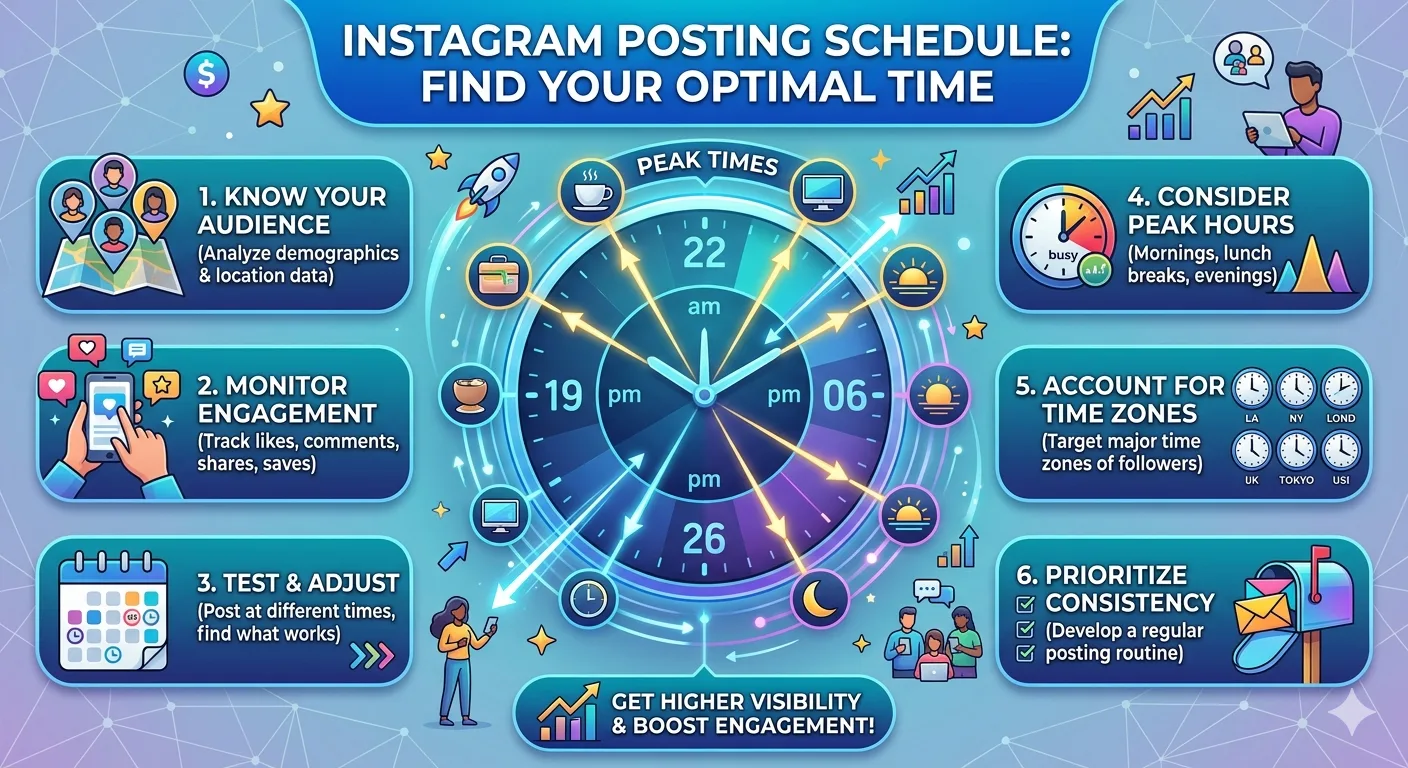
How to Find Your Actual Best Posting Times
Here is a practical, step-by-step approach to identifying when your specific audience is most active and engaged.
Step 1: Access Your Audience Activity Data
Instagram's native Insights tool, available for business and creator accounts, provides data on when your followers are most active by day of week and hour of day. This is the most direct source of information about your specific audience's patterns.
Step 2: Identify Your Top Activity Windows
Look for the days and times with the highest concentration of follower activity. Most accounts will see a few distinct peaks commonly during commute times, lunch breaks, and evening hours, though the specific pattern varies significantly by audience type.
Step 3: Cross-Reference With Your Historical Post Performance
Beyond audience activity data, review your published posts' performance by the time they were posted. Look for patterns do posts published during certain windows consistently show stronger early engagement than posts published at other times? This combines audience presence data with actual performance outcomes.
Step 4: Test Systematically
Rather than guessing, run a structured test: for several weeks, post similar content types at different times within your identified peak windows, and track engagement rate and reach for each. This helps narrow down not just the general window but the specific time within it that performs best for your account.
Step 5: Account for Content Type Differences
Different content types may have different optimal posting times even for the same audience. Educational carousel content that people want to save for later might perform well posted in the morning when people are planning their day, while entertainment content might perform better in the evening when people are relaxing and more likely to engage immediately.
How Audience Location Affects Posting Time
For accounts with audiences concentrated in specific geographic regions, posting time should be calibrated to the audience's local time, not the account owner's location.
Single-Region Audiences
If your audience is predominantly located in one region, your posting schedule should be based entirely on that region's time zone, regardless of where you personally are located. A business based in one time zone targeting customers primarily in a different time zone should schedule posts according to the customer's local activity patterns. instapv.xyz
Multi-Region Audiences
For accounts with significant audiences across multiple time zones, there is no single posting time that will be optimal for everyone. Options include posting at times that capture the overlap of multiple regions' active periods, alternating posting times across different days to reach different regional segments over time, or accepting that some content will primarily reach whichever audience segment is active at posting time and planning content distribution accordingly.
Instagram Insights typically provides a breakdown of your audience by top locations, which is the starting point for understanding how geographically distributed your audience actually is.
Posting Frequency vs Posting Time: Which Matters More?
A common question is whether posting time matters more than posting frequency how often you post overall. The honest answer is that they serve different purposes and both matter, but in different ways.
Posting Frequency's Role
Posting frequency affects how often you have opportunities to reach your audience, how much content the algorithm has to evaluate and potentially distribute, and how consistently your account appears in your followers' feeds. An account posting three times a week has three opportunities per week for content to perform well; an account posting daily has seven.
Posting Time's Role
Posting time affects how well each individual posting opportunity is optimized whether that post has the best possible chance of generating early engagement given when it goes live.
How They Work Together
The most effective approach combines both: a sustainable posting frequency (as discussed in earlier posts in this series, consistency matters more than raw volume) with each post scheduled during your audience's identified peak activity windows. A account posting three times a week at optimal times will generally outperform an account posting seven times a week at random times, because each of the three posts has a better chance of generating the early engagement that drives algorithmic distribution.
General Activity Patterns by Audience Type
While individual account data should always take precedence, here are general activity pattern tendencies that can serve as a starting hypothesis before you have gathered your own data particularly useful for new accounts that do not yet have enough historical data for analysis.
Professional and B2B Audiences
Tend to show activity peaks during commute times (early morning and early evening) and lunch breaks, with notably lower activity during core working hours and weekends compared to other audience types.
General Consumer and Lifestyle Audiences
Often show activity spread across the day with peaks in early morning, lunch, and evening and frequently show strong weekend activity, particularly Saturday and Sunday mornings and afternoons.
Younger and Student Audiences
Tend to show activity concentrated in after-school hours, evenings, and late nights, with less differentiation between weekdays and weekends compared to working-age audiences.
E-Commerce and Shopping-Focused Audiences
Often show activity patterns that spike around paydays, weekends, and evening hours when people have time for browsing and discretionary purchasing decisions.
These are starting points, not rules and should be validated against your own audience data as soon as you have sufficient information to do so.
How to Research Competitor Posting Patterns
Understanding when competitors and successful accounts in your niche tend to post can provide useful additional context, particularly for new accounts without their own historical data.
Using InstaPV, you can view a public account's recent posts and note the posting times reflected in their content and combine this with their engagement rate data to assess whether their apparent posting schedule correlates with strong performance.
If multiple successful accounts in your niche show similar posting time patterns, this suggests something about when your shared target audience tends to be active useful as a starting hypothesis while you gather your own account-specific data.
Adjusting Your Schedule Over Time
Posting time optimization is not a one-time exercise. Audience activity patterns can shift due to seasonal changes, broader behavioral trends, changes in your audience composition as your account grows, and platform-wide algorithm updates.
Seasonal Adjustments
Audience activity patterns often shift around holidays, summer versus school-year periods (for audiences with significant student populations), and other seasonal factors specific to your industry. Reviewing audience activity data periodically at least quarterly helps catch these shifts.
Adjustments as Your Audience Grows
As an account grows and attracts followers from new geographic regions or demographic segments, the aggregate audience activity pattern can shift even if your original audience's behavior remains constant. Periodic re-analysis ensures your posting schedule continues to reflect your current audience rather than your audience from months or years ago.
-
How to Generate Instagram PDF Reports for Your Business
-
How to Research Competitors on Instagram Without Them Knowing
-
10 Instagram Growth Hacks That Actually Work in 2026
Frequently Asked Questions
Q: Is there a single best time to post on Instagram that works for everyone?
No. While some general patterns exist evenings and weekends tend to show higher overall activity across many account types the specific optimal time for any individual account depends on that account's particular audience, which varies significantly by niche, geography, and demographics.
Q: How much does posting time actually affect reach compared to content quality?
Content quality and relevance to your audience remain the primary drivers of reach and engagement. Posting time acts as a multiplier optimizing it can meaningfully improve the performance of strong content, but it cannot substitute for content that does not resonate with your audience.
Q: Should I post at the same time every day?
Consistency in posting time can help establish audience expectations, but it is not strictly necessary, and rigid consistency should not come at the expense of posting when your specific content and audience activity data suggest is optimal for that particular post.
Q: How long should I test before settling on a posting schedule?
A testing period of at least four to six weeks, with a reasonable volume of posts across the time windows you are testing, provides enough data to identify meaningful patterns while accounting for natural variation between individual posts.
Q: Does posting time matter for Stories the same way it matters for feed posts?
Posting time matters somewhat differently for Stories due to the 24-hour visibility window. A Story posted just before your audience's active period maximizes the overlap between the Story's visibility window and your audience's availability, which is a slightly different consideration than the algorithmic distribution timing relevant to feed posts.
Conclusion
The question "when is the best time to post on Instagram" does not have a single universal answer — and chasing generic recommendations based on aggregate data from millions of unrelated accounts is unlikely to produce meaningful improvements for your specific account.
The most effective approach is grounded in your own data: understanding when your specific audience is active, testing systematically within those windows, and adjusting over time as your audience and the platform evolve. Combined with a sustainable posting frequency and content that genuinely serves your audience, a data-informed posting schedule becomes one more piece of a coherent strategy — not a magic switch, but a meaningful optimization that compounds over time.
Research successful accounts in your niche for posting pattern insights on InstaPV →