Introduction
Open Instagram Insights for any post and you will see two numbers sitting close together: reach and impressions. Often, these numbers are close to each other but not identical and sometimes the gap between them is significant. For anyone new to Instagram analytics, this raises an obvious question: aren't these the same thing? Isn't reach just how many people saw my post, and impressions just... also how many people saw my post?
The short answer is no they measure related but distinctly different things, and understanding the difference is essential for correctly interpreting your content's performance.
This guide explains exactly what reach and impressions measure, why they often differ, what a healthy relationship between the two looks like, and how to use both metrics together to get a more complete picture of how your content is actually performing.
The Core Definitions
Let's start with the precise definitions, because the difference between these two metrics comes down to one specific distinction.
Reach
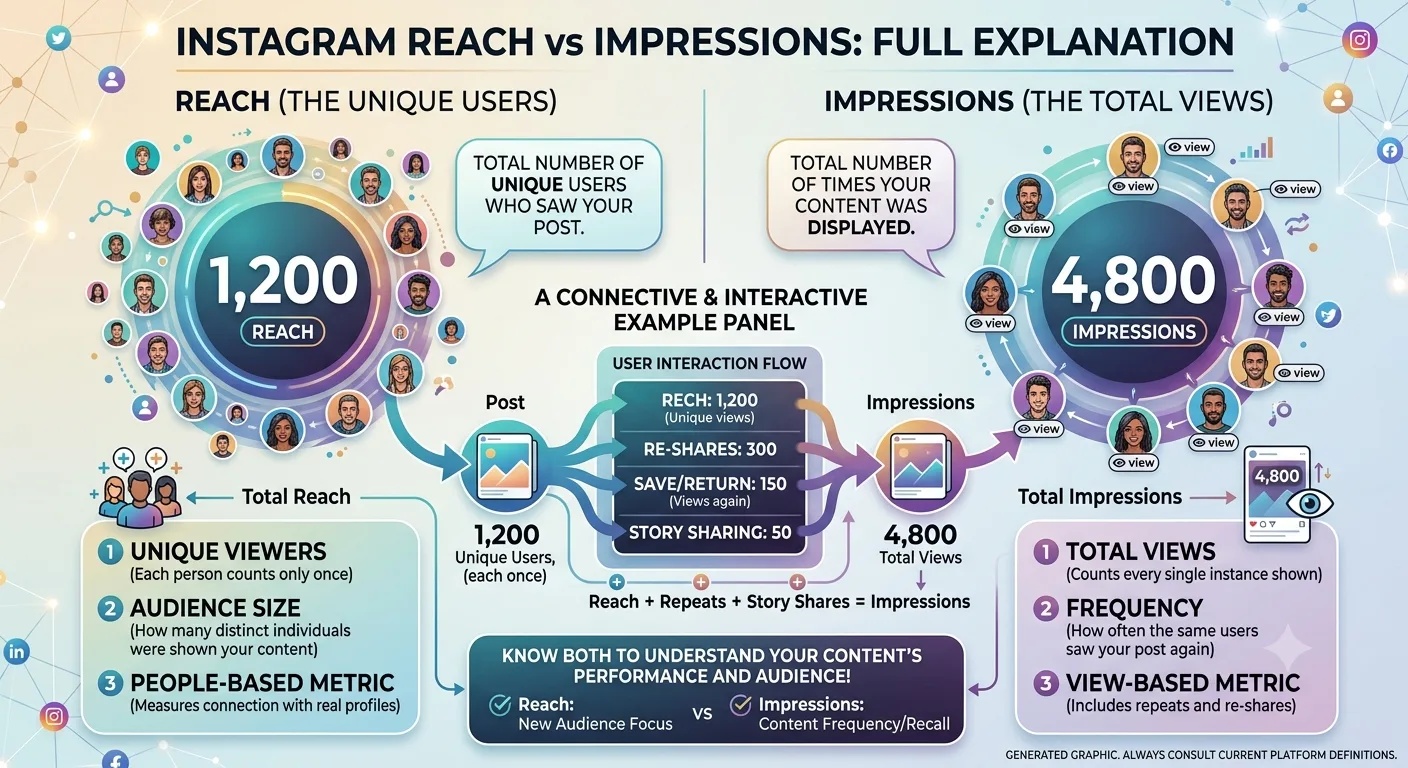
Reach measures the number of unique accounts that have seen your content at least once during the measurement period. Each account is counted only one time, regardless of how many times that account actually viewed the content.
If 1,000 different people each saw your post one time, your reach would be 1,000. If those same 1,000 people each saw your post three times, your reach would still be 1,000 because reach counts unique viewers, not total views. instapv.xyz
Impressions
Impressions measure the total number of times your content was displayed, including multiple views from the same account. Unlike reach, impressions do not deduplicate by viewer every single view counts, even if the same person viewed the content multiple times.
Using the same example: if 1,000 different people each saw your post three times, your impressions would be 3,000 three views per person, multiplied across 1,000 people.
A Simple Analogy
Think of reach and impressions like a movie playing in a theater over a week.
Reach is like asking: how many different individual people walked through the door and watched the movie at least once during the week? If 500 different people each came once, your reach is 500.
Impressions is like asking: how many total tickets were used during the week, counting any repeat visits? If those same 500 people came an average of 1.5 times each some came back for a second viewing your total ticket usage, or impressions, would be 750.
The reach number tells you about the size of your audience. The impressions number tells you about the total volume of exposure that audience generated, including repeat exposure.
Why Impressions Are Usually Higher Than Reach
In almost every case, impressions will be equal to or greater than reach for any piece of content. This makes sense mathematically impressions count every view, while reach counts only unique viewers, and the minimum possible impressions for any reach number is when every viewer saw the content exactly once (in which case impressions would equal reach).
Any time a viewer sees the content more than once, impressions increase while reach does not. So the gap between impressions and reach reflects the amount of repeat viewing happening.
Common Reasons for Repeat Views
Appearing in multiple places. A single post might appear in someone's main feed, then again later if they visit your profile directly, then again if a friend shares it to their story and the original viewer sees it a third time through that share.
Stories specifically. If someone watches your story, then later that day opens your profile and watches your Highlights (which may include that same story content), this generates additional impressions from the same viewer.
Algorithm re-surfacing. Instagram sometimes shows content again to users who engaged with it previously, particularly if the content continues to perform well generating additional impressions from viewers who already saw it.
Saved content revisits. If someone saves your post and returns to view it again later from their saved collection, this counts as an additional impression from the same unique viewer.
What the Impressions-to-Reach Ratio Tells You
The relationship between impressions and reach sometimes expressed as a ratio provides useful information about how your content is being consumed.
Calculating the Ratio
Impressions ÷ Reach = Average views per unique viewer
If a post has 10,000 impressions and 8,000 reach, the ratio is 1.25 meaning, on average, each unique viewer saw the content 1.25 times.
A Ratio Close to 1.0
A ratio very close to 1.0 where impressions and reach are nearly equal means that most viewers saw the content exactly once, with very little repeat viewing. This is typical for content that does not strongly encourage revisiting, such as time-sensitive announcements that people see once and move past.
A Higher Ratio
A meaningfully higher ratio say 1.5 or above indicates significant repeat viewing. This can be a positive signal for certain content types: educational content that people return to for reference, or content that generates conversation leading people to revisit the post multiple times.
However, a very high ratio combined with low reach can also indicate that your content is mostly being shown repeatedly to the same small group of highly engaged followers rather than reaching new audiences which may or may not align with your goals depending on whether audience growth or deepening engagement with existing followers is the priority for that content.
Which Metric Matters More?
The honest answer is that it depends on what question you are trying to answer they serve different diagnostic purposes.
When Reach Matters More
If your goal is audience growth, brand awareness, or expanding beyond your existing follower base, reach is the more directly relevant metric. Reach tells you how many distinct individuals your content is putting your brand or message in front of which is the foundation for converting new viewers into followers, customers, or advocates.
For evaluating whether content is successfully reaching new audiences (as opposed to just being seen repeatedly by the same engaged core), comparing reach to your follower count is informative. If reach significantly exceeds your follower count, your content is reaching beyond your existing audience a positive signal for the algorithmic distribution discussed throughout this series.
When Impressions Matter More
If your goal is total exposure volume for example, evaluating the overall visibility of a campaign or assessing how much "airtime" a piece of content is getting regardless of whether it's the same or different people seeing it impressions provide that total volume figure.
Impressions can also be useful for understanding the cumulative effect of content that benefits from repeat exposure for instance, a series of related posts where impressions across the whole series indicate total brand exposure even if individual viewers saw multiple posts in the series.
Using Both Together
The most complete picture comes from looking at both metrics together, particularly the relationship between them. A post with high reach and a ratio close to 1.0 reached a large new audience with minimal repeat viewing strong for awareness goals. A post with moderate reach but a high ratio generated significant repeat engagement from a smaller audience potentially strong for deepening relationships with an existing audience, though less impactful for growth.
How Reach and Impressions Relate to Engagement Rate
As covered in earlier posts in this series, engagement rate is typically calculated relative to follower count, using the formula (Total Engagements ÷ Total Followers) × 100. However, for account owners with access to their own Insights data, an alternative calculation uses reach instead of followers:
Engagement Rate by Reach = (Total Engagements ÷ Reach) × 100
This version of engagement rate answers a slightly different question: of the people who actually saw this content, what percentage engaged with it? This can be a more precise measure of content quality than the follower-based formula, because it accounts for the fact that not every follower sees every post.
A post might have a relatively low engagement rate when calculated against total followers, but a high engagement rate when calculated against reach indicating that the content itself is compelling to those who see it, even if overall distribution (reach) was limited. This distinction can help diagnose whether a content issue is about the content's quality (low engagement rate by reach) or about distribution (low reach but reasonable engagement rate by reach).
Reach and Impressions for Stories vs Feed Posts
These metrics behave somewhat differently across content formats, which is worth understanding when comparing performance across your content mix.
Feed Posts and Reels
For feed posts and Reels, reach and impressions reflect all the places content can appear main feed, profile visits, Explore page, hashtag pages, and shares. The potential for impressions to exceed reach is generally higher for content that can be discovered through multiple channels, such as Reels that may appear on the Explore page in addition to followers' feeds.
Stories
For Stories, the relationship between reach and impressions is often closer to 1.0 for any individual story frame, since each frame within a story is typically viewed once per session by any given viewer. However, across an entire Highlight or a multi-frame story sequence, impressions can exceed reach if viewers who saw the active story later revisit the same content through Highlights.
Where to Find These Metrics
For Your Own Account
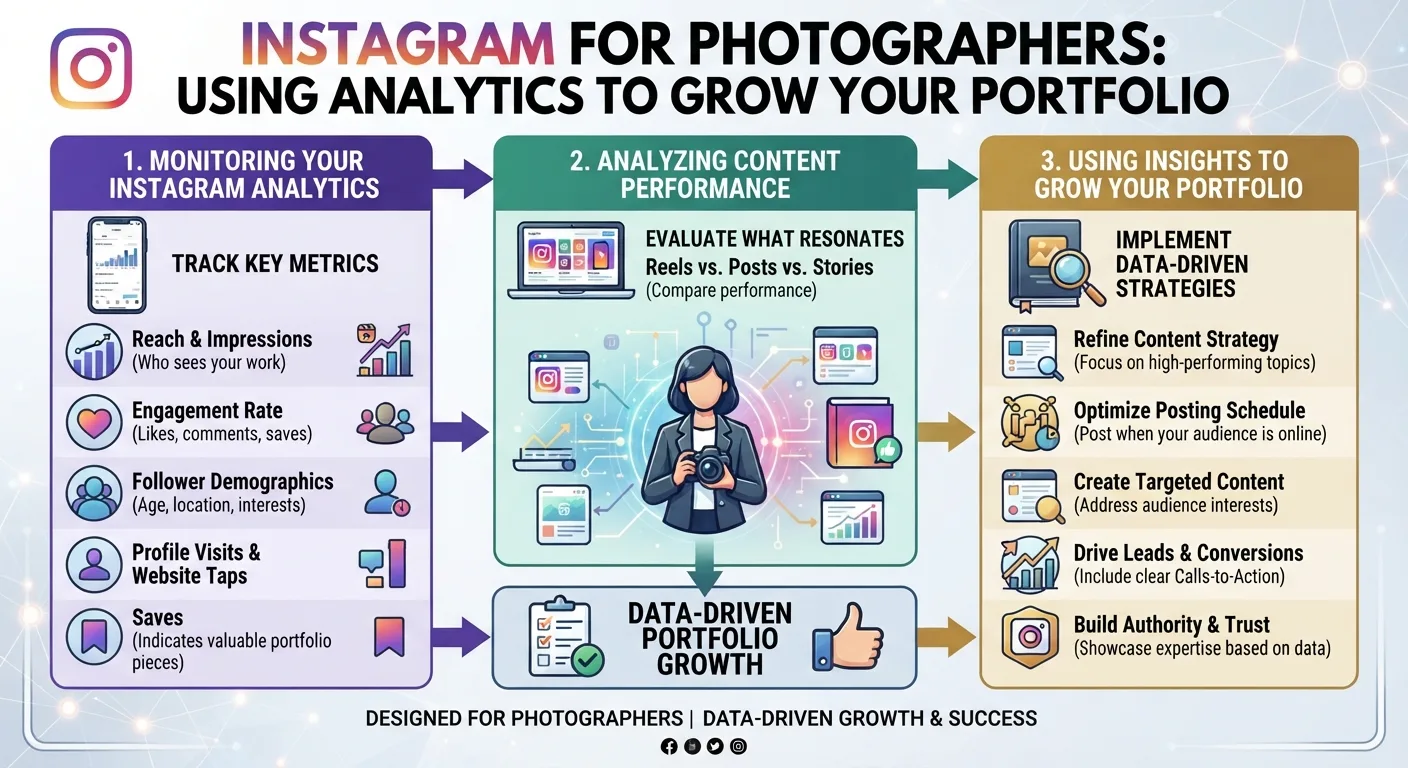
Reach and impressions for your own posts, Reels, and stories are available through Instagram's native Insights tool, accessible for business and creator accounts directly within the app by tapping on individual posts or through the overall account Insights dashboard.
For Public Accounts You Do Not Own
Reach and impressions specifically are private metrics not visible to anyone other than the account owner, even for public accounts. This is different from metrics like follower counts, post counts, and visible engagement (likes and comments), which are publicly accessible.
For researching public accounts, tools like InstaPV provide the publicly available analytics that can serve as proxies follower growth trends and engagement rate calculated from visible likes and comments even though direct reach and impressions figures for accounts you do not own are not accessible to any third-party tool, as this data is never made public by Instagram for any account.
Common Misconceptions
"Impressions Are Better Than Reach Because the Number Is Bigger"
Impressions will almost always be a larger number than reach for the same content, simply due to how each is calculated. A larger impressions number does not inherently mean better performance it might simply reflect more repeat viewing, which could be positive or neutral depending on context.
"Low Reach Always Means Bad Content"
Reach is influenced by many factors beyond content quality alone, including posting time, current algorithm behavior, and how your specific audience's activity happens to align with when content was posted. A single post's reach figure in isolation is less informative than reach trends across multiple posts over time.
"Reach Equals Follower Count"
Reach can be higher than your follower count (when content reaches non-followers through Explore, hashtags, or shares) or lower than your follower count (since not every follower sees every post). Reach and follower count are related but not the same thing, and comparing reach to follower count is itself a useful diagnostic, as discussed above.
-
Instagram Posting Schedule: When Is the Best Time to Post?
-
How to Generate Instagram PDF Reports for Your Business
-
How to Research Competitors on Instagram Without Them Knowing
Frequently Asked Questions
Q: Can impressions ever be lower than reach?
No. By definition, impressions can never be lower than reach for the same content, since reach counts unique viewers (a subset of total views) while impressions count total views (which includes all unique viewers plus any repeat views). At minimum, impressions equal reach; they cannot be lower.
Q: Why did my impressions go up but my reach stayed the same?
This typically means your existing audience is viewing the content multiple times through Highlights, saved posts, or being shown the content again by the algorithm without the content reaching new unique viewers. This could indicate strong engagement from your existing audience without corresponding growth in new audience exposure.
Q: Is a high reach always a good sign?
High reach generally indicates strong distribution, which is positive for visibility goals. However, reach alone does not indicate whether that visibility translated into meaningful engagement or business outcomes pairing reach with engagement rate and saves provides a more complete picture of whether that reach was valuable.
Q: Do reach and impressions reset, or are they cumulative?
For individual posts, reach and impressions typically continue to accumulate over time as more people see the content, though the rate of accumulation slows significantly after the initial posting period. For account-level Insights covering a specific date range, the figures reflect activity within that selected period.
Q: How can I improve my reach specifically?
Reach improvements generally come from the same factors that drive algorithmic distribution discussed elsewhere in this series strong early engagement (particularly saves and shares), content formats that the algorithm currently favors for discovery (such as Reels), and content that resonates broadly enough to be shown to non-follower audiences through Explore and hashtag pages.
Conclusion
Reach and impressions answer two related but distinct questions: how many different people saw this content, and how many total times was it seen. Neither metric alone tells the complete story reach without impressions context misses information about repeat viewing, while impressions without reach context can overstate how many actual people your content reached.
Understanding both metrics, and particularly the relationship between them, gives you a more nuanced view of how your content is actually being consumed whether it is reaching new audiences, generating repeat engagement from existing ones, or some combination of both. Combined with engagement rate and the other metrics covered throughout this series, reach and impressions form an essential part of a complete Instagram analytics toolkit.
Explore engagement and growth analytics for any public account on InstaPV →